Week 8 Multi cell Battery Pack
Multi cell Battery Pack
- The weakest cell imposes a limit on overall operation of battery pack Because it is very important to protect an individual cell, over voltage / undervoltage limits apply to all series connected cells
- Due to weakest cell reaching the limit earlier than other cell, battery pack may be under-utilized.
- This pack can neither deliver nor accept energy/power.
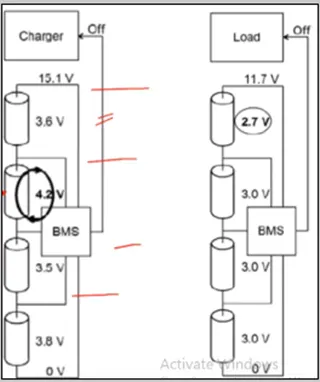
- A cell becomes weak due to Capacity, SOC, leakage, Internal resistance of cell. Which results in different behavior of that cell in the battery pack. It is very important to avoid this type of problems.
So, the cell balancing is done to keep the voltage and state of charge of all the cell same. A balanced battery is one in which, at some point in its cycle, all the cells
are exactly at the same SOC.
It is done in 2 ways: -
- Active balancing
- Passive balancing
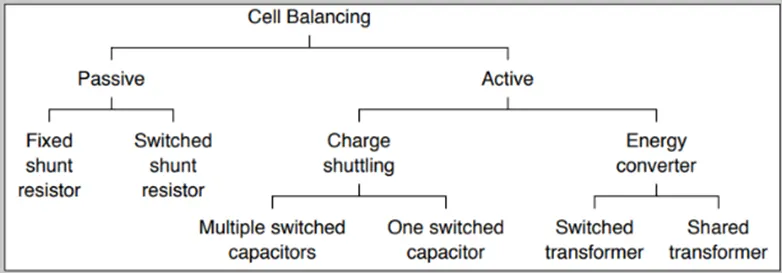
Passive balancing
In this the charge drains from cells having too much charge and dissipates drained energy as heat. It is a dissipative technique.
Passive: Fixed shunt resistor
■ The simplest electronics designs are for passive balancing systems.
■ The general idea is that a resistor is placed in parallel with each cell, and used to drain charge from that cell.
■ The energy removed from the cell is dissipated as heat.
■ The simplest design of all is the “fixed shunt resistor design.”
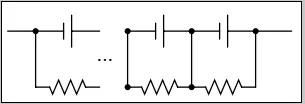
■ The idea is that high-voltage cells will have greater balancing current, and so will self-discharge more quickly than low-voltage cells.
■ However, note that the circuit is always dissipating charge, even when the pack is perfectly balanced.
A variation on the design uses Zener diodes to “shut off” balancing when cell voltage drops below some point.
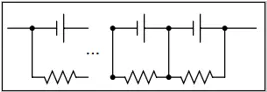
■ The Zener voltages are chosen to correspond to a “100 % SOC” setpoint. e.g., about 2:2 V for a lead-acid cell.
■ When a cell’s voltage is above the Zener setpoint, the resistor path is activated, and that particular cell’s charge is depleted until the cell’s voltage drops below the zener setpoint.
■ Note that this design works for chemistries where overcharge is tolerable, and the cell can “float.”
This includes lead-acid and nickel-based chemistries, but not lithium-ion chemistries.
Passive: Switched shunt resistor
■ A variation on the above idea, which works for lithium-ion chemistries as well, is to replace the Zener diode with a BMS-controlled switch.
This switch is some kind of transistor circuit.
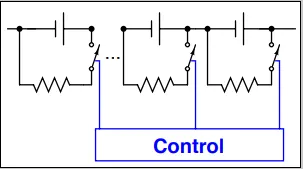
- The electronics required to control the transistor make this design more complicated; however, it allows for much greater flexibility in balancing strategy.
- The BMS closes switches on cells having too much charge, allowing them to drain.
- Note that the added complexity is not as big an issue as it used to be.
- Modern battery-stack monitoring chips have built-in circuitry to control either an internal transistor switch (for slow balancing) or an external transistor switch (for faster balancing).
Active balancing
It transfers voltage from higher cell to lower voltage cell. Charge moves from “high cells” to “low cells,” attempting to conserve energy in the battery pack.
Active: Switched transformer
- An alternative approach, which can move a great deal of charge at once, is to use a transformer.
- Rapidly switching the primary creates an approximate AC waveform
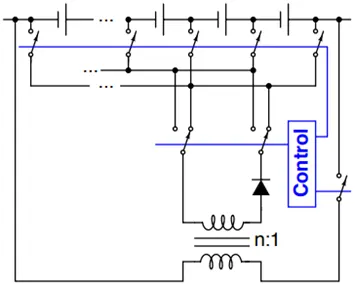
- The diode plus switches select into which cell to dump the charge.
- Much more efficient than passive balancing; much faster than capacitive methods; but also, expensive due to transformer and electronics costs.
- Presently, silicon vendors are working to create automated controls chips that will make this design much more feasible.
- Active cell balancing is effective but costly and complex. Can happen during both charging and discharging.
- Passive Balancing only during charging as we cannot further discharge the battery pack and cell energy not take out from Battery itself. So, it also affects charging time.
- So, the balancing has to be done quickest to make soc of all cell equal.
Reference:-
http://mocha-java.uccs.edu/ECE5720/ECE5720-Notes05.pdf