Week - 8 Mass Scaling
Aim: To check the effect of the masss scaling and how it effect the simulation time by using parameters called TSSFAC and DT2MS which is non physical mass added to the model .
Because of the this mass scaling the simulation runs faster with stability. and in the challenge we need to compare the implicit and explicit analysis simulation time,as shown below.
Procedure:
1)when there is no mass scaling: Here in this case from the keyword manager *control_timestep is removed so that the CPU it takes more load to solve the problem and as shown below.
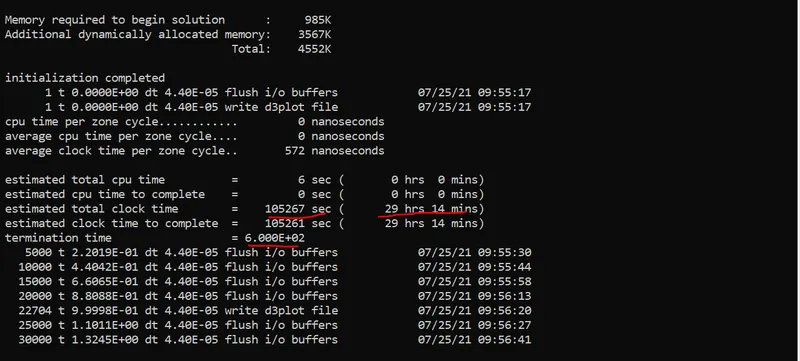
Fig:Mass scaling removed.
In the above image its shows total clock time is 29hrs 14mins and the current timestep (DT) is the 4.40E-05 which is 0.0000440.
When the *Control_Timestep is activate with the given the TSSFAC=0.9 as default standard and DT2MS=-3.500E-5 is when i run the simulation the there is no mass added as shown below.
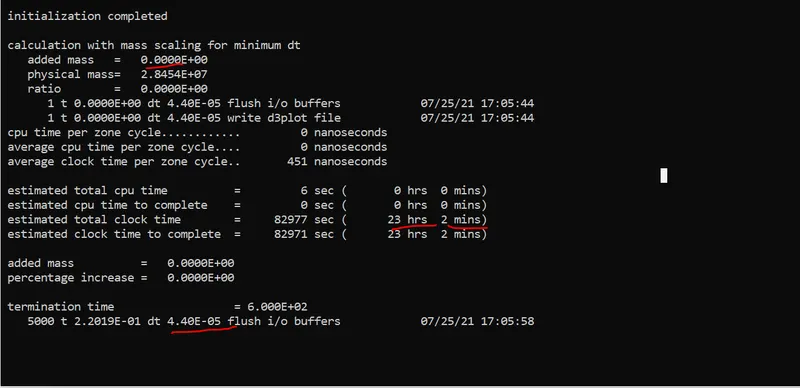
Current timestep is DT=0.000040 and clock time is 82977sec or 23hrs 2mins. as we change the DT2MS the the mass get added limit on mass scaling is 8% and stability should be completely intact.
i)when the DT2MS=-3.500E-05
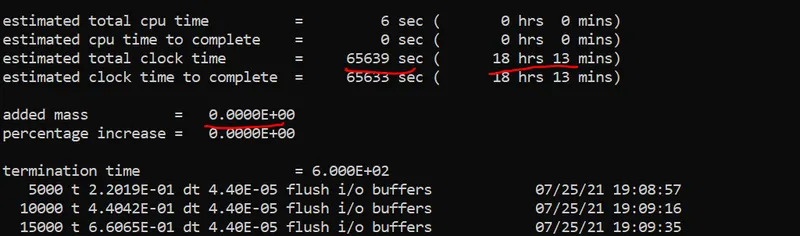
ii)When DT2MS= -5.500E-05
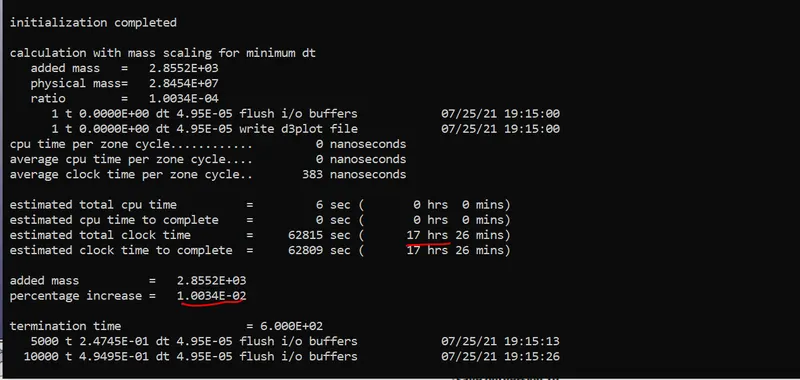
iii)DT2MS= -6.500E-05
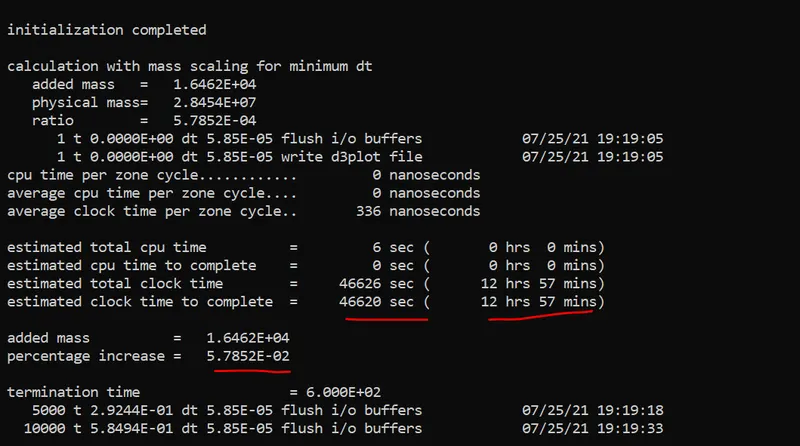
iv) DT2Ms = -7.500E-05
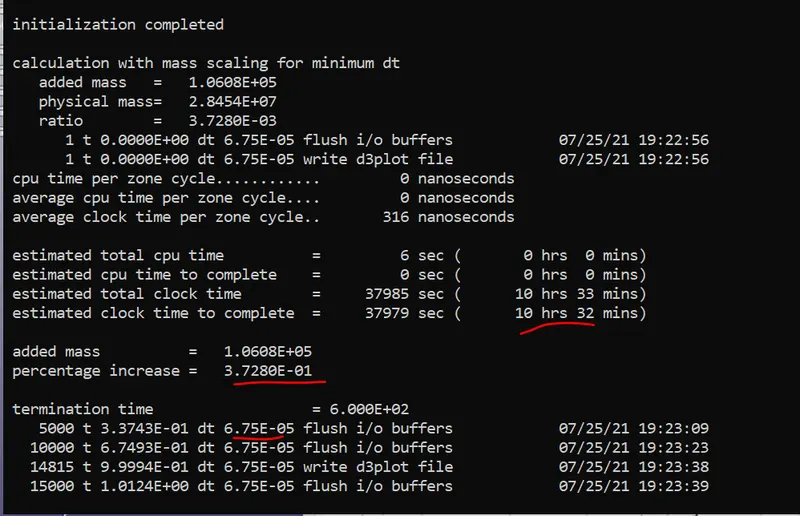
v) DT2MS= -8.500E-05
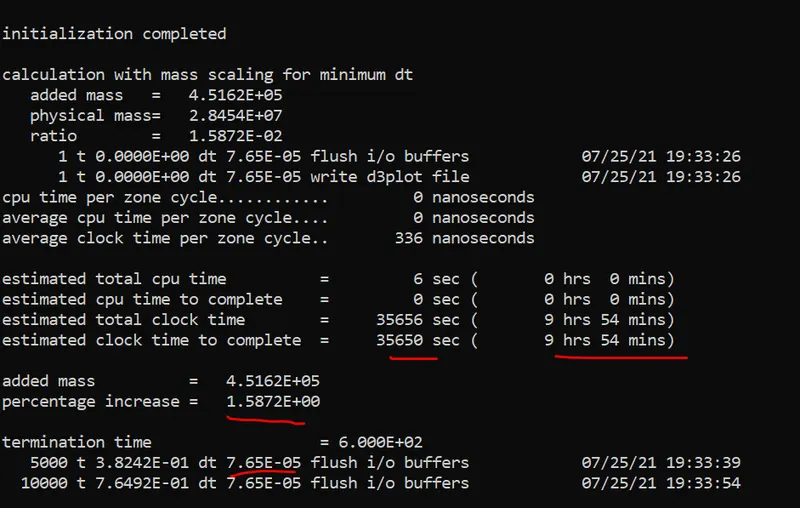
vi)DT2MS= -9.500E-05
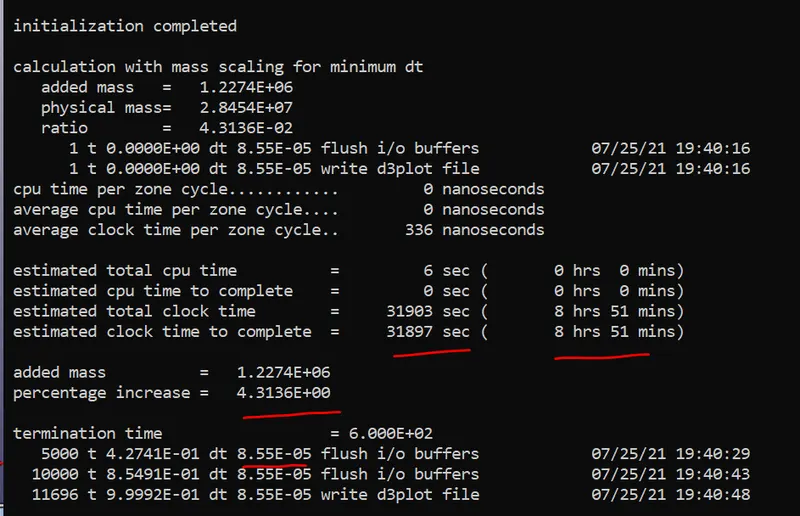
vii)DT2MS = -10.500E-05
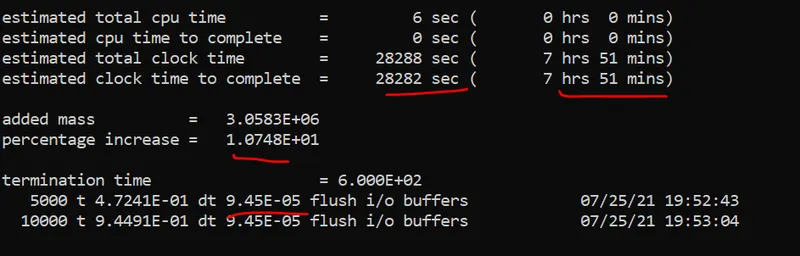
viii)DT2MS= -12.500E-05
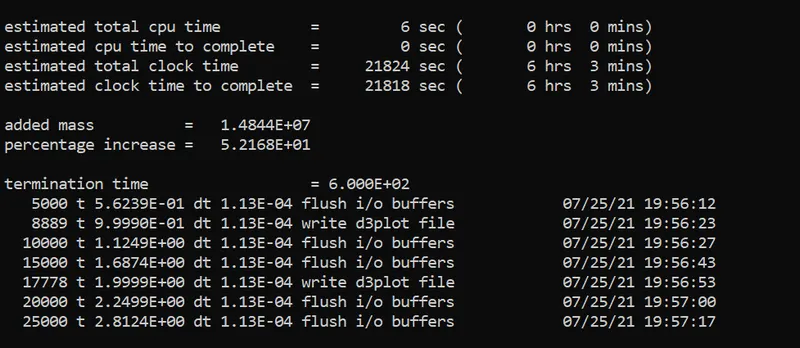
ix)DT2MS= -14.500E-05
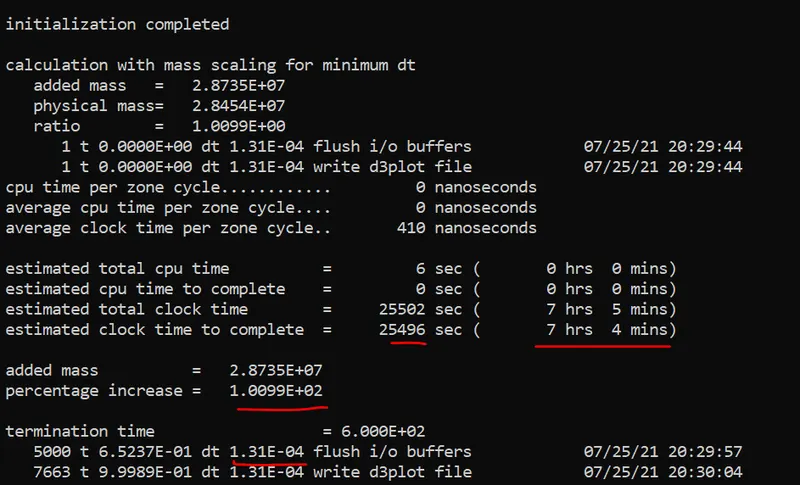
x)DT2MS= -16.500E-05
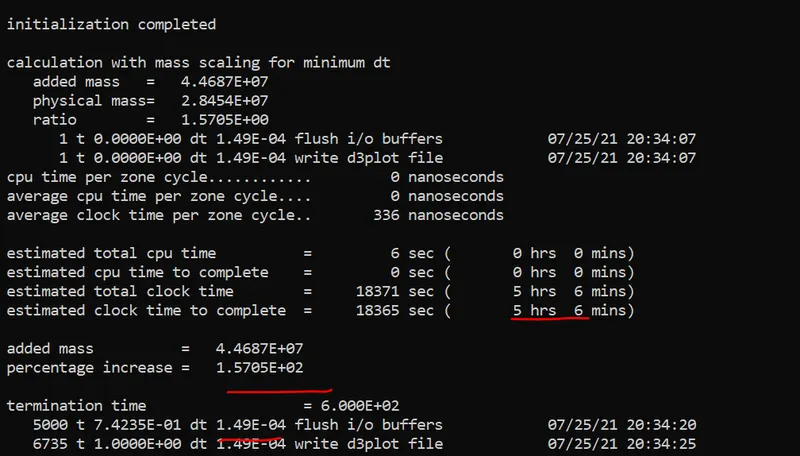
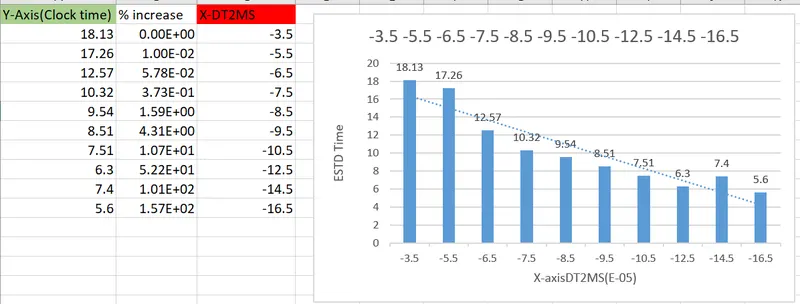
histogram plotted to compare the runtime with mass scaling trials:
Implicit Analysis:
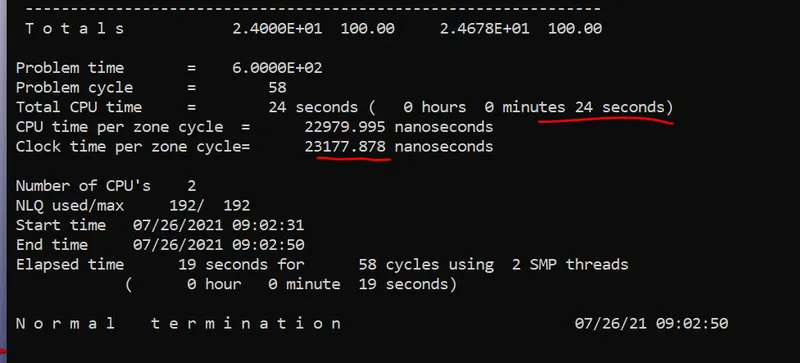
To solve the the problem using implict analysis in the Ls-Dyna we need to add the control cards those are *Implict _Auto,*implicit_General,*Implicit _solver as shown below.
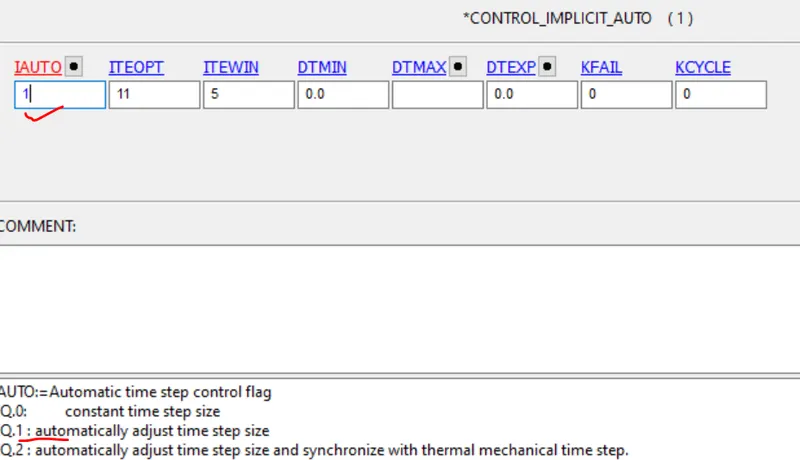
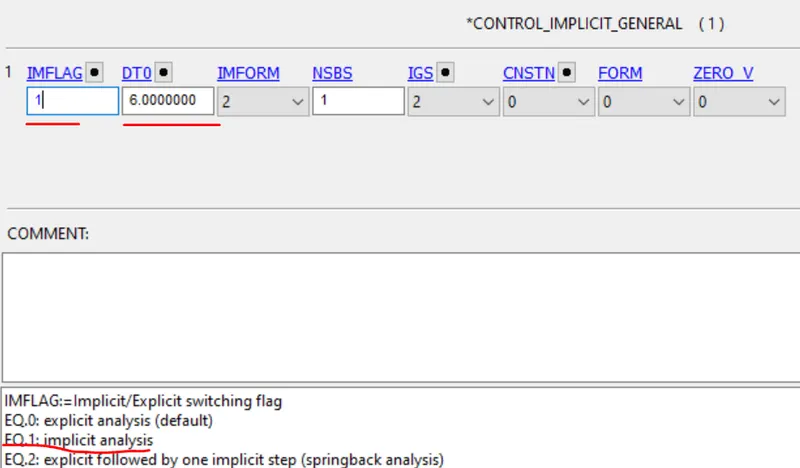
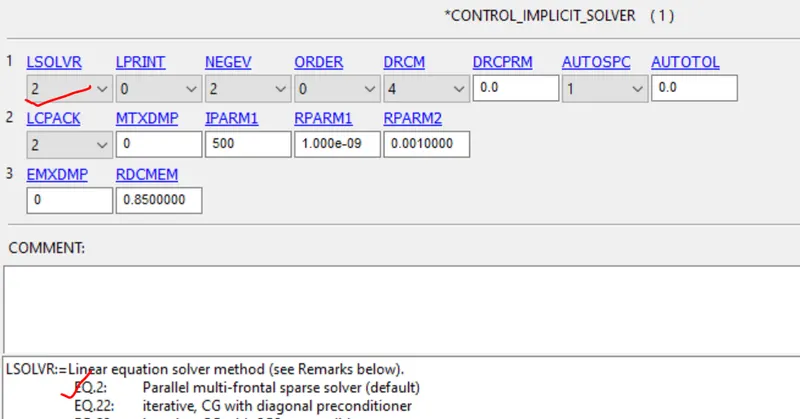
As above mentioned cards has their own importance to run the problem as the implicit analysis. The Implicit auto states that it adjust the Time-step automatically and Implicit solver states that defines the speed to solver the problem by default it selected the parallel multi solver which 2 and Implicit general shows that the problem run as implicit analysis. In the Control_implicit_general value of DT0 is taken End time or termination time/100 then it will be 600/100=6 is mentioned in the card.
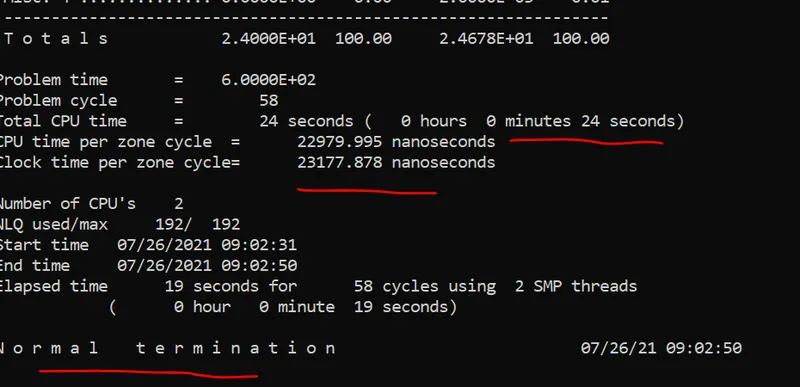
In the Explicit analysis i have mentioned as per the standards the TSSFAC is taken as 0.9 and DT2MS value is keep on increasing which is non physical mass to be added to reduce the current time step and to avoid the computation time or current time DT . Added mass is should be stabilized manner.
If we increase the DT2MS value the mass addition can be observed in the simulation which means the DT will modified or increased and the total time is decreased. The TSSFAC effect the time step which is suppose if we take the suppose 0.6 which is minimum value multiply with the current time step which effect the simulation runs slower.
Observation:
i) As the value of the of the DT2MS increasing the the negative DT2MS is being if we use negative DT2MS the non physical mass gets added which means as we keep increase the negative value of DT2MS the it reflect in the simulation and total simulation time get reduced.
ii) In the explicit and Implicit does the same when the compared to explicit analysis the implicit analysis has solved problem very quickly it all depends on the the acccuracy of the problem. If the problem is solved using implicit analysis in each time step the solution has to converge and where as the explicit analysis its solves the problem not accurately but takes min time step then moves to next iteration.
iii)In the crash like simulation we use explicit analysis it solves problem with minimum time step value. if we use the implicit analysis the computation time is more and cost effective so we dont prefer for the implicit analysis.
iv) The added mass is non physical form its does not effect our results it just effect the total simulation time.
Result:
Mass scaling is effecting the total simulation time by changing the DT2MS values using trail and error menthod as shown above.