Week - 8 Mass Scaling
AIM:
To use mass scaling to reduvce the run time of the model and ensure the stability of mass scaling.
To ensure that the hard limit on mass scaling is does not exceed 8%.
To use both implicit and explicit solutions and check its effects.
PROCEDURE:
Mass-scaling refers to a technique whereby nonphysical mass is added to a structure in order to achieve a larger explicit timestep.Mass scaling enables an analysis to be performed economically without artificially increasing the loading rate. Mass scaling is the only option for reducing the solution time in simulations involving a rate-dependent material or rate-dependent damping, such as dashpots and spotwelds.
Note: Almost the final mass can be altered from 8% to 10% by not affecting the inertia of the body
DT2MS:
DT2MS is where you input your desired minimum timestep for your simulation. So mass will be added to any elements that drop below this timestep in order to compensate. Also, it's important to know that negative and positive values for DT2MS will behave differently. Negative will only add mass to elements that drop below that threshold, Positive will add or remove mass from all elements to make the timestep the exact same for all elements of the model.
TSSFAC:
TSSFAC is just the scale factor for the computed time step which is 0.9 by default. This can be lowered with higher energy simulations like explosions, but generally it's best just to leave it at 0.9.
Initial run:
The model is set for run using the timestep values of 0.9 for TSSFAC & -3.5E-5 for DT2MS
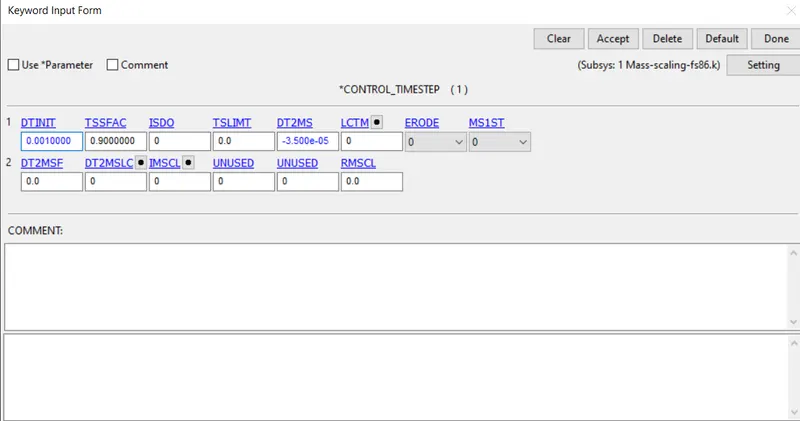
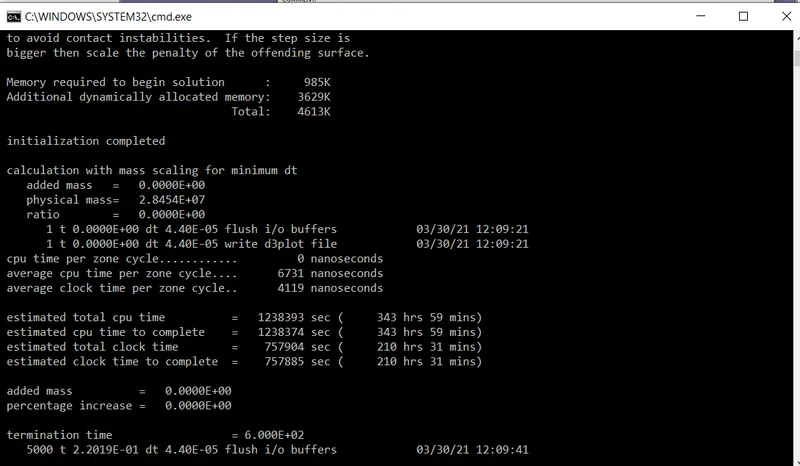
The total clock time obtained was 210 hrs and 31mins which is under the focus of reduction by changing the values of TSSFAC & DT2MS
Now various trails would be conducted and a histogram will be plotted inorder to graphically visualize the time reduction that was taken for the entire process.
RUN 2:

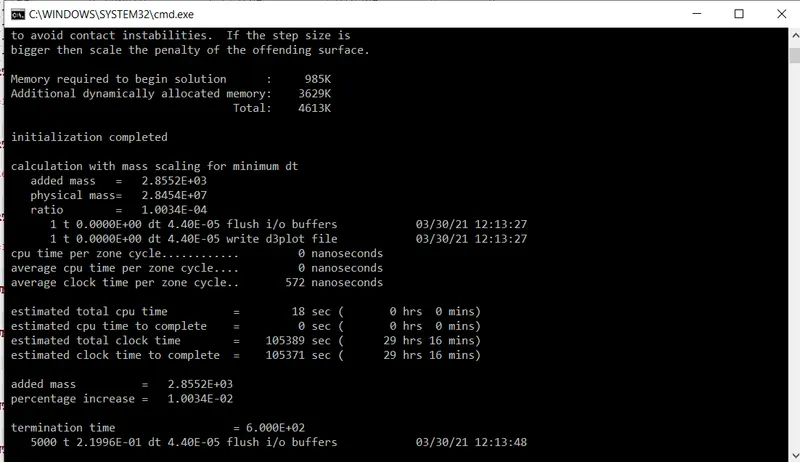
Now setting the values for dt2ms and tssfac as -5.5e-5 and 0.8.
The model is now subjected to run and the output is compared with the previous run.
Now the total run time has reduced to 29hrs and 16 mins from 210 hrs and 31 mins ,but the percentage of mass has increased to 0.01.
RUN 3:

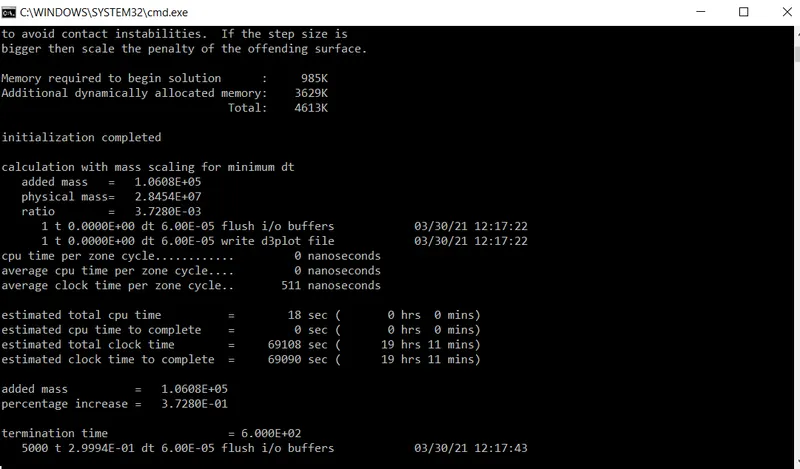
By setting the value of dt2ms to -7.5e-5 and tssfac undisturbed, the above run has shown an quicker run than the previous one.
That is the time step has reduced from 29 hrs to 19 hrs, with a increase in mass percentage of 0.372.
RUN 4:

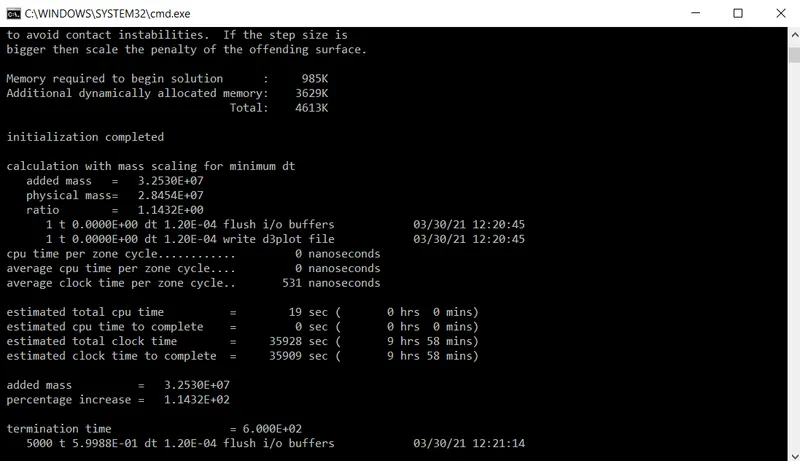
The percentage of mass has gained to 1.142e2 with the reduction in total run time from 19 hrs to 9 hrs.
this was achieved by setting the value pf dt2ms as -1e-4 and tssfac as 0.8.
The same method can be used for n number of iterations until a least runtime is obtained.
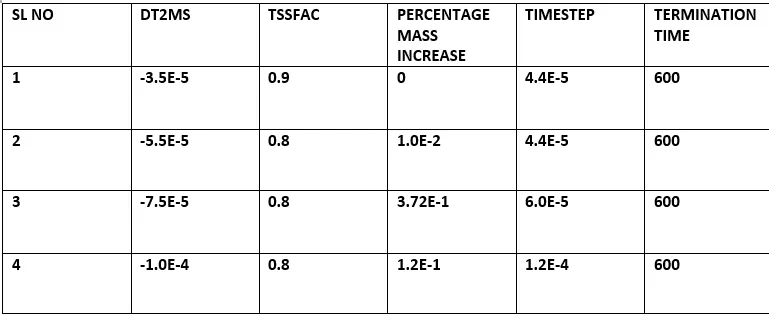
The table above shows comparitive values between various dt2ms and tssfac inputs.
CONCLUSION:
It is known that the balance between the reduction in computation time and added mass can be maintained using both dt2ms and tssfac.