Week - 8 Mass Scaling
The student is supposed to take the attached model and do trial and error for mass scaling. Once the mass scaling objective is reached, a histogram should be plotted to compare the runtime with mass scaling trials. Finally, the student has to run the same model using implicit solver with necessary changes and compare implicit and explicit runtime.
Mass scaling.
mass scaling enables an analysis to be performed economically without artificially increasing the loading rate. mass scaling is the only option for reducing the solution time in simulations involving arate dependent damping such as dashpots .in such simulations increasing the loadin rate is not an option because material strain rates increase by the same factor as the loading rate. when the properties of the model change with the strain rate artifically increasing the loading rate artifically changes the process.
one of the methods used in the industry to reduce the run time of an explicit FEM analysis is a technique called mass scaling. the run time of fe simulations is aminly a function of the model size and the size of the solution step.
as per the CFL condition the stable time step for explicit analysis is

- here e min is the size of the smallest mesh element ,c is the speed of the stress wave the scaling factor is used for providing numerically stability.
- the smallest element in the mesh has the biggest impact on the run time.
- lets see what c is made of.
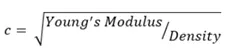
the difference between using a positive or negative number for DT2MS IN *CONTROL_TIMESTEP is as follows :
Negative :mass is added to only those elements whose timestep would otherwise be less than TAAF*abs(DT2MS).when mass scaling is appropriate i recommended this method.
positive : mass is added or taken away from elemets so that the time step of every element is the same . my option is there is no advantage to using this method over the negative DT2MS method and i find it harder to rationalize.
the parameter MS1ST IN *control_timestep controls whether mass is added only once during initialization (MS1ST=1) or anytime as necessary to maintain the desired time step specified via DT2MS(MS1ST=0).
you can use ENDMAS in *control _Termination to stop the calculationafter certain amount of mass has been added.
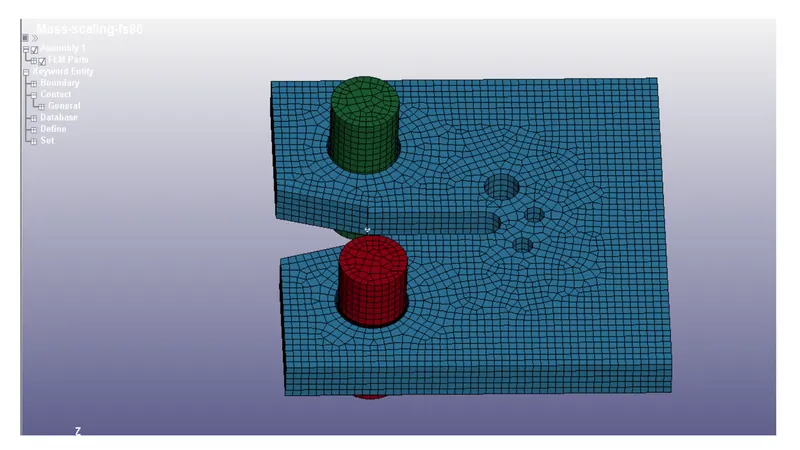
trial 1
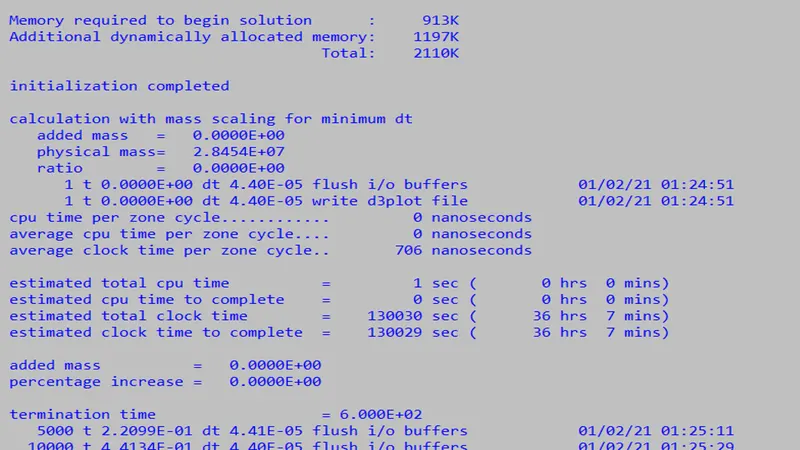
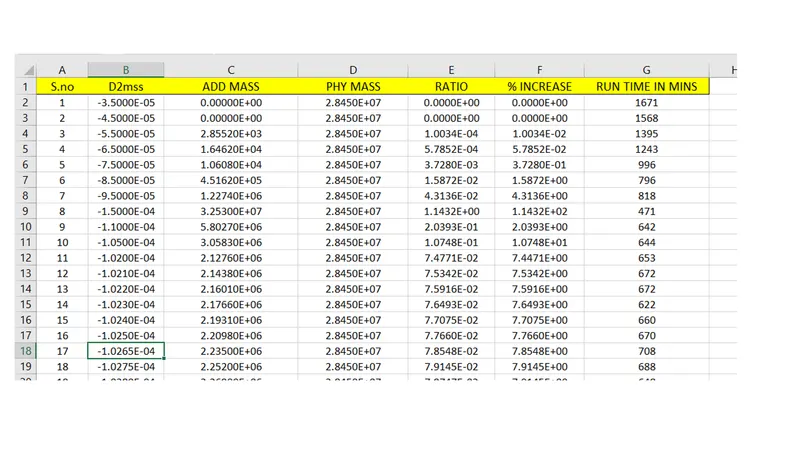
the model have TSSFAC and DT2MS values as 0.9 and -3.5e-5 respectively, we can see estmate the simulation time in 36 hrs 7min.
trial 2
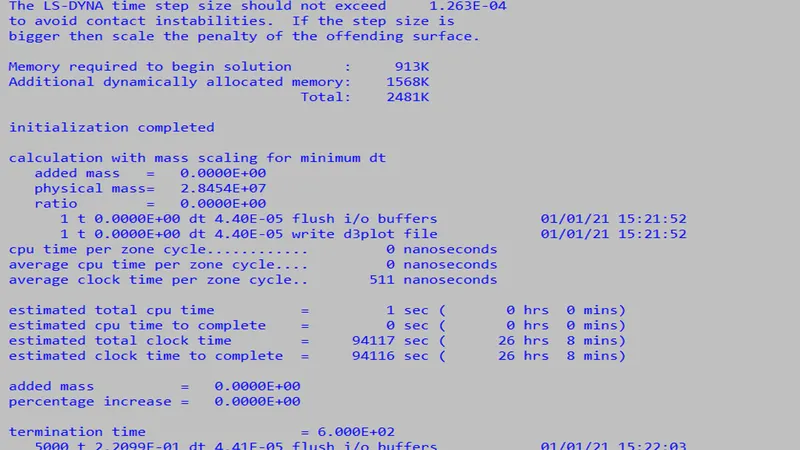
- the st2ms value is -4.5e-5 still no added masss and the run time is 26hr 8min.
Trial -3
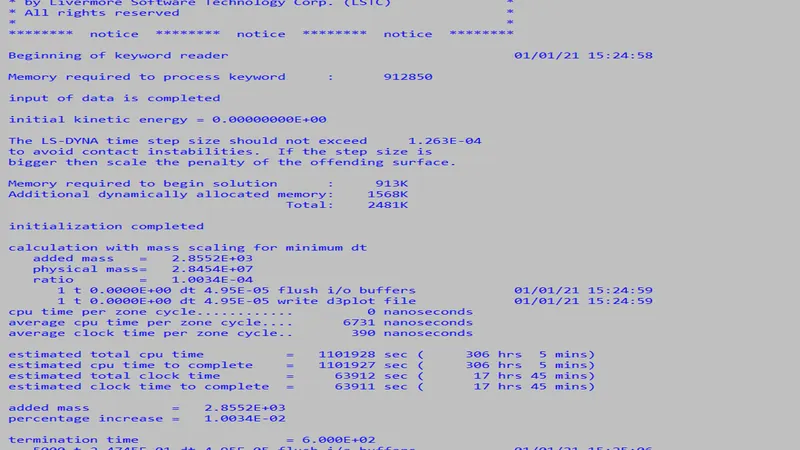
- the dt2ms value is -5.5e-5 the added mass is 2.855e3cand the run time is 17 hr 45min the run time is reduced and the percentage increase is 1.0034e-2.
Trial 4
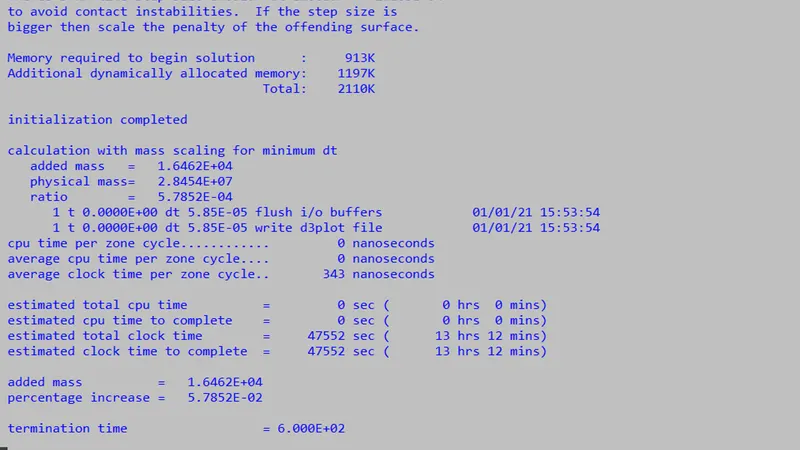
- the dt2ms value is -6.5e-5 the added masss is 1.6462e4 and the run time is 13 hr 12 min the run time is reduced and the percentage is increase is 5.7852e-04.
trial 5
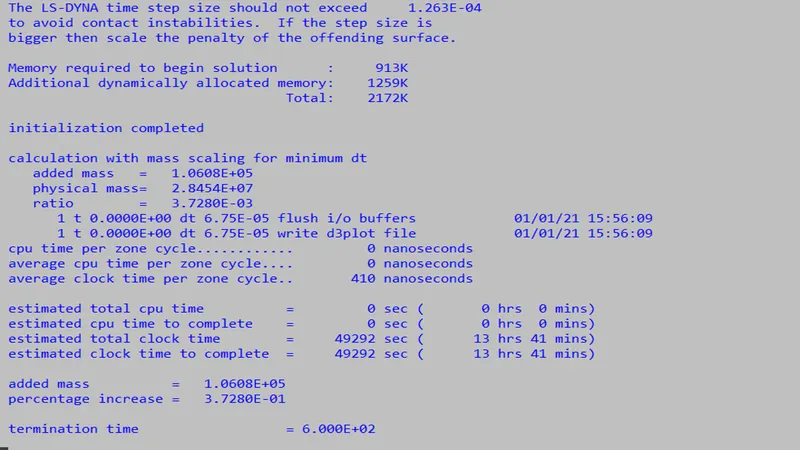
- the dt2ms value is -7.5e-5 the added mass is 1.6462e4 and the run time is 13 hrs 12 min the run time is reduced and the percentage increases is 3.7280e-3.
trial 6
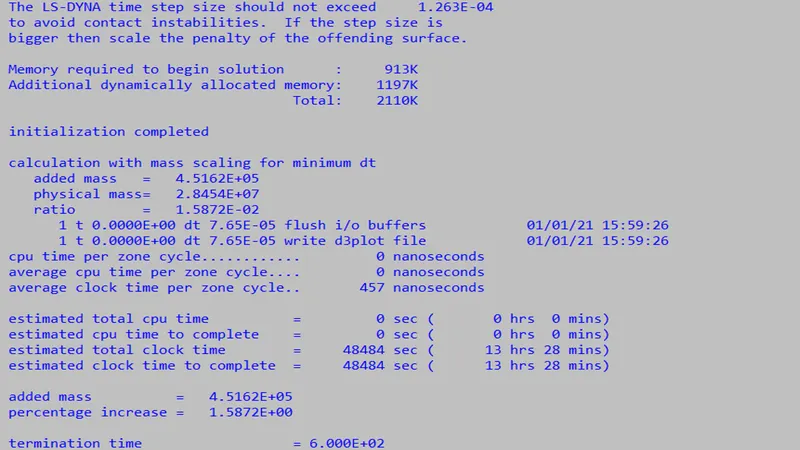
- the dt2ms value is -8.5e-5 the added mass is 4.5162e5 and the run time is 13 hrs 28 min the run time is reduced and the percentage increase is 1.5872e0.
trail 7
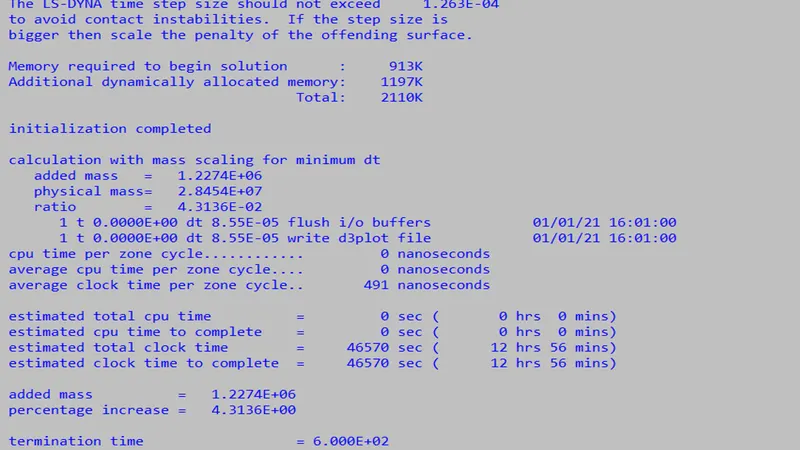
- the dt2ms value is -9.5e-5 the added mass is 1.2274e6and the run time is 12 hrs 56 min the run time is reduced and the percentage increase is 4.3136e-02.
trial 8
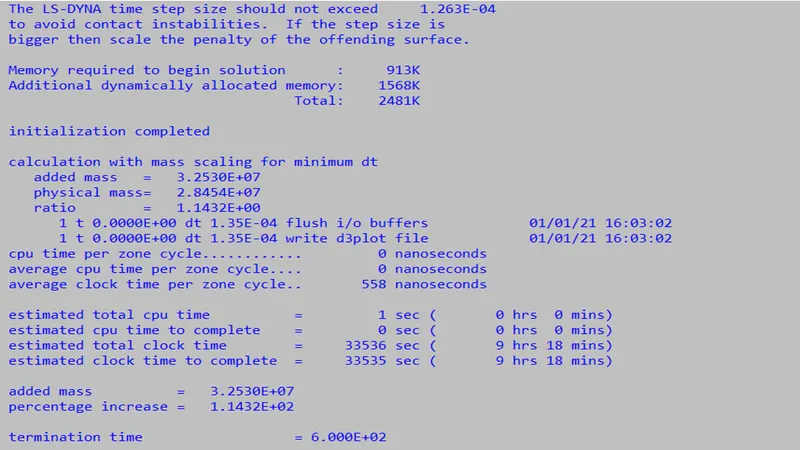
- the dt2ms value is -1.5e-4 the added mass is 3.2530e7 and the run time is 9 hrs 8 min the run time is reduced and the percentage increase is 1.1432e0.
trial 9
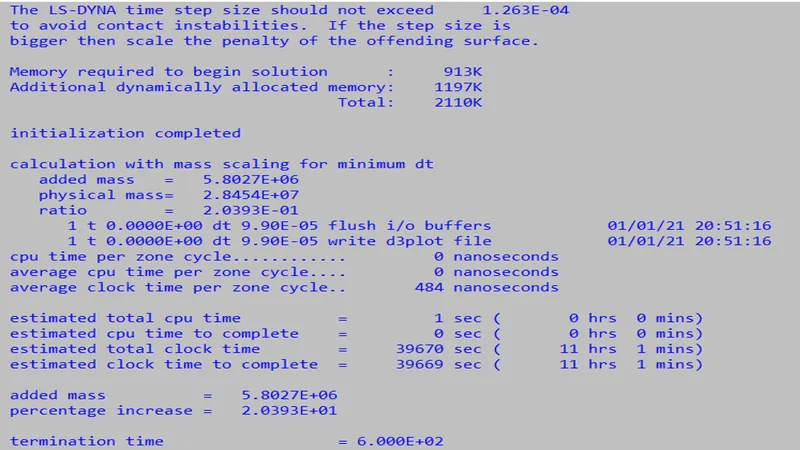
- the dt2ms value is -1.1e-4 the added mass is 5.8027e6 and the run time is 11 hrs 1 min the run time is reduced and the percentage increase is 2.039e-01..
trial 10
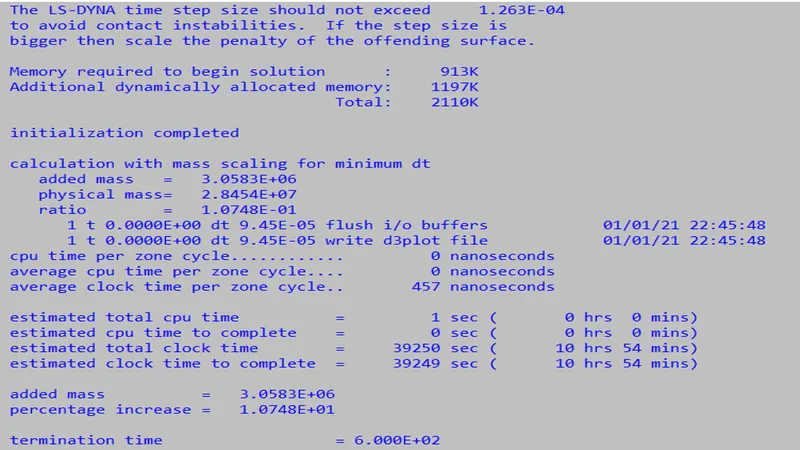
- the dt2ms value is -1.02e-4 the added mass is 3.0583e6 and the run time is 10 hrs 54 min the run time is reduced and the percentage increase is 1.0748e-01.
trial 11
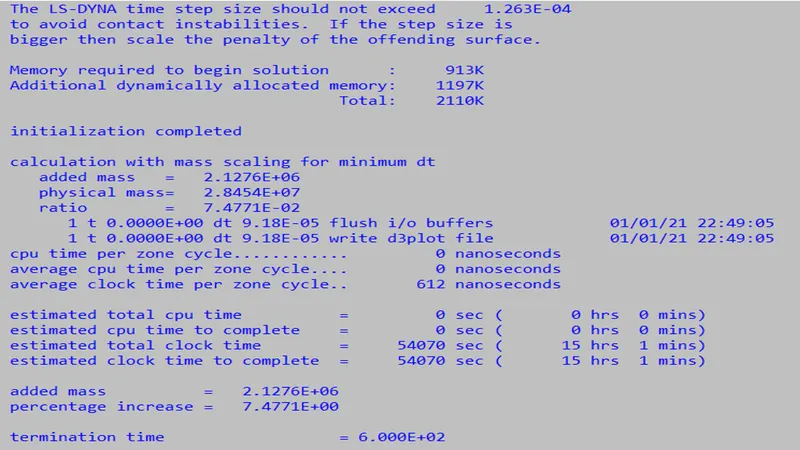
- the dt2ms value is -1.02e-4 the added mass is 2.1276e6 and the run time is 15 hrs 1 min the run time is reduced and the percentage increase is 7.4771e-02.
trial 12
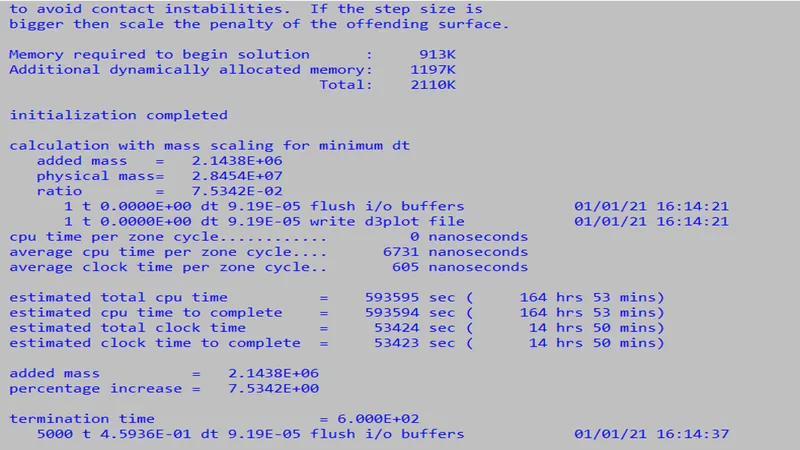
- the dt2ms value is -1021e-4 the added mass is 2.1438e6 and the run time is 14 hrs 50 min the run time is reduced and the percentage increase is 7.5342e-02.
trial 13
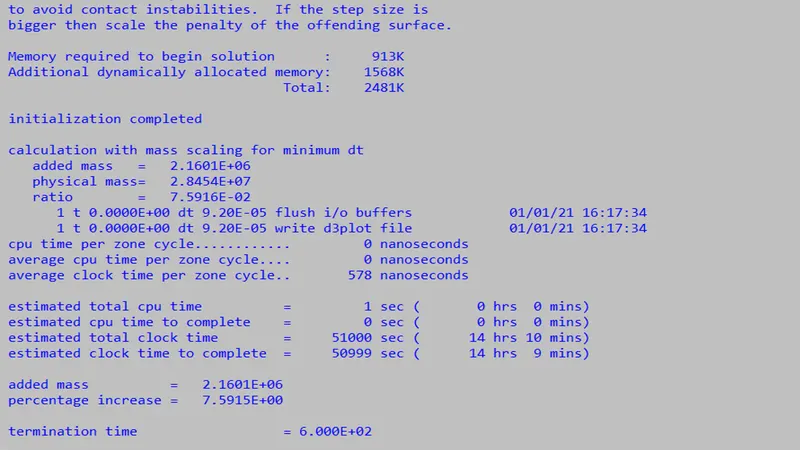
- the dt2ms value is -1.022e-4 the added mass is 2.1601e6 and the run time is 14 hrs 9 min the run time is reduced and the percentage increase is 7.5916e-02.
trial 14
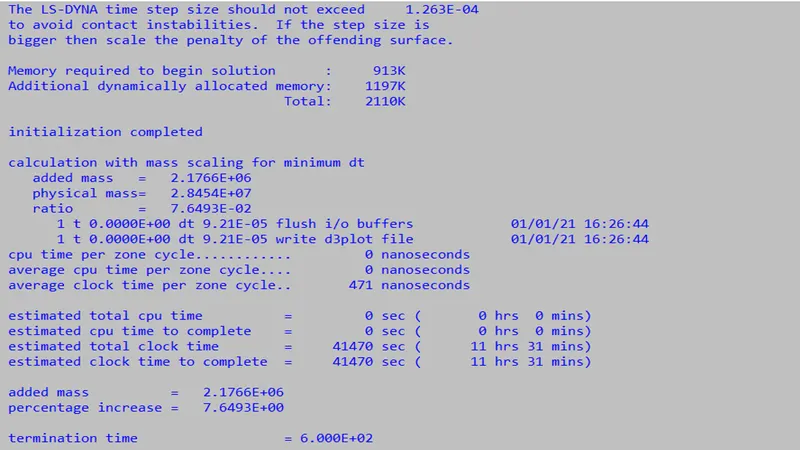
- the dt2ms value is -1.023e-04 the added mass is 2.1766ee6 and the run time is 11 hrs 31 min the run time is reduced and the percentage increase is 17.6493e-02.
trial 15
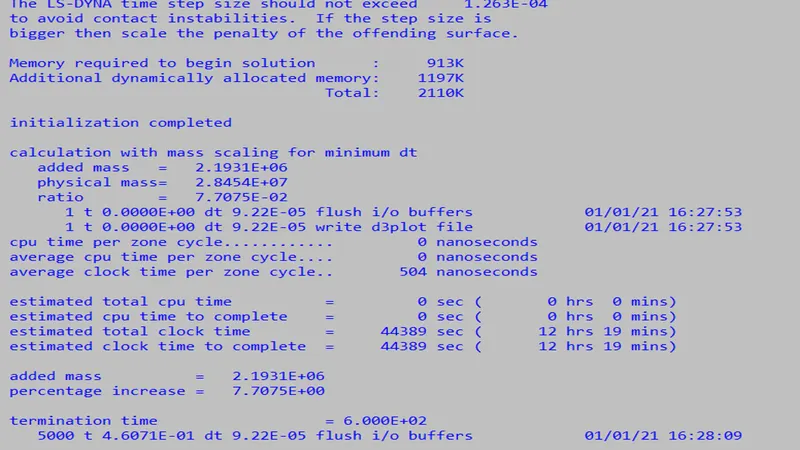
- the dt2ms value is -1024e-04 the added mass is 2.1931e6 and the run time is 12 hrs 19 min the run time is reduced and the percentage increase is 7.7075e-02.
implicit analysis.
this model is now run with implicit method and runtime is compared with the explicit method.where the model alredy assign with material card and section card also efined the stress strain curve and mass scaling curve.
then to shift from explicit to implicit analysis use te Control_implicit_general card, control_implicit_auto card ,control_implicit_solution card and control_implicit_solver card.
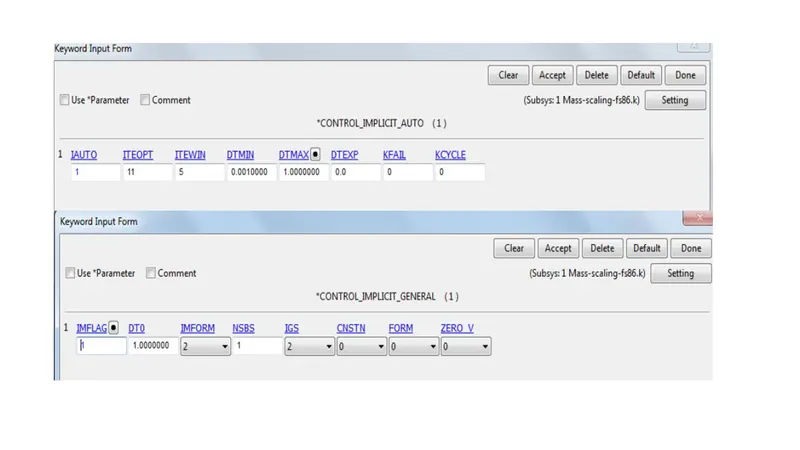
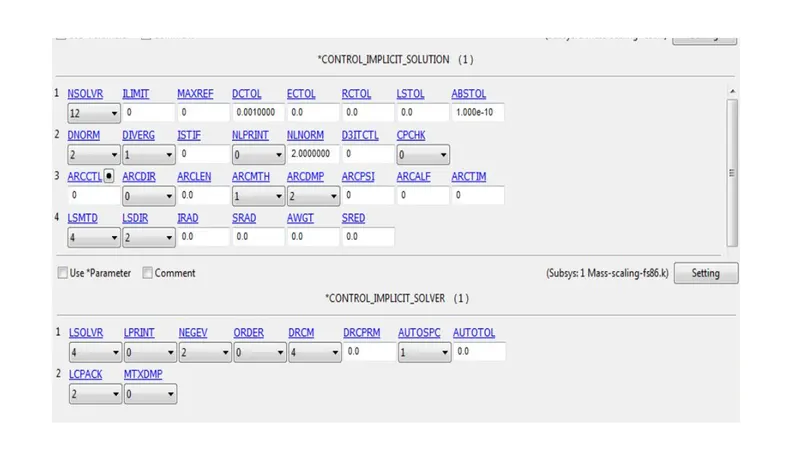
after adding the some important implicit cards the run starts and obtained the normal terminnation
histogram graph
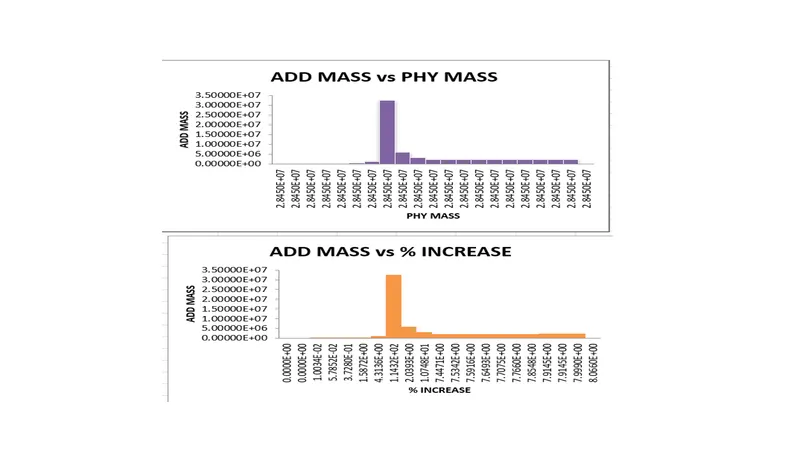
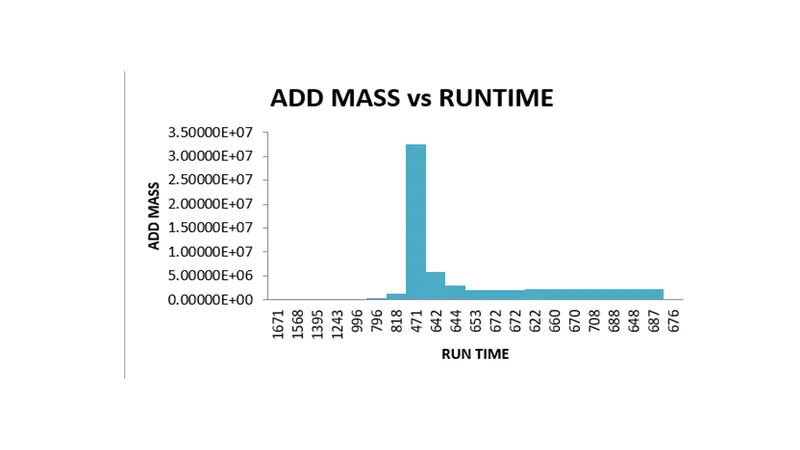
conclusion
- the objective of mass scaling is achieved for the given model by varying the values of DT2MS and TSSFAC using trial and error method.
- by considering the hard limit on mass scaling being 8 % the optimized values of DT2MS =-1.0289e-4 and TSSFAC=0.9 with lowest possible runtime required to complete the simulation .
- the values of DT2MS and TSSFAC doesnot affect the run time required to complete the simulation for implicit analysis.
- learned the concept of mass scaling and its necessity in explicit analysis