Mass Scaling
AIM
To compare the same simultions using the control_timestep card and without that card and optimize the dt2ms and tssfac values for better stability and lesser runtime
OBJECTIVE
Here we are provided with the fully prepared deck with the control time step card.Control_timestep card has a parameter called DT2MS which is the mass addition to prevent the lower timestep which happens because of the lower element charasteristic length or due to the high deformation happens to the elements while it undergoing large stress.So inorder to prevent the simulation from error terminated or became too slow due to the low time step we are inputting this control_timstep card.DT2MS have accepted the values in negative as well as in possitive values.DT2MS is basically the time step below which the mass will be added so a to increase the timestep of that particular element .This increasing the time step happens to the DT2MS value which is the lowest time step acceptable in simulation.This increasing time step because the mass is added to the nodes of the element So basically the density of the element at that area is inncreasing ,So when density increases the speed of the wave through it will reduce .This will increase the time step.Increasing the timestep will finish the run in less amount of time as iterations wiill be reduced.But when there is lot of non linerities involved in the problem,this usage of higher time steps may skip those non linearities and that will lead to inappropriate results.
PROCEDURE
We need too import the model into Ls Dyna first.The deck is made with the CONTROL_TIMESTEP card.Then using the Model checker we made sure that the deck is free of errors.Then we need to save the keyword file.using the Notepad++ we need to open the same keyword file and we need to comment($) that control_timestep card.So that ls dyna will not read that line while solving it.So the problem will be solved without the considering the mass scaling paramters.So the results will be based on the normal problem solving.
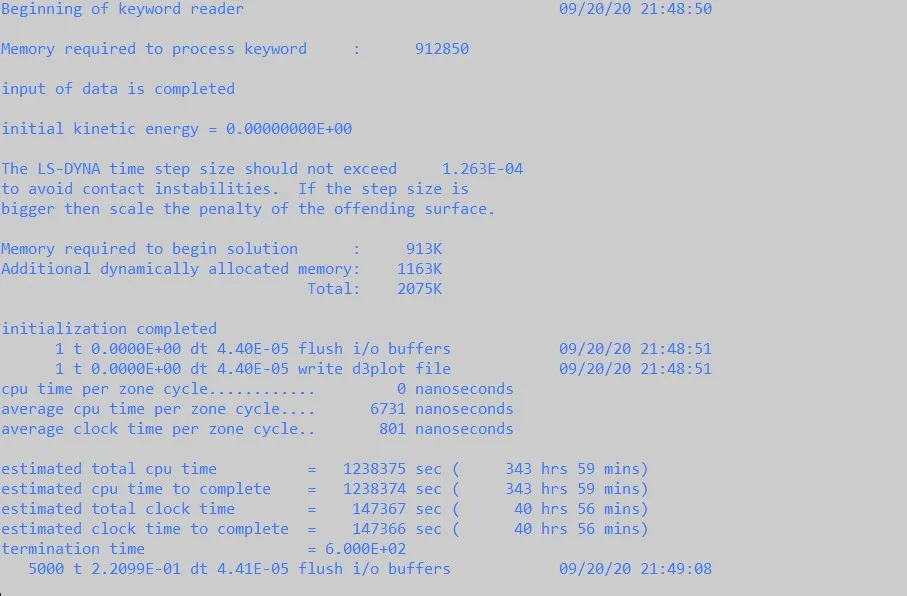
Fig 1 Without Mass Scaling
Here without mass scaling we obtained the total run time of the model as 40 hrs and 56mins.And the time step it considers to solve the problem is 4.41E-5.
Then in next case we need to remove that comment($) which we made in the keyword file earlier.So that the run will take the Control Time step card in the run. So that when an element in the model deforms much and the time step of the elements goes below the dt2ms value there will be mass adition to increase the time step.The deck is prepared with the dt2ms value of 3.5x10⁻⁸ms. So obviously we knows this is less than the normal run timestep.So there will not be any mass addition as the time step not expected to drop below that value.
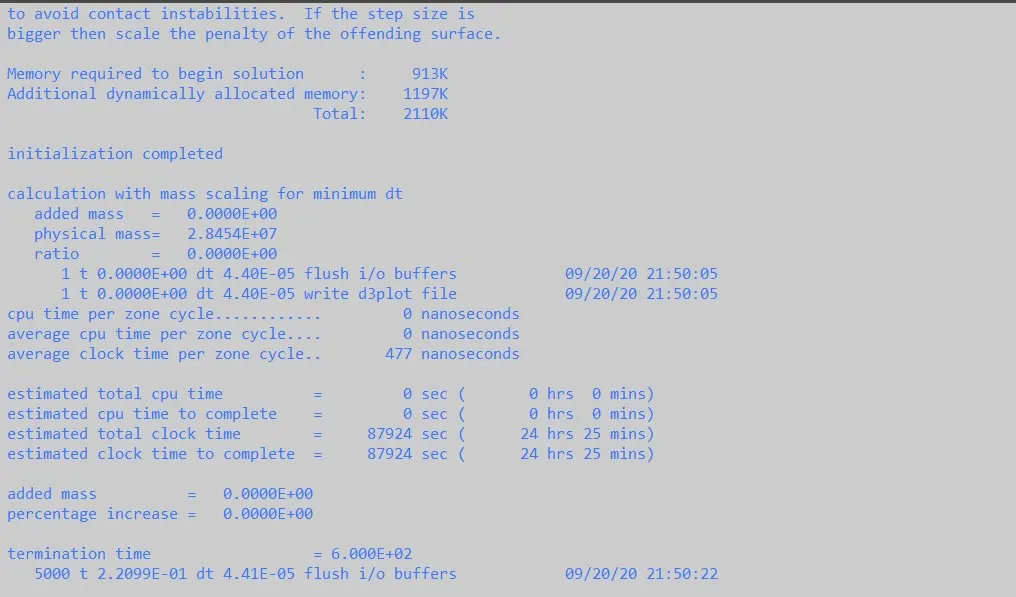
Fig 2 With Mass Scaling DT2MS value
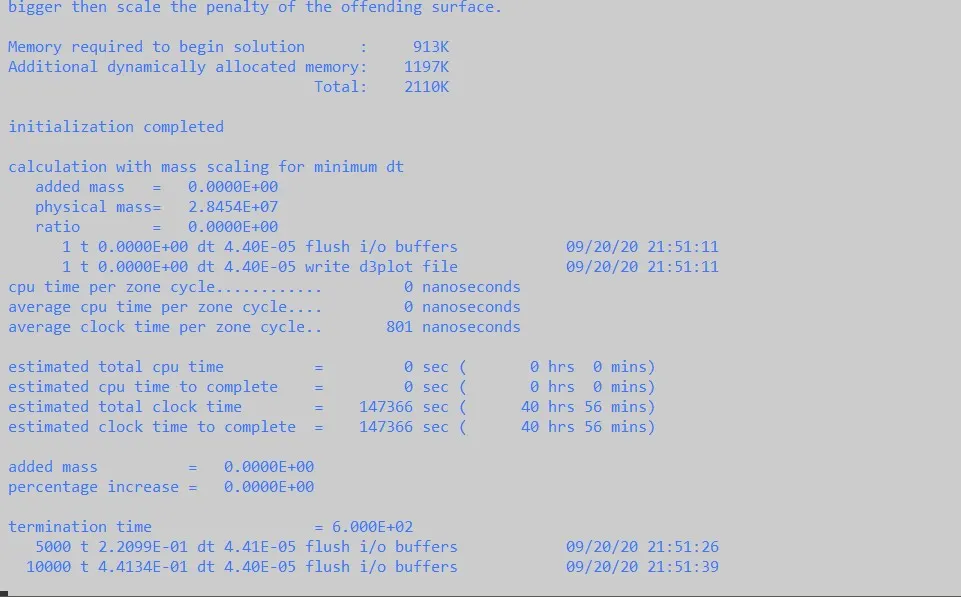
Fig 3 With Mass Scaling DT2MS value of 4.5x10^-5
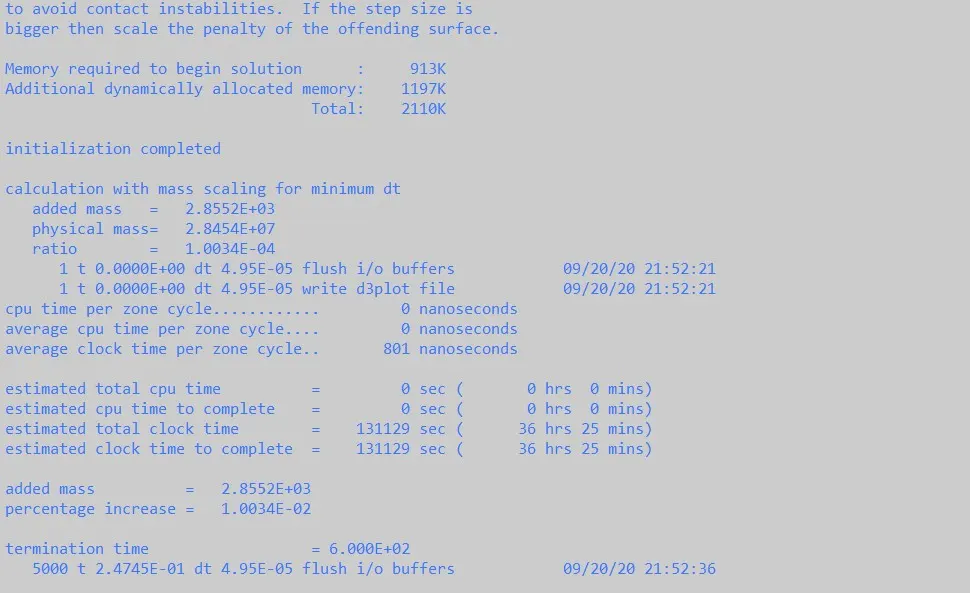
Fig 4 With Mass Scaling DT2MS value of 5.5x10^-5
As the dt2 ms value is 5.5 x10^-8 , with the 0.9 tssfac the time step for solving the problem will be 0.9 times the 5.5 x10^-8 ,that is 4.95x10^-8.Hre the run time is less thsn the prvious run time.But at the same time we can see that there is added mass in the model.Added mass is 2.85x10^3.this addition is because the time step value of some elements goes below the dt2ms value.So inorder to increase the time step to dt2ms value ,there is mass addition is required.
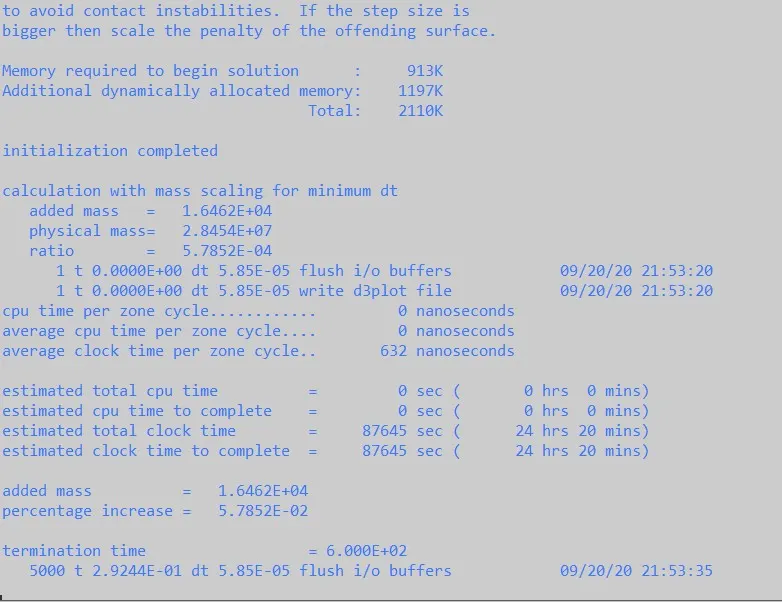
Fig 5 With Mass Scaling DT2MS value of 6.5x10^-5
As the dt2ms value is 6.5 x10^-5 , with the 0.9 tssfac the time step for solving the problem will be 0.9 times the 6.5 x10^-5 ,that is 5.85x10^-5.Here the run time is again less than the previous run time.Also as expected we can see that there is added mass in the model.Added mass is 1.646x10^4.As we increase the dt2 ms value,obviously more and more elements will be having the time step value less than the dt2ms value.So the solver will tried to add the mass on each and every such elments to improve its timestep.That is why the added mass is increased to 1.6462x10^4.At the same time the dt2ms is increased so definitely the run time will gets reduced.That is why the run time is 24 hrs and 20 mins .Also the % mass added is neraly .057 only which is within the limit.So we can try increasing the dt2ms value.
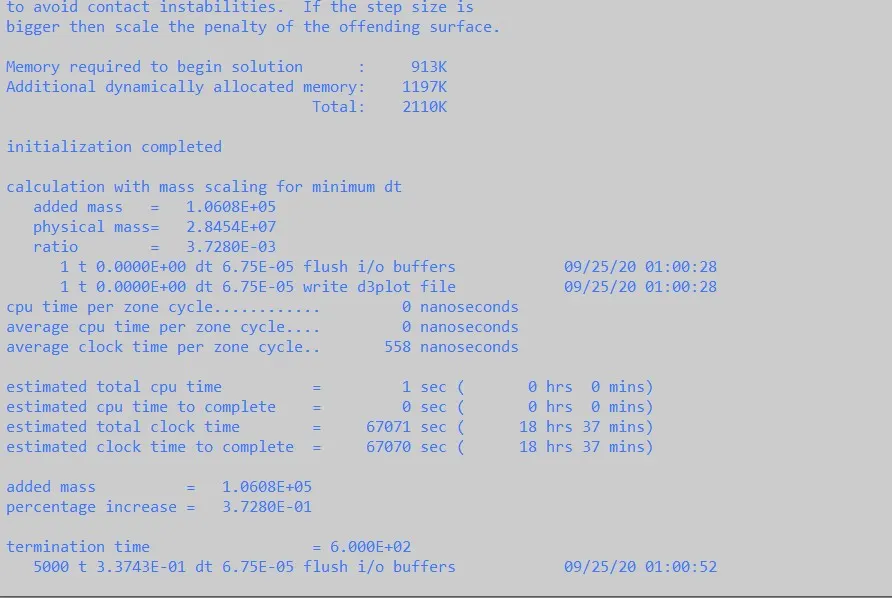
Fig 6 With Mass Scaling DT2MS value of 7.5x10^-5
Then we increased the dt2ms to 7.5x10^-5.All obvious ,run time reduced and the added mass increased and the percentage mass addition is also increased .Also the % mass added is neraly .3 only which is within the limit.So we can try increasing the dt2ms value.
Then we trying with the dt2ms value of 8.5x10^-5
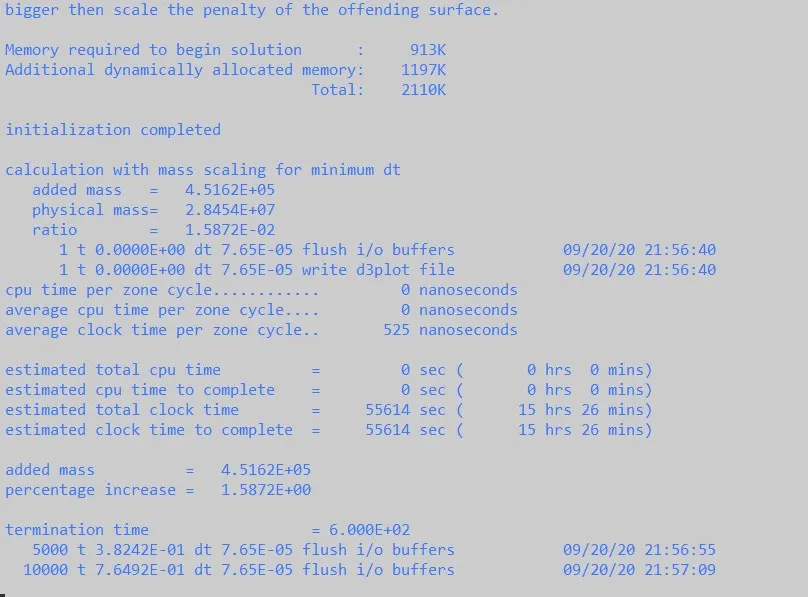
Fig 7 With Mass Scaling DT2MS value of 8.5x10^-5
As expected the mass addition increased as more and more elements have the time step comes below the dt2ms value of 8.5x10^-8 .And the percentage mass addition is 1.5 % ,And the run time reduced to just 15 hrs and 26 mins ,because the time step here is increased to nearly 7.65x10^-5.So the number of iterations are way less than as intial case .
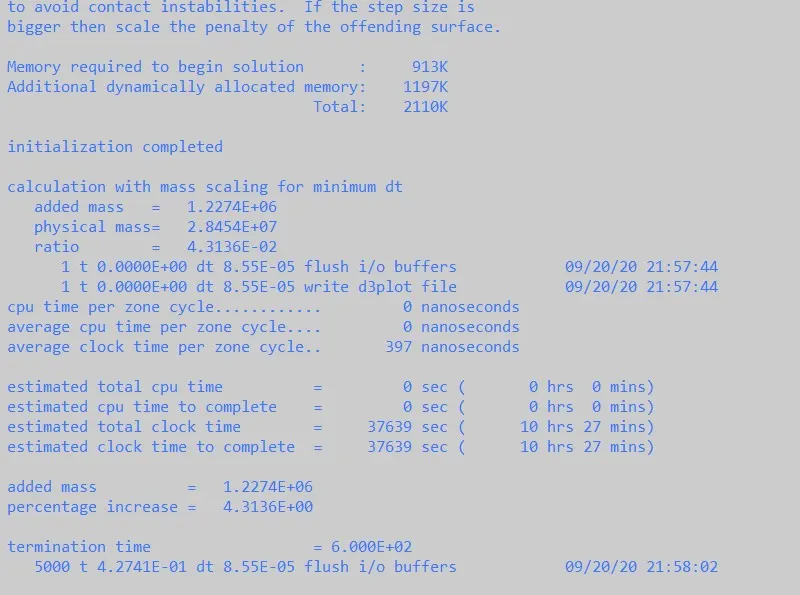
Fig 8 With Mass Scaling DT2MS value of 9.5x10^-5
As in the above case the time for run is 10hrs 27 mins which is the smallest and the time step is agai increased as the dt2 ms value increased ,here the timestep for solver solving the problem is 8.55x10^-5 .So the solving is much faster.And the added mass is increased to 1.22 x 10^6 and the percentage mass addition is 4.31 % which is basically in the within the hard limit range.
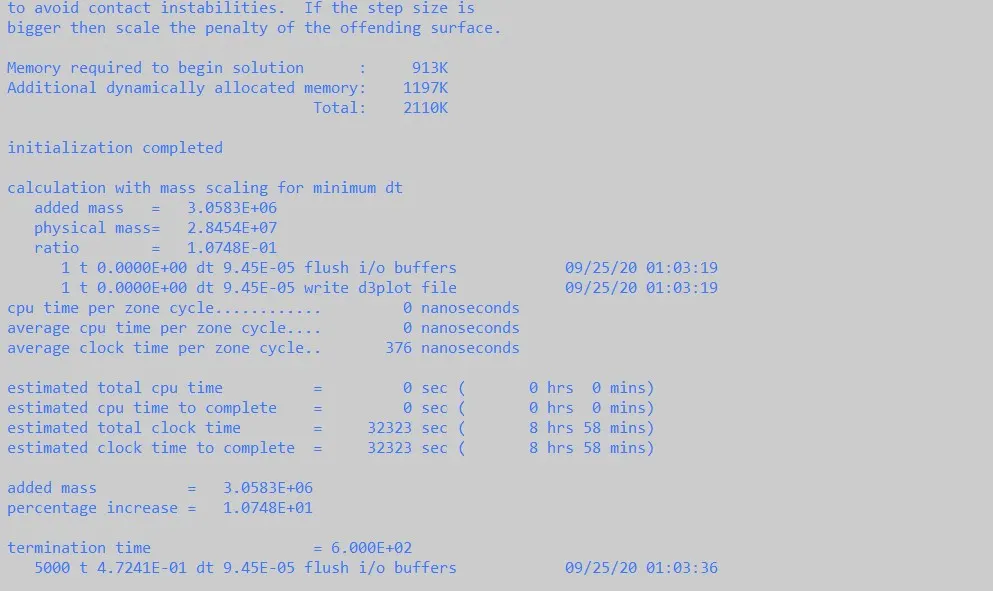
Fig 9 With Mass Scaling DT2MS value of 10.5x10^-5
Here we are using very big timestep compared to the time step the solver used to solve the model without the control timestep card.So as we expected the added mass is very much high and the percentage of the mass addition is higher than the hard limit given for mass scaling.here the percentage goes high upto 10% .So this run is not acceptable to us.Because the added mass will increase the kinetic energy from nowhere .This mass is not actually in th model,Solver adds this inorder to solve the problem.So we need to be cautious of this mass addition.Here runtime is lesser than the previous case.Also as expected the time step for solving the problem whih influenced by the dt2ms and the tssfac is about 9.45x10^-5.
So we came to the conclusion that inorder to speed up the simulation and making the added mass within the 8% limit we can take the dt2ms value as 9.5x 10^-5.So now we need to optimize the tssfac value inorder to ensure the stability of the model.
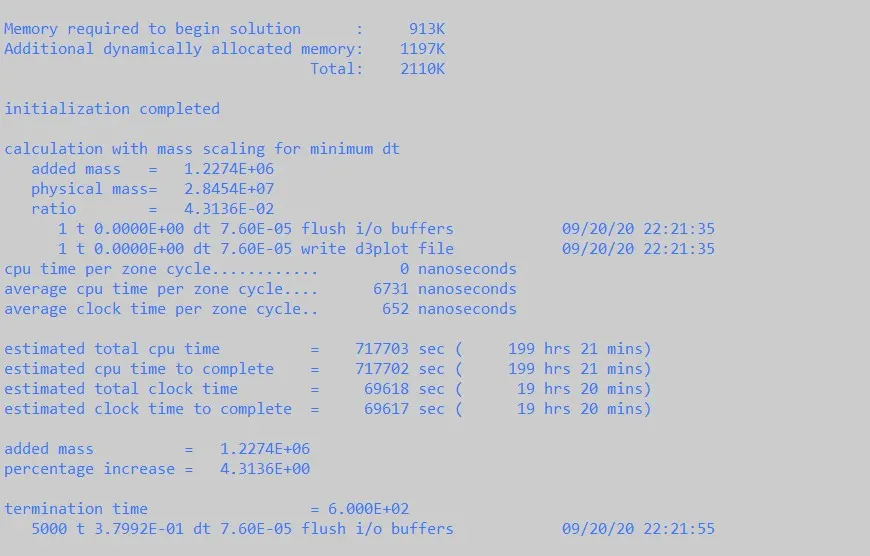
Fig 10 Run with TSSFAC 0.8
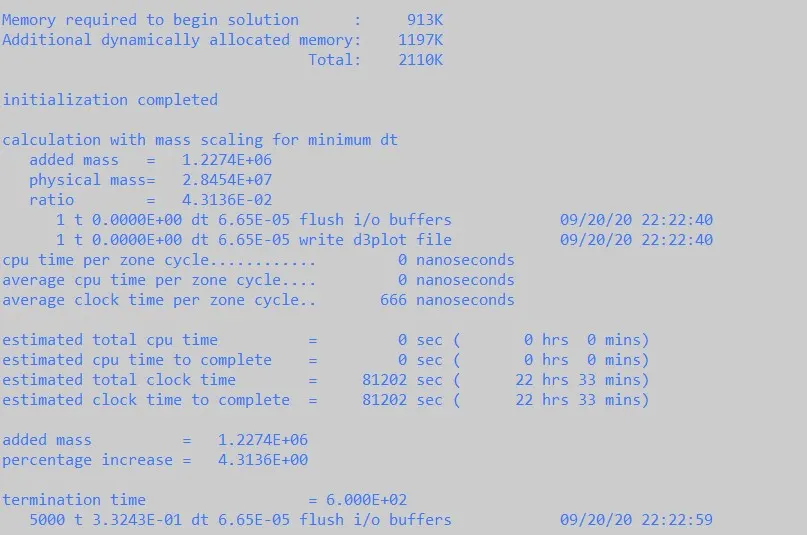
Fig 11 Run with TSSFAC 0.7
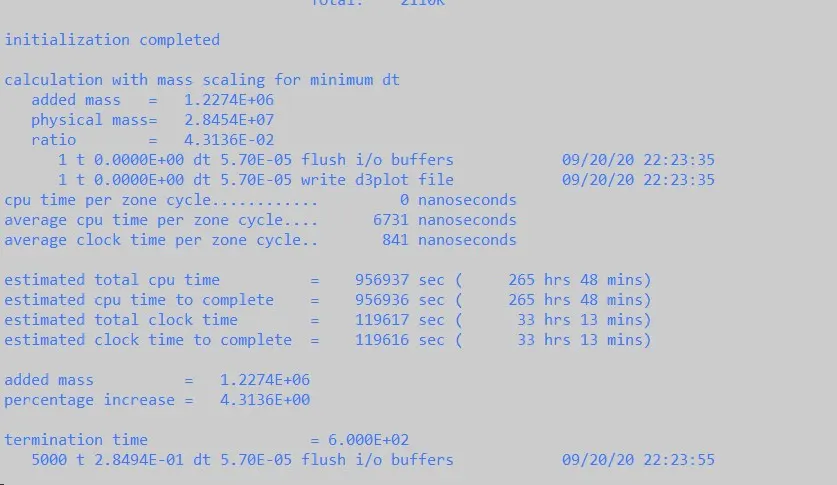
Fig 12 Run with TSSFAC 0.6
In every run with differant tssfac values but same dt2ms values we found that the added mass values adn the percemtage of added mass is same.It is just because the added masss just depends only on the dt2ms value.Since the dt2ms is same in above cases added mass is same in bove cases.
We know that as the tss fac is reduced the time step in which the solving calculations in solver will be done speedly.Before that stress wave from one node hits its nearby node the value at those nodes should be calculated .So for this we are providing the minimum time step size as dt2ms ,but as a cautionary step to this process we are giving a tssfac value which again scales down the time step, so that these values are calculated much before the stress wave hits that node.So the explicit analysis will be stable.But as the tssfac value is reduced the timestep is reduces .So basically the runtime of the simulation will gets increased .But at the same time as tssfac is reduced ,problem will be solved with comparitively small timestep ,so the stability of the probelm will be increased .
But the tssfac value will be generally ranges between 0.5 to 0.9.But these 0.5,0.6 small values are used for blast explosives.As the run simulation time is pretty less in case of tssfac =0.9 we can take that to reduce our run time.That will scales down our time step to lower value than the dt2ms we input,so the stability will be ensured by the tssfac value.Reducung the tssfac will increase our runtime.
| Run time | DT2MS |
| 40hr36min | 0 |
| 40hr56min | 4.50E-05 |
| 36hr25min | 5.50E-05 |
| 24hr20min | 6.50E-05 |
| 14hr8min | 7.50E-05 |
| 15hr26min | 8.50E-05 |
| 10hr27min | 9.50E-05 |
| 14hrs45min | 10.5E-05 |
Table 1 Runtime vs DT2MS
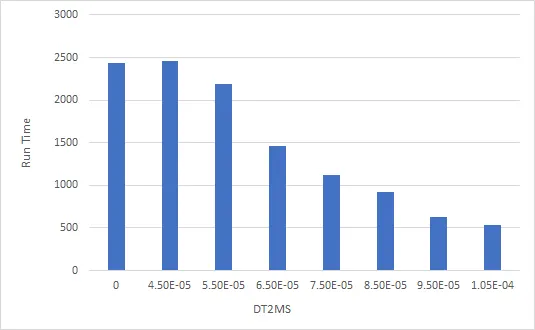
Fig 13 Histogram of DT2MS vs Run Time
It is quite evident from the histogram that as the dt2ms value increases the run time keeps on reducing but after the time step of 9.5x10^-5 the added mass is very high which is not in the acceptable limits.So we cm into the conclusion that the 9.5x10⁻⁵ is the time step which is optimised for the efficient speedy run with the tssfac value of 0.9.
Then we add the implicit cards such as implicit general,implicit auto for coberting the simulation to impliict analysis(by Imflag =1).Then we run th same model in LS Program Manager.With the ITEOPT value of 50,we found that the runtime is pretty much reduced as compared to the explicit case.Since the implicit can move with high time steps if the iterations required is lesser than the ITEOPt and ITE WIN values speedy solving of problem is a capability of implicit solver.Since the problem is not so complex,there may not be any timestep reductions happens.IF there is so much complexities occurs in model,then may be implicit may take so much time than the explicit.
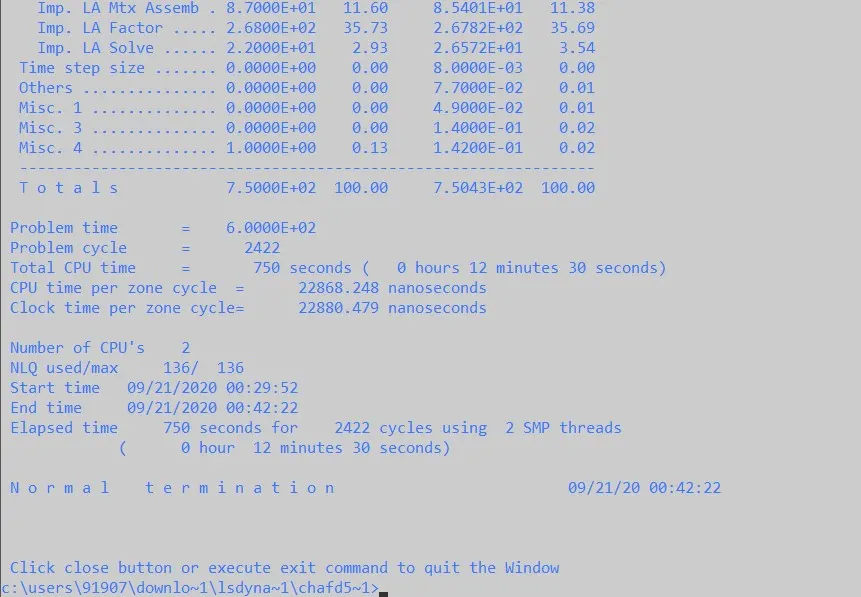
Fig 13 Implicit Run
CONCLUSION
As the dt2ms value increases the timestep will increases with the addition of the mass in the model.After a particular limit we cannot accept that mass addition as it will leadys to destruction of the physical sense of the problem.Within a limit this can be used to speed up the simulation with the use of the tssfac which is a cautionary parameter to stablise the model.
Learning Outcome
Learned about the mass scaling parameters and the importance of control Timestep card