Week 8: Literature review - RANS derivation and analysis
AIM: To Apply reynold's decomposition to the NS equations and come up with the expression for reynold's stress and to explain the understanding of terms reynold's stress and turbulent viscosity.
Theoritical Background:
Turbulent Flow
Turbulent flow is fluid motion characterized by chaotic changes in pressure and flow velocity It is in opposite to a laminar , which occurs when a fluid flows in parallel layers, with no disruption between those layers.
turbulence is commonly realized in low viscosity fluids. In general terms, in turbulent flow, unsteady vortices appear of many sizes which interact with each other, consequently drag due to friction effects increases. This increases the energy needed to pump fluid through a pipe.
The onset of turbulence can be predicted by the dimensionless Reynolds number, the ratio of kinetic energy to viscous damping in a fluid flow. However, turbulence has long resisted detailed physical analysis, and the interactions within turbulence create a very complex phenomenon.
Reynolds number(Re)
Reynolds number quantifies the turbulence level in the system. Higher value of Reynolds number more chaotic the turbulence is
It's the ratio of inertia force to the Viscous force
For the flow to be turbulent the Reynolds number must be greater than the critical value.
Re for the flow in round pipe
Re < 2300 - Laminar flow
2300 < Re < 4000 - Transient flow
Re > 4000 - Turbulent flow
Turbulence Modeling Approaches.
Converge offers 2 turbulence modeling approaches
1] Reynolds Average Navier Stokes (RANS)
Solves equation for an ensemble average velocity field and magnitude of turbulent fluctuations
2] Large Eddy Simulation
Solve equations for a filtered time dependent velocity field that represents large scale turbulence motion
Governing Equations for the boundary Layer is given by
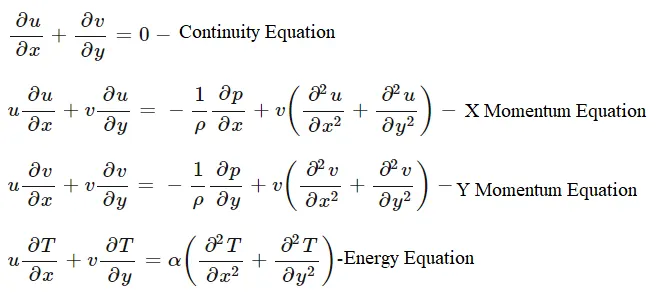
We will use the governing equations and integrate over time which is much larger than the turbulance time scale. This is called as the Avergaing process. We apply Reynolds decomposition process to obtain original set of equations called as the Reynolds Average Navier Stokes(RANS)
Reynolds Decompostion:
In this case we split the variable in to Main and Fluctuating component
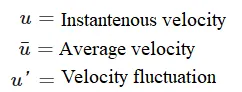
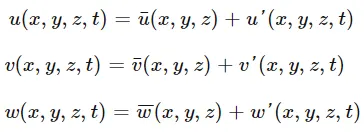
The mean time Average velocity is the function of Space While the fluctuating velocity is the function of both time and space.
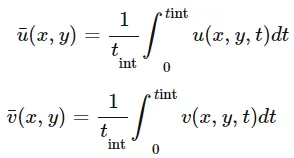
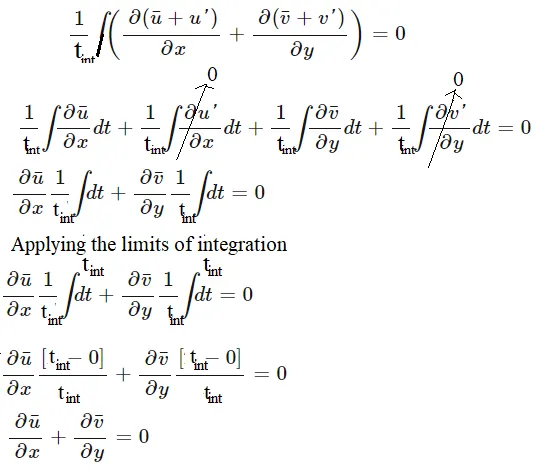
When you integrate the fluctuating component, its always equal to be zero
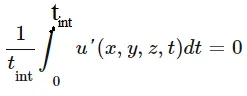
We are using Reynolds decomposition menthod to prove the flucutating component is zero

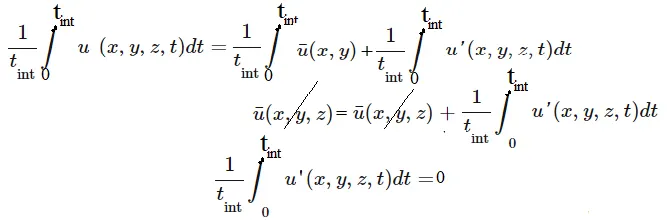
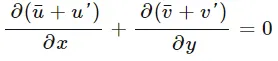
Now we are applying Reynolds Number decompostion on Continuity Equation

Applying Reynolds number Decomposition to the above equation
Substitute
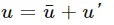 and
and 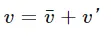
Integrating the above with respect to Time and then doing Time averaging
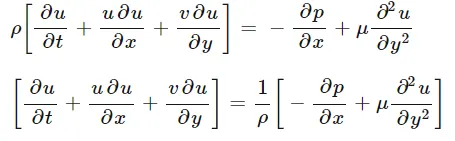
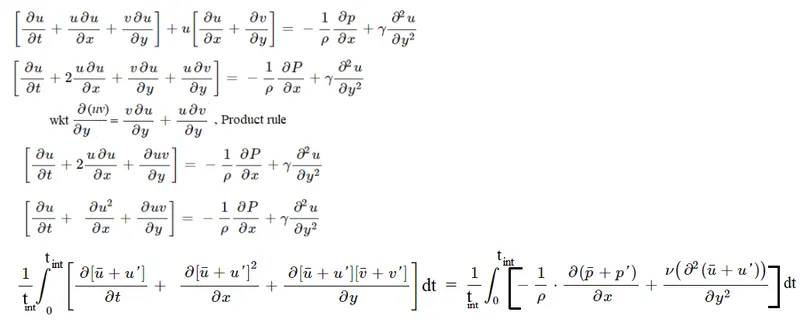
Applying Reynolds number decomposition on Momentum equation
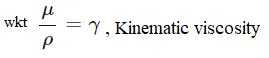
Adding an extra term on the left hand side





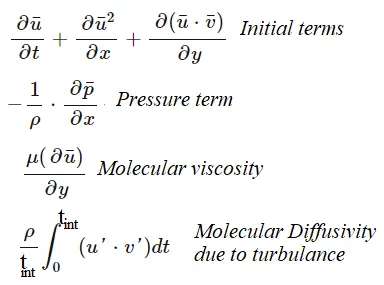
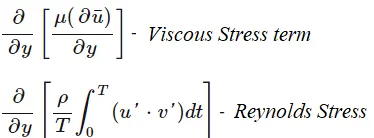
Reynolds Stress:
In fluid dynamics , the Reynolds stress is the component of the total stress stensor in a fluid obtained from the averaging operation over the Navier-Stokes equations to account for turbulent fluctuations in fluid momentum.

with  being the flow velocity vector having components
  in the
  coordinate direction (with denoting the components of the coordinate vector
  ). The mean velocities
  are determined by either time averaging , spatial averaging or ensemble averaging, depending on the flow under study. Further
  denotes the fluctuating (turbulence) part of the velocity.
The theory of the Reynolds stress is quite analogous to the Kinetic theory of gases, and indeed the stress tensor in a fluid at a point may be seen to be the ensemble average of the stress due to the thermal velocities of molecules at a given point in a fluid. Thus, by analogy, the Reynolds stress is sometimes thought of as consisting of an isotropic pressure part, termed the turbulent pressure, and an off-diagonal part which may be thought of as an effective turbulent viscosity.
Turbulant Viscosity:
In a turbulent fluid, a linear interface between two different fluids breaks apart to form small-scale structures, also known as eddies. ... This effective viscosity is called turbulent viscosity. The product of this turbulent viscosity and the shear, gives us the net diffusive flux of fluid across the grid box.
Molecular Viscosity
At a molecular level, viscosity is a result the interaction between the different molecules in a fluid. It is the friction between the molecules in the fluid. Just like in the case of friction between moving solids, viscosity will determine the energy required to make a fluid flow.