Week 8: Literature review - RANS derivation and analysis
Aim: To apply reynolds decomposition to Navier-stokes equations and come up with the expression for reynolds stress.
Objective: 1. To derive an expression for reynold's stress by applying reynold's decompisition to NS equation.
2. To explain the term reynold's stress in own words.
3. To explain turbulent viscosity and differentiate it from molecular viscosity.
Introduction:
What is turbulence ?
The fluid motion characterized by chaotic changes in pressure and flow velocity is termed as turbulence or turbulent flows. The commencement of turbulence can be predicted by dimensionless reynold's number, the ratio of kinetic energy to viscous damping.
Why study turbulence ?
During pre-mixing combustion, turbulence causes faster burning and flame extinction. It is very important to capture these phenomenons in the simulation hence, appropriate turbulent length scale has to be used. The turbulent length scale is a physical quantity related to the size of the large eddies that contain energy in turbulent flows. For I.C engine applications, the turbulent length scale is between 0.1 mm to 1 mm. These length scales are very small and very small grid size has to generated to capture the effects of turbulence and to get accurate solution. But performing a simulation with such small grid size computationally expensive. Hence, turbulence modeling helps in capturing these effects with larger grid size.
The converge CFD software offers two turbulence models, RANS (reynold's avereged navier stokes equation) and LES (large edddysimulation). Only RANS modeling is discussed in this lierature review.
RANS derivation
The RANS modeling approach uses reynold's decomposition where the flow variables (eg. velocity) are decomposed into mean and fluctuating terms.
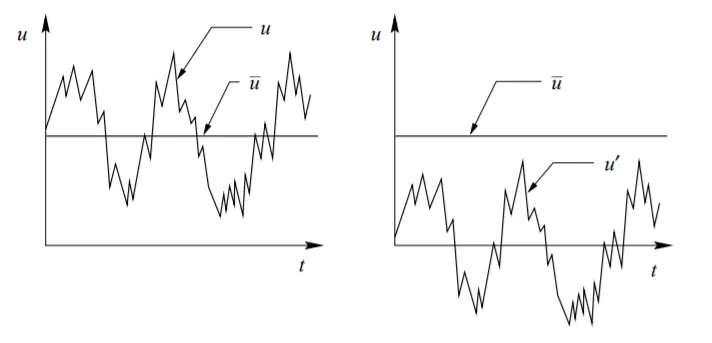
From the above figure, it can be seen that u (instantaneous velocity) gives accurate decription of flow variables and u' is the fluctuating term and  is the mean term which gives the average values of flow variables.
The governing equations for boundary layer,
The continuity equation
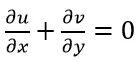
The momentum equation

The energy equation

The governing equations are solved and converted to reynold's averaged navier stokes equations. These equations along with turbulence model are used to simulate turbulent flows.
Splitting the flow variables (eg. velocity) into mean components and fluctuating components.
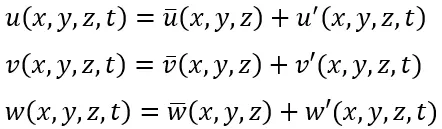
The above equations are the reynold's decomposition. u is the instantaneous velocity, u' is the fluctuating velocity component and is the mean velocity component.
The mean velocity component is given by,
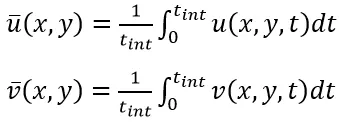
The integration of flutcuating components is equal to zero. Apply time integration to the flow variables which is split using reynold's decomposition method,

The mean velocity components gets cancelled and that leaves the fluctuating velocity component equal to zero.

Apply reynold's decomposition method and time integration to the continuity equation.
Solving for continuity equation
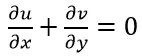
Applying reynold's decopmosition method to the above equation,
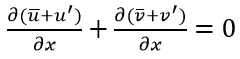
Applying time integration to the above equation,

The above equation is simplified into,

The time integration of fluctuating components is equal to zero and hence, the above equation is further simplified into,
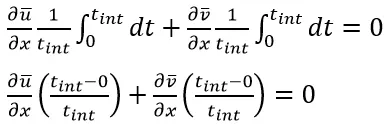
Solving the above equation gives,
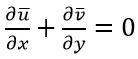
Thus, it can be said that the time averaged velocity component satisfies the continuity equation.
Solving for momentum equation
Transfering the density in LHS to RHS,

The ratio of absolute viscosity to density is kinematic viscosity.

Substituting the kinematic viscosity to the above equation,

Adding the continuity equation multiplied with velocity component u to convert the momentum equation into much more simplified form,

The above equation is further simplified into,

By applying product rule to above equation gives,


Now, applying the time integration to the above equation.

The above equation is simplified into,

As the time integration of fluctuating components is equal to zero, all the fluctuating velocity components and mean velocity components multiplied with fluctuating components are cancelled out.
But the square of fluctuating component always gives positive number hence, time integration of such components are not equal to zero.
And the product of two different fluctuating velocity components gives negative values hence, such components are not equal to zero.
Therefore, the above equation is further simplified into,

Assumption:
The variation of velocity component in y-direction is more compared to the velocity component in x-direction. Hence, the fluctuating velocity component in x-direction is ignored due to the above assumption.
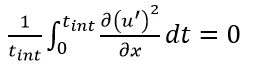
Applying the above assumption to the simplified momentum equation gives,

By further simplification and slight modification, the above equation becomes,


The above equation gives as expression for viscous stress and reynold's stress. The viscous stresses are caused by the molecular diffusion across the boundary enclosing the control volume. If the molecular diffusion causes fluid molecules to move into a region of fluid with different velocity, then momentum is transfered and a viscous stress exists. The reynold's stress is a component of total stress tensor in a fluid obtained by averaging operation over navier stokes equation to account for turbulent fluctuations in fluid momentum.
Turbulent viscosity and how is it different from molecular viscosity.
When the flow is laminar, the diffusion mechanism within the flow is achieved by molecular motion. This phenomenon is termed as the molecular viscosity. When the flow is turbulent, the diffusion mechanism of the flow is not only done by the molecular motion, but also by the highly intensified eddy motion. This phenomenon termed as the turbulent viscosity. Therefore, the term turbulent viscosity is added to molecular viscosity in momentum and energy equations. The turbulent viscosity increases the shear rate and affect the velocity and heat transfer. Thus, the concept of turbulent viscosity is virtual and it is used to predict turbulent flow characteristics.