Week 8: Literature review - RANS derivation and analysis
What is turbulent viscosity? How is it different from molecular viscosity?
Viscosity is the phenomenon (and the measure) of transverse momentum transport a moving fluid. In laminar flow the mechanism of momentum transport is diffusion due to molecular motion and the resutlting molecular collisions, the same as for mass transport and for heat conduction.
In a turbulent flow, the mechanism of transverse momentum transport is dominated by bulk mixing at scales mostly well above the mean free path. So the effective viscosity in a region such as a turbulent boundary layer is much higher than in laminar flow.
The more effective momentum transport due to the mixing in the turbulent boundary layer results in a thinner boundary layer between any wall in contact with the fluid and the free stream outside the boundary layer where the flow obeys potential flow laws.
The utility of the analogy is strained by the fact that while the molecular viscosity is a property of the fluid, the Turbulent viscosity is a property of the flow.
Reynold's stress :
Reynolds decomposition allows the simplification the Navier–Stokes equations by substituting in the sum of the steady component and perturbations to the velocity profile and taking the mean value. The resulting equation contains a nonlinear term known as the Reynolds stresses which gives rise to turbulence.
Reynolds stress is the component of the total stress tensor in a fluid obtained from the averaging operation over the Navier–Stokes equations to account for turbulent fluctuations in fluid momentum using Reynolds decomposition. The Reynolds stress is the small-scale turbulent fluctuations in turbulent fluids and plasmas.
Assume a flow v with a time scale T. Let τ denote a time scale τ << T. We can then write for each component of the velocity

One splits the Euler equation or the NS equations into an average and a fluctuating part. One finds that upon averaging the fluid equations, a stress on the right hand side appears of the form  .This is the Reynolds stress, conventionally written
  .
.

the incompressible NS equation—can be written (in a non-conservative form) as 
and
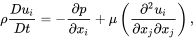
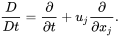
where  is the Lagrangian Derivative or the Substantial derivative.
Defining the flow variables above with a time-averaged component and a fluctuating component, the continuity and momentum equations become
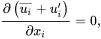
and

Examining one of the terms on the left hand side of the momentum equation, it is seen that

where the last term on the right hand side vanishes as a result of the continuity equation. Accordingly, the momentum equation becomes

Now the continuity and momentum equations will be averaged. The ensemble rules of averaging need to be employed, keeping in mind that the average of products of fluctuating quantities will not in general vanish. After averaging, the continuity and momentum equations become

and

Using the product rule on one of the terms of the left hand side, it is revealed that
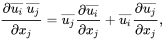
where the last term on the right hand side vanishes as a result of the averaged continuity equation. The averaged momentum equation now becomes, after a rearrangement:
where the Reynolds stresses, , are collected with the viscous normal and shear stress terms,  .
.
Reynolds averaged N-S equation:

Reynolds stress:
