Week 8: Literature review - RANS derivation and analysis
Apply reynold's decomposition to the NS equations and come up with the expression for reynold's stress.
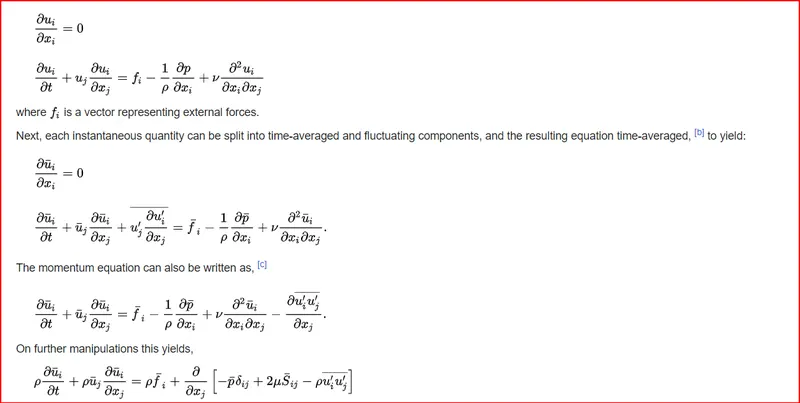
The Reynolds-averaged Navier–Stokes equations (RANS equations) are time-averaged[a] equations of motion for fluid flow. The idea behind the equations is Reynolds decomposition, whereby an instantaneous quantity is decomposed into its time-averaged and fluctuating quantities, an idea first proposed by Osborne Reynolds. The RANS equations are primarily used to describe turbulent flows. These equations can be used with approximations based on knowledge of the properties of flow turbulence to give approximate time-averaged solutions to the Navier–Stokes equations. For a stationary flow of an incompressible Newtonian fluid, these equations can be written in Einstein notation in Cartesian coordinates as:
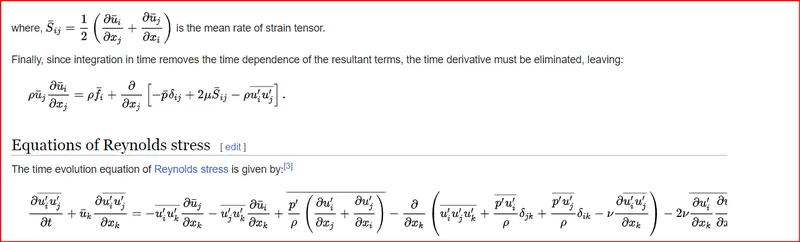
The left hand side of this equation represents the change in mean momentum of a fluid element owing to the unsteadiness in the mean flow and the convection by the mean flow. This change is balanced by the mean body force, the isotropic stress owing to the mean pressure field, the viscous stresses, and apparent stress (`-bar(rhou'iu'j)`)owing to the fluctuating velocity field, generally referred to as the Reynolds stress. This nonlinear Reynolds stress term requires additional modeling to close the RANS equation for solving, and has led to the creation of many different turbulence models. The time-average operator
.
¯\overline{.} is a Reynolds operator.
Derivation of RANS equations

Explain your understanding of the terms reynold's stress.
In fluid dynamics, the Reynolds stress is the component of the total stress tensor in a fluid obtained from the averaging operation over the Navier–Stokes equations to account for turbulent fluctuations in fluid momentum.
The velocity field of flow can be split into a mean part and a fluctuating part using Reynolds decomposition. We write

with  being the flow velocity vector having components
  in the
  coordinate direction (with denoting the components of the coordinate vector
  ). The mean velocities ¯
 are determined by either time averaging, spatial averaging or ensemble averaging, depending on the flow under study. Further
  denotes the fluctuating (turbulence) part of the velocity.
We consider a homogeneous fluid, whose density ρ is taken to be a constant. For such a fluid, the components τ'ij of the Reynolds stress tensor are defined as:

Another – often used – definition, for constant density, of the Reynolds stress components is:

which has the dimensions of velocity squared, instead of stress.
What is turbulent viscosity? How is it different from molecular viscosity?
The derivation for the turbulent viscosity (aka the turbulent momentum diffusivity) follows similar steps as for the turbulent diffusivity for a tracer. Here we will consider flow in a two-dimensional (xz) plane, but similar expressions hold for each pairwise correlation of velocity components.
() and (). The advective flux of x-momentum in the z-direction
Now we will take the time average of each of these terms
(1) For the first term, the time average of the product of the two time averages is redundant since these are just constants in time.
(2) The second term is identically zero. The time-average concentration is just a number and the fluctuating part has zero time average, so their product is zero.
(3) Similarly, the third term is identically zero.
(4) The fourth term represents a time averaged correlation between the horizontal and vertical velocity component fluctuations. Physically, this term represents the turbulent transport of x-momentum in the z-direction.
Simplifying:
As before, we often model turbulent transport using Newton’s Law of viscosity, but with a viscosity that is much (several orders of magnitude in the ocean) larger than the molecular viscosity.
We usually drop the overbars from the time-mean quantities.
Turbulent viscosity vs Molecular viscosity
The Coefficient that relates the average shear stress and the rate of velocity gradient in the turbulent flow is called the turbulent viscosity. The viscosity in the turbulent flow is non-homogenous and it varies in space.
The turbulent transfer of momentum by eddies giving rise to an internal field fraction, in a manner analogous to the action of molecular viscosity in the laminar flow but taking place on a much larger scale Eddy viscosity is the function of the flow, not of the fluid. It is greater for flows with more turbulence.
Molecular viscosity is the same as viscosity. The coefficient of molecular viscosity is the same value as the dynamic viscosity. Molecular viscosity is the transport of mass motion momentum solved by the random motions of individual molecules not moving together in Coherent groups. Molecular viscosity is analogous in laminar flow to eddy viscosity in a turbulent flow.
The molecular viscosity is the microscopic property of the fluid and the eddy viscosity is the flow property emerging from the increased momentum transport through the flowing fluid due to the turbulent velocity fluctuations.