Week 8 - Challenge 5 - Core & Cavity Design
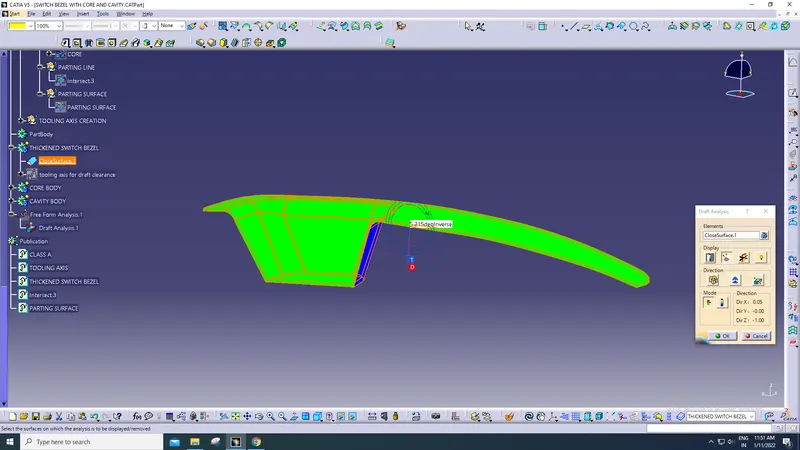
- Screenshots of the Draft analysis report switch bezel plastic component
- Screenshots of the core and cavity blocks in various orientations (Isometric, Front, Side, and Top View)
front view
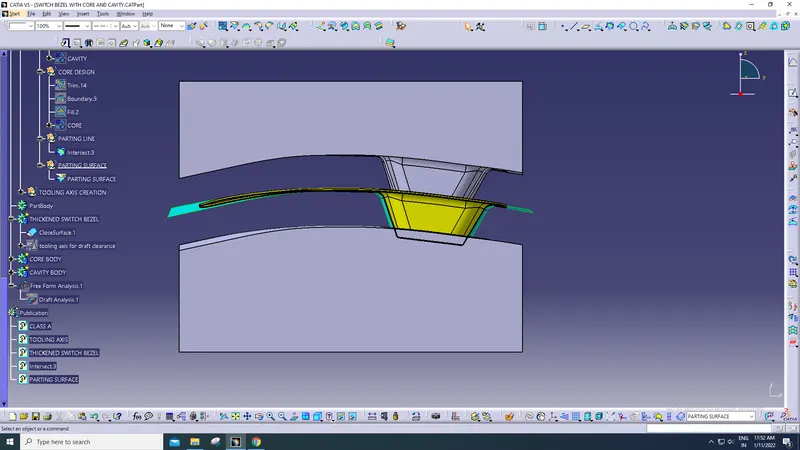
side view
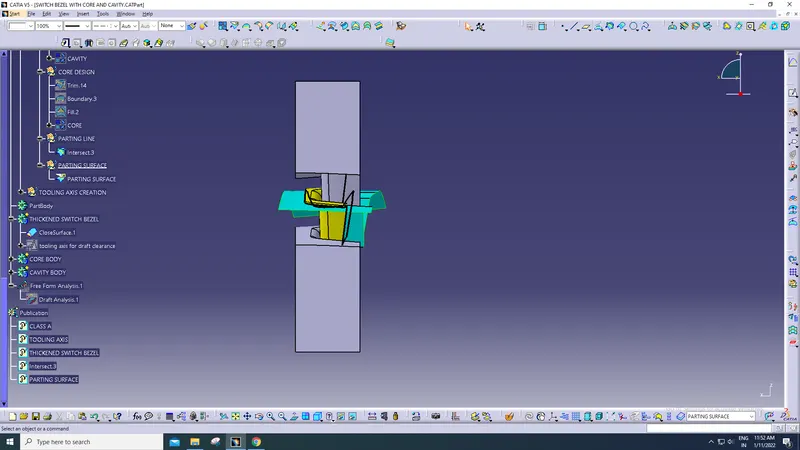
top view
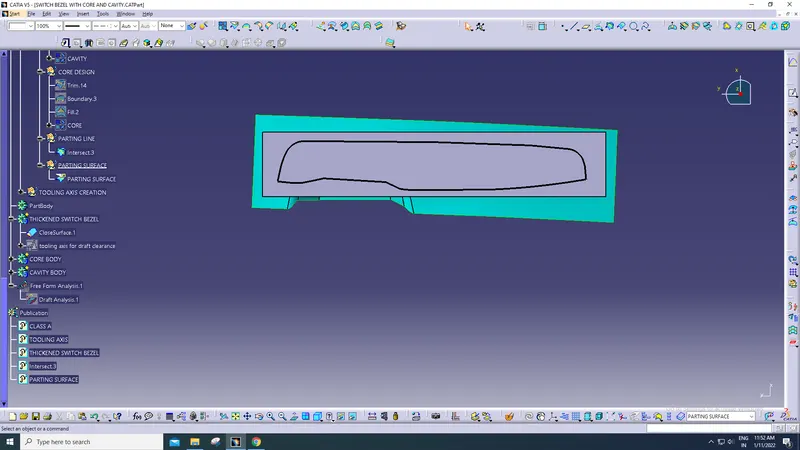
isometric view
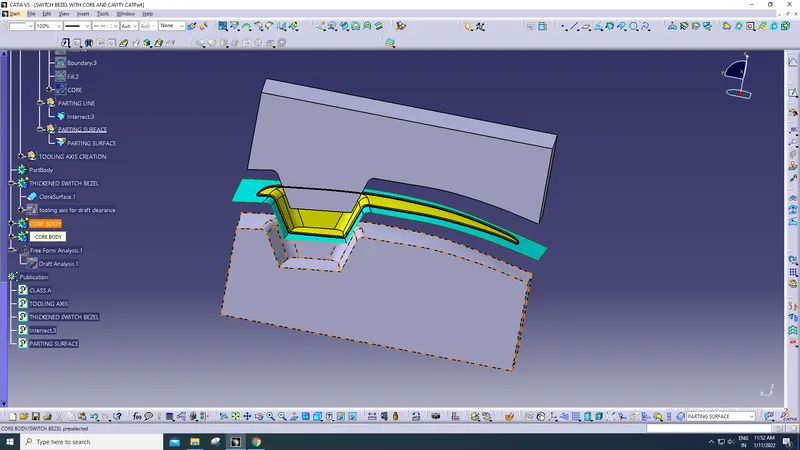
PARTING LINE
parting line is the line in which the core and cavity meets , simply it is the line of separation on the plastic part where the two halves of the plastic injection mold meet. The line actually indicates the parting 'plane' that passes through the part.
PARTING SURFACE
OBJECTIVE
to make a detailed report on explaining the tooling axis creation for switch bezel
tooling axis is the direction in which the core and cavity moves to make a moulded component
every component which are going to be created must initally have a defined tooling axis , so that the component will get physically abled to be produced
procedure
initially the class A surface given as an input must be analysed in such a way that all the components in that part are properly joined and given to us as a single part and create a boundary for the class A surface , here the class a surface for switch bezel is given
to create a tooling axis , first the tooling axis of the paticular part must me predefined , the predefenition of the tooling axis involves some factors , such as , there must' nt be any holes or slots in that face and it has a completed surface perpendicular to that axis
first we create a dummy tooling axis in z direction for this switch bezel , which will give us an ease for identification of tool clearance on the other respective axises
then the analysis of the tool clearance on the x direction is made , for that we must have an axis system to do that
in that axis system , take zx plane , then make an intersection on that class a surface , from that intersection , create lines on the tapered sides of the intersectioned sketch , then from that lines created , create a bisecting line form them , which will result as the same dummy tooling axis we created , which says that the tool clearance on the x axis is perfect , if it really does .
the same procedure is done for the tool clearance in y direction , but the plane selection on the axis system will be on the yz plane
then a bisecting line between the lines of tool clearance in x and y direction is made , which will give as the tooling actual toolin axis for the switch bezel
then make a publication for the switch bezel and the tooling axis seperately , as mentioned
objective
to make a detailed report on explaining the draft analysis for switch bezel
note : the actual draft for the every automotive plastic component designed must be 3 and above degrees
procedure
for making the draft analysis , insert the featuerd draft analysis tool , then place the compass in the created tooling axis to define the new current draft direction , then lock the draft direction by lock tool , then use the analysis under running point tool to measure the draft in the paticular position by moving the cursor along the coin holder , and set the angle in the colour scale varient as 3 degress . if the colour of the switch bezel transforms into green colour , then the component is perfectely drafted to get manufactuered properly ,