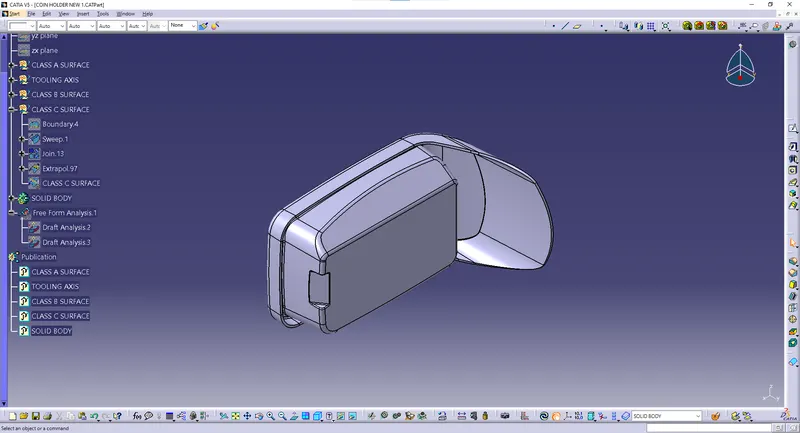
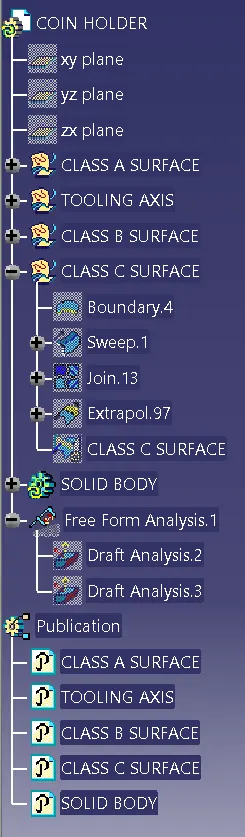
Week 8 - Challenge 3 - Coin Holder Design
TO DESIGN A COIN HOLDER BY USING CLASS A SURFACE
AIM:
- To design a coin holder Plastic component through the given Class-A surface by creating a tooling axis and draft analysis of the given surface.
Raw material used:
DESIGN PROCEDURE:
- To setup the class-A surface and to creating a tooling axis
- add draft angle
- To create a base surface of model
- To create a B-surface
- To create a C-surface
- To use close surface for creating a solid part model.
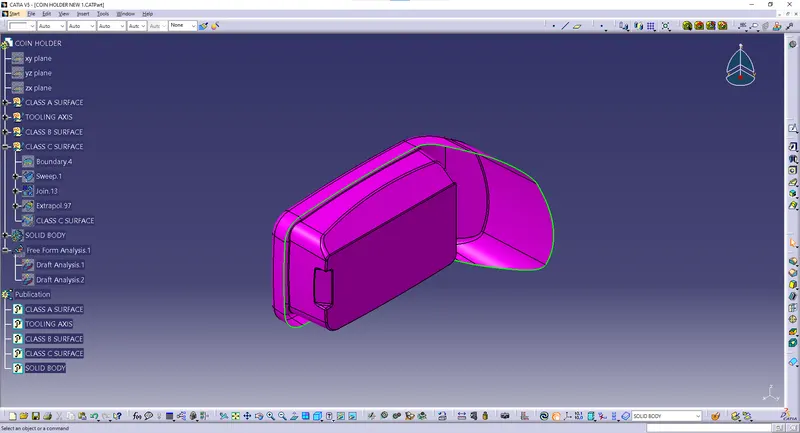
CLASS-A SURFACE:
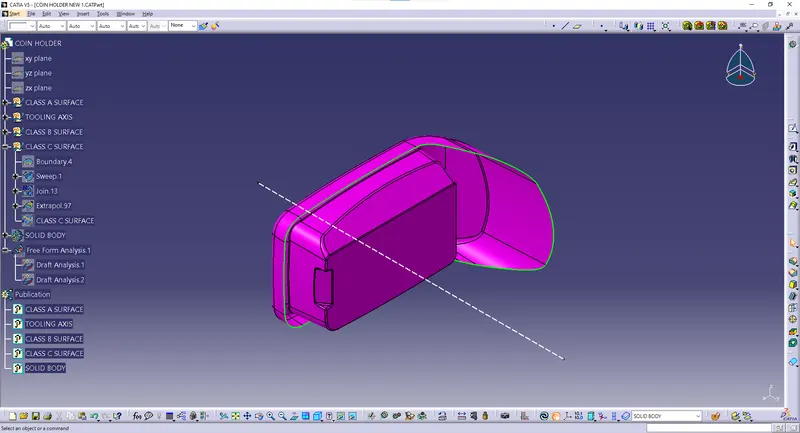
TOOLING AXIS:
- Tooling axis can be classified into two methods
- direct method
- For this model, to use a line at mid-point of the base of the coin holder
- Due to perpendicular walls of the class A surface
DRAFT ANALYSIS:
- The Drafting analysis was performed on the class-A surface by using the Feature Draft Analysis command.
- Using this command, the compass was set on the main tooling axis and the Draft angle was changed to 3 degrees.
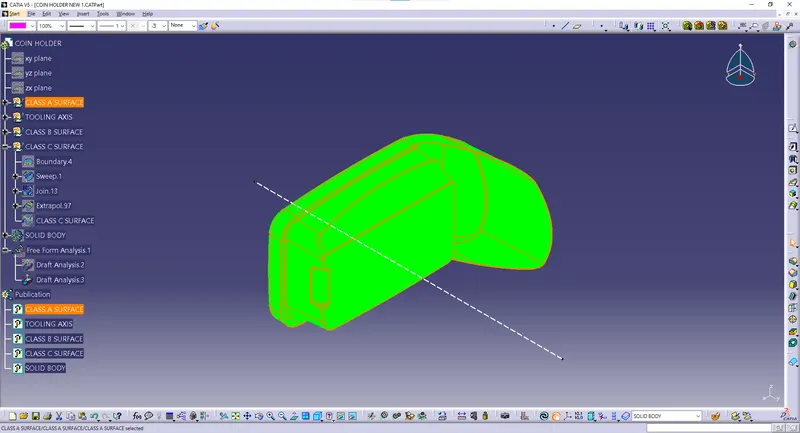
CLASS B SURFACE
Class-B surface means the thickness of a part it is not visible and is inside part. In other words, the Class-B surface is a surface below a certain thickness from the class-A surface. This is the surface that contains engineering aspects of a model.The Class B finish is a quality finish with only minimal imperfections. A Class B finish is the most common finish for exterior surfaces. It is normally specified on surfaces such as external covers, panels, and parts that are fairly prominent.
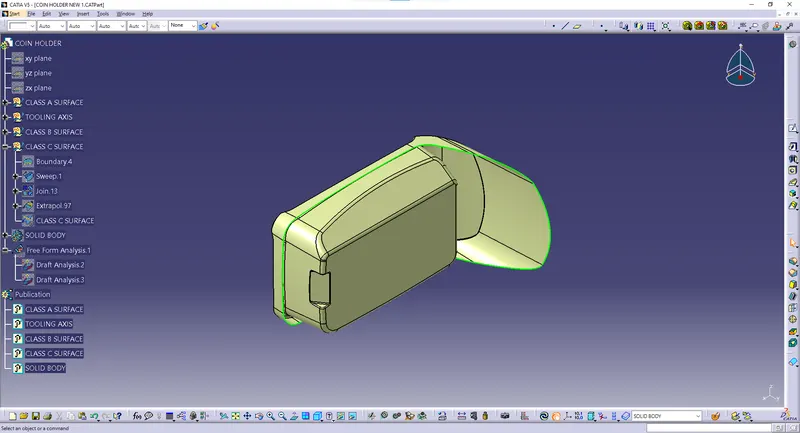
The surface that joins class-A and class-B surfaces are class-C surfaces. Class C is often specified for interior surfaces not readily visible, surfaces that will be covered by another part when assembledThe Class C finish allows more imperfections than Class A or B. Class C is often specified for interior surfaces not readily visible, surfaces that will be covered by another part when assembled, or surfaces which the Customer feels do not need to meet a high cosmetic finish.
DRAFT ANGLE
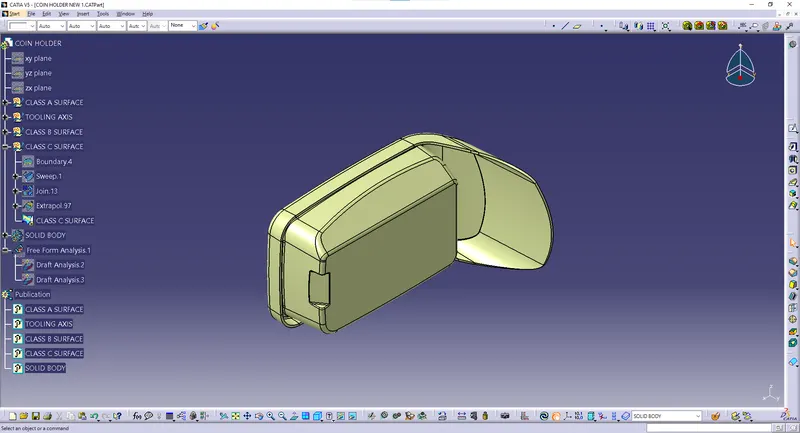
When developing parts for plastic injection molding, applying a draft (or a taper) to the faces of the part is critical to improving the moldability of your part. Without it, parts run the risk of poor cosmetic finishes and may bend, break, or warp due to molding stresses caused by plastic cooling. Equally important, an absence of draft may prevent parts from ejecting from the mold, damaging not only the parts but possibly the mold itself—a costly and time-consuming detour.
PART BODY
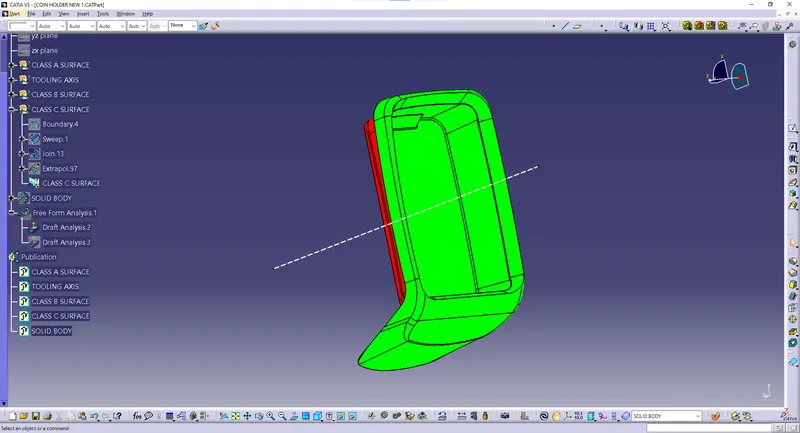
Close Surface feature usedto make a solid body from the surface