Week 7 State of charge estimation
1.Simulate the 3 test cases from harness dashboard and write a detailed report on the results
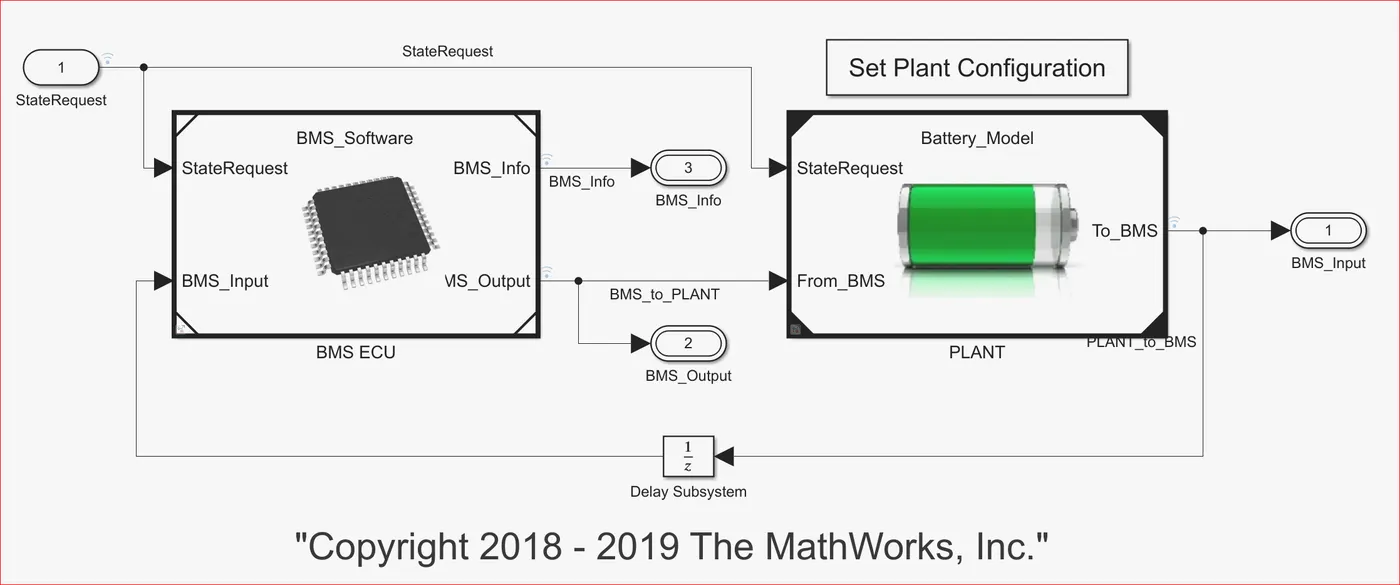
BMS ECU BLOCK:
PLANT BLOCK:
Test Case 1:
OUTPUT : Test case 1
Cell Voltages (Top Left):
Displays the voltage of individual cells over time. The graph shows some transient behavior initially and then stabilizes.
Cell Temperatures (Top Center):
Shows temperature profiles of the cells. A gradual increase is seen, indicating heating during charging or discharging.
State of Charge (SOC) (Top Right):
SOC percentage of the battery pack over time. The curve indicates charge depletion or replenishment.
Pack Current (Bottom Left):
Represents the current flowing through the battery pack. Spikes and steady-state behavior reflect charging and discharging.
BMS State (Bottom Center):
Indicates system modes such as:
Standby: Initial inactive state.
Charging: When the battery is being charged.
Driving: During discharge or use in driving mode.
Balancing Command (BalCmd) (Bottom Right):
Shows the balancing command over time, likely to ensure cells are balanced during operation.
Test Case 2 :
OUTPUT :Test case 2:
Test Case 3:
OUTPUT : Test case 3
----------------------------------------------------------------------------------------------------------------------------------------------------------------------------------------
2.What is coulomb counting? Refer to the above model and explain how BMS implements coulomb counting for SOC estimation ?
Coulomb counting is a method used to estimate the State of Charge (SOC) of a battery by tracking the flow of charge in and out of the battery over time. The basic idea is to measure the current (in amperes) flowing through the battery and integrate this current over time to calculate the total charge added or removed from the battery. The charge is typically expressed in ampere-hours (Ah) or milliampere-hours (mAh)..
In a Battery Management System (BMS), coulomb counting is implemented by continuously measuring the current flowing through the battery during charging and discharging cycles. The BMS keeps track of the charge transferred to and from the battery using a high-precision current sensor. As current flows in (during charging), the SOC increases, while it decreases when current flows out (during discharging). The BMS also requires an initial SOC as a starting point for this calculation.
To ensure accuracy, the BMS must compensate for factors such as battery efficiency and temperature changes, which can affect the charging and discharging processes. Over time, coulomb counting can accumulate small errors due to these factors, which is why it is typically combined with other estimation techniques like voltage-based or model-based methods for more accurate and reliable SOC estimation.
------------------------------------------------------------------------------------------------------------------------------------------------------------------------------------------------------------------------------