Week 7 State of charge estimation
1.Simulate the 3 test cases from harness dashboard and write a detailed report on the results
To open the Lithium Ion Battery Management algorithm firstly we have to download the zip file from the link given in the task and the link has also been attached below for refrence.
The zip file is download from the link .
The zip file is extracted and saved .
open the simulink and click OPEN and select the battery systeam file .
open the plant and select the files .
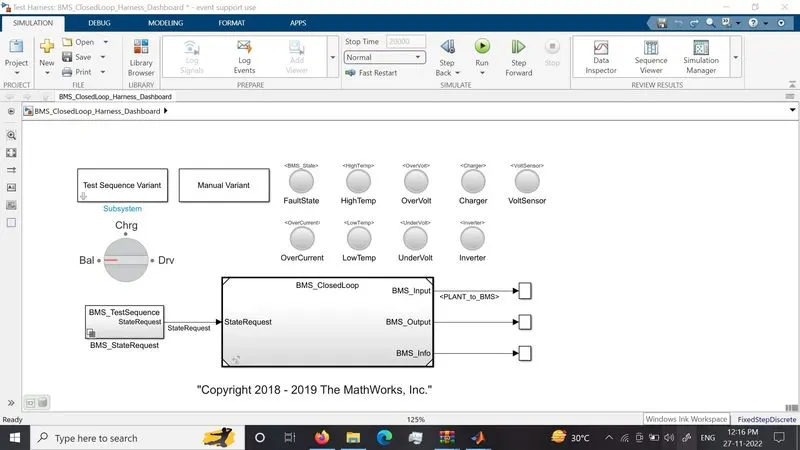
BMS_ClosedLoop_Harness_Dashboard model;
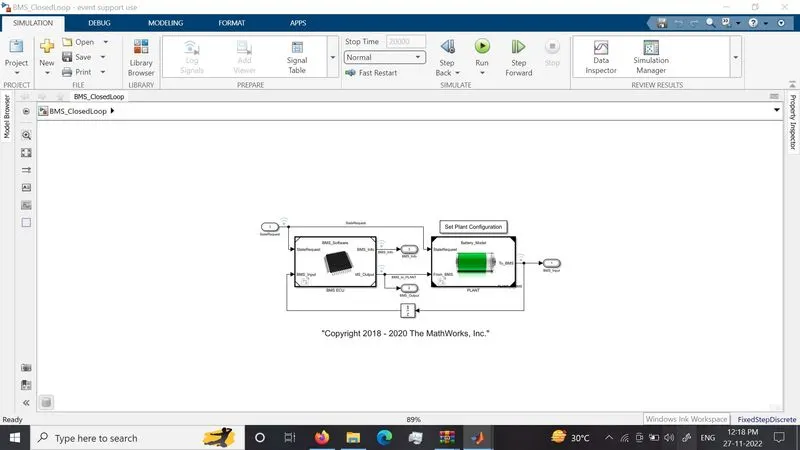
BMS ECU and Plant;
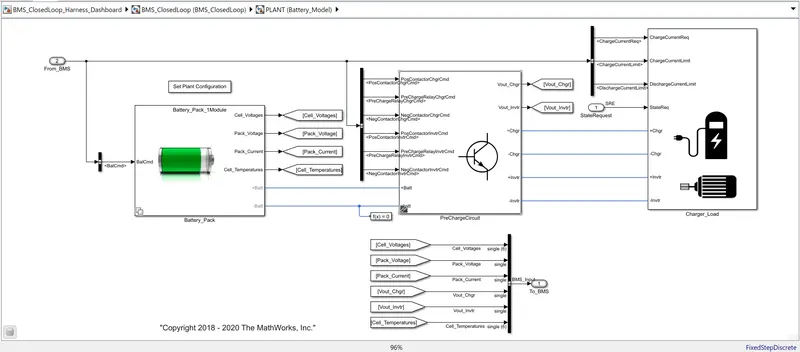
Here we have selected 1 module for simple calaulation and less simulation time.
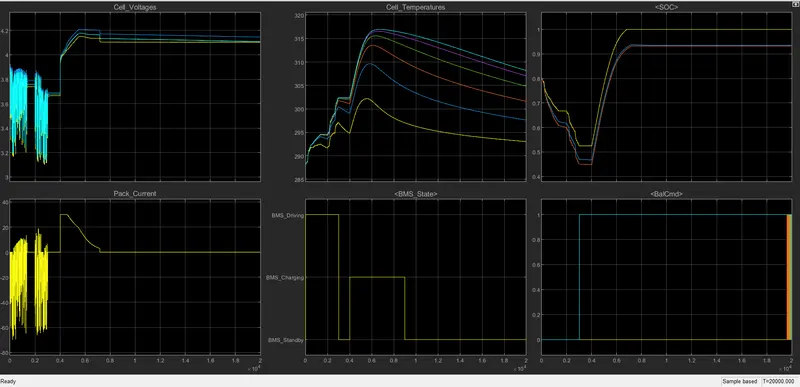
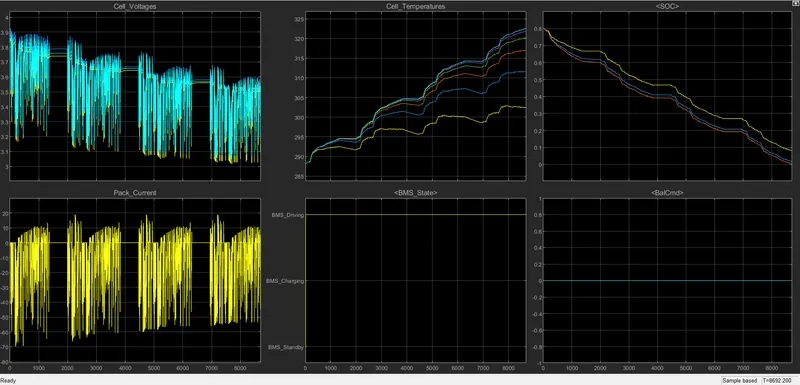
 In the scope SOC of module, Cell voltages, Pack Current, Cell Temperature, BMS state and cell balancing command are seen as output.
a) Test Case 1:-
changeing the Test sequence (BMS_ClosedLoop_Harness_Dashboard model) to 1 and run the simulation .
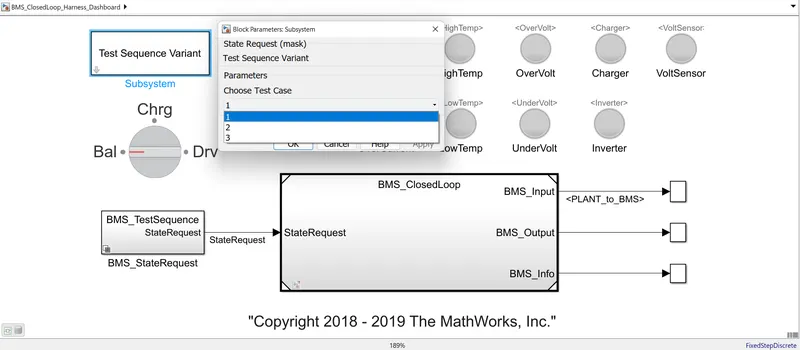
Results of Test Sequence 1:-
Simulation is ran for 20000 sec and the result are as below:-
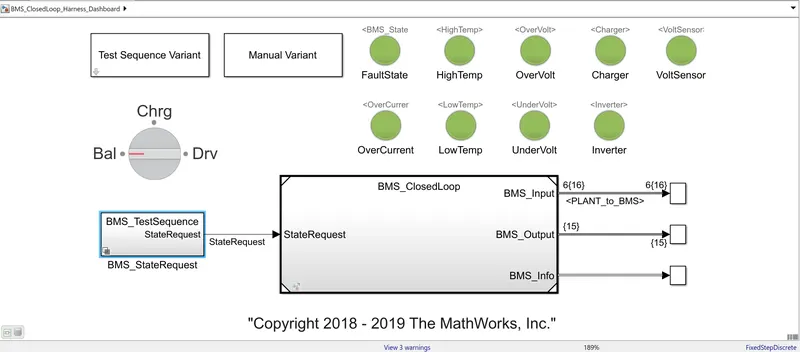
The Lamp indication were green for all states which means the model is fault free.
b) Test case -2:-
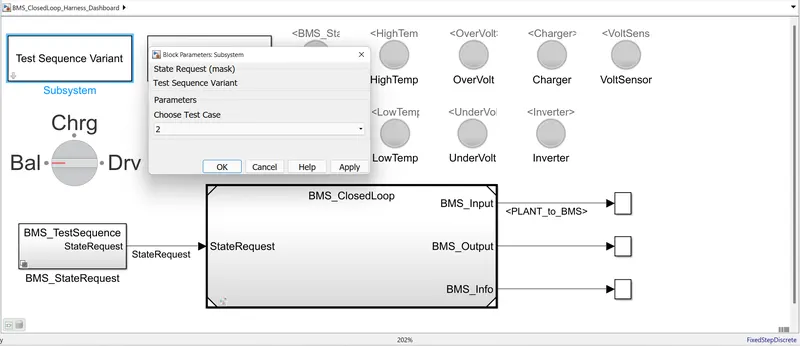
Results of Test Sequence 2:-
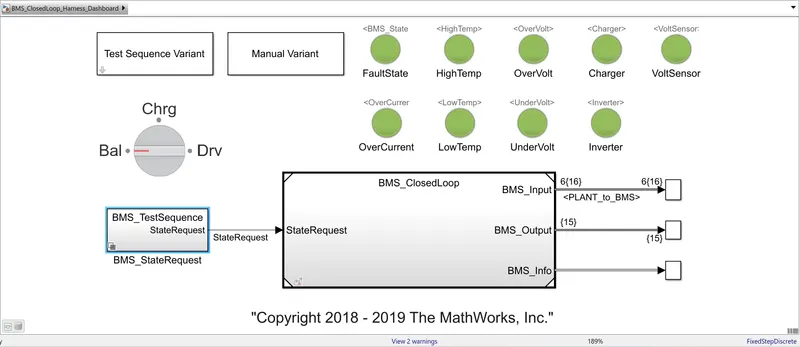
The Lamp indication were green for all states which means the model is fault free.
B. What is coulomb counting? Refer to the above model and explain how BMS implements coulomb counting for SOC estimation ?
The ‘coulomb counting’ or CoulCount method was developed by Schmitt et al.18 as a heuristic method, although the underlying theory is reasonably accessible.19 It depends on the recording of the current noise only. The signal is filtered with a high-pass filter with a cut-off frequency of 0.01 Hz. The filter may be either analogue (although the implementation of a good-quality 0.01 Hz analogue filter is difficult) or digital. The absolute value of the measured current samples is then summed over time. A steep slope is taken as an indication of rapid corrosion, although it is not possible to calibrate this in terms of an estimated corrosion rate.
Coulomb Counting Method:-
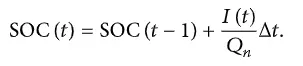
The Coulomb counting method measures the discharging current of a battery and integrates the discharging current over time in order to estimate SOC. Coulomb counting method is done to estimate the SOC(t) , which is estimated from the discharging current,I(t) , and previously estimated SOC values,SOC(t-1) .
SOC is calculated by the following equation:
But there are several factors that affect the accuracy of Coulomb counting method including temperature, battery history, discharge current, and cycle life
Modified Coulomb Counting Method
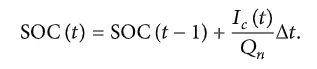
To improve the Coulomb counting method, a new technique called modified Coulomb counting method is proposed. The modified Coulomb counting method uses the corrected current to improve the accuracy of estimation. The corrected current is the function of discharging current. There is a quadratic relationship between the corrected current and discharging current of battery. By practice of experimental data, corrected current is calculated by the following form:

where k2 , k1 and k0 are constant values obtained from the practice experimental data.
In modified Coulomb counting method, SOC is calculated by the following equation:
SOC estimation in Battery model:-
To observe the coulomb counting method we need to open the BMS_ClosedLoop>BMS ECU and then on SOC_ Estimation block