Week 7 State of charge estimation
WEEK 7- State of Charge Estimation
1.Simulate the 3 test cases from harness dashboard and write a detailed report on the results
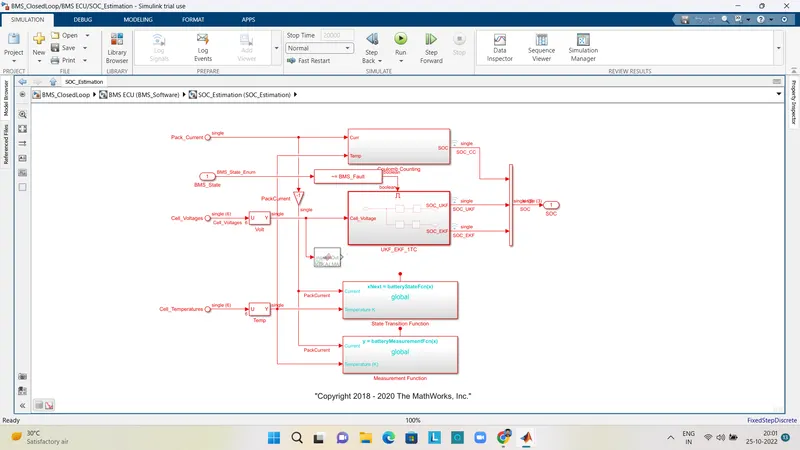
2.What is coulomb counting? Refer to the above model and explain how BMS implements coulomb counting for SOC estimation?
Ans:
BMS Closed Loop Harness Dashboard
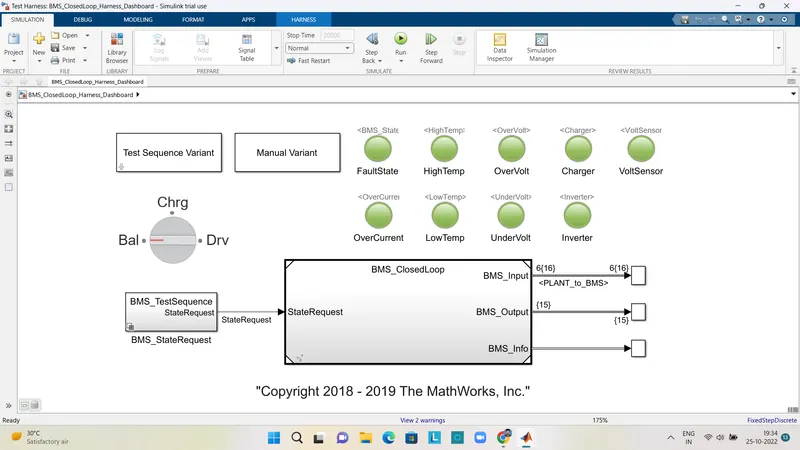
Here the icons shows whether there is any fault or not. Green shows it has no fault. But when there is any faults, it shows red colour. For simulating 3 test cases, the test sequence variant block is adjusted to 1, 2 and 3 for three test cases.
Test-1 Results
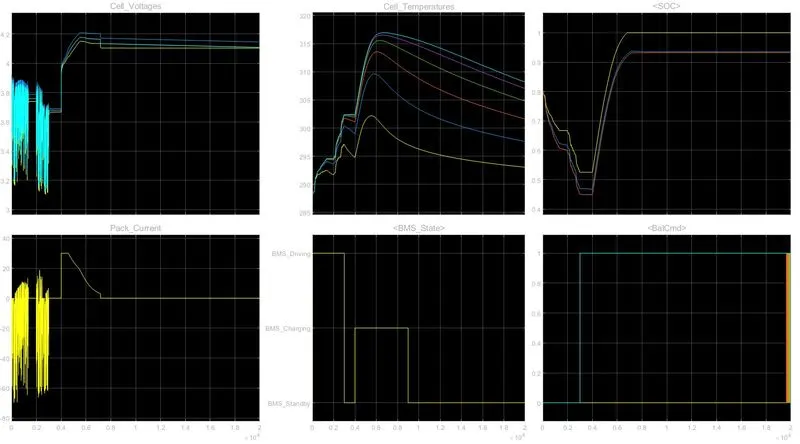
i) Driving (Discharging) mode (0-3000 sec):- All the cells for the first 3000 sec are in driving mode, so here the discharge of all the cell takesplace and its varies in the range of 3.1 to 3.9 V. The cell temprature increases from 288K to 302 K and the SOC also reduces from 80 % to 45%.
ii) Balancing mode (3000-4000 sec) :- After 3000sec for 1000 sec, cell balancing occur and the modules are in standby mode and they are having constant voltage near about 3.7V. The cell temperature reduces slowly and the SOC is also constant during this period (45%).
iii) Charging and Balancing (4000- 9000 sec):- After 4000 sec the charging occurs and the cell voltage increased from 3.7 to 4.2 V, with current of 30A and then the current reduces from 30A to 2.6 . The cell temperature also start to increase exponentially upto constant current region and reduces as current flow reduces in constant voltage mode. The SOC also increases from 45% to 94%.
iv) Post charge Balancing (9000- 20000sec):- After 9000 sec the post cell balancing starts under standby mode. The cell temperature reduces in this mode and tries to reach the ambient temperature. And the SOC remains constant to 94%.
Test-2 Results
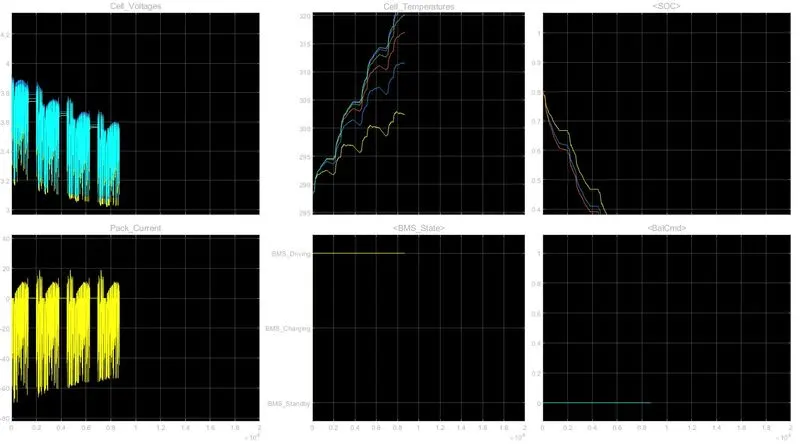
i) Driving Mode (0-10000 sec):- The cell voltage varies from 3.9 V to 3.05 volt, which is the cut off voltage of cell and the entire cell is drained upto 8692 sec. The cell temperatures varies from 288K to 322.5K. SOC reduces from 80% to 0%.
ii) Charging Mode (10000- 20000 sec): The cell got drained earlier before reaching this mode.
Test-3 Results
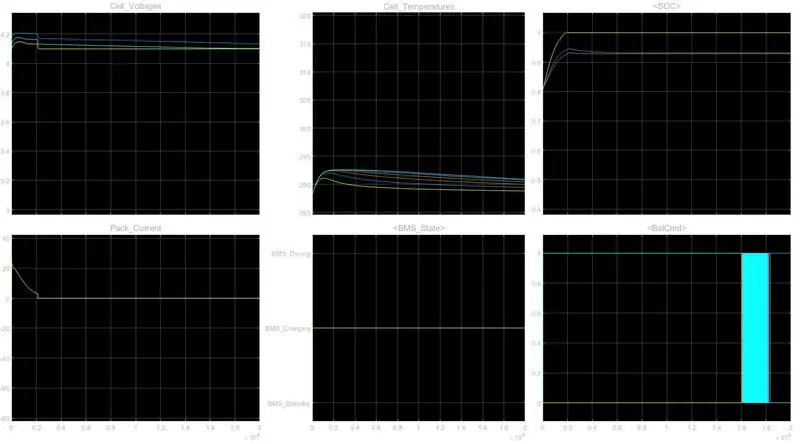
i) Charging (0-20000 sec):- Cell Voltages increases from there intial values and after 2000 sec they got constant. The pack current initally start from 0 to 30A and then start decreasing. SOC was initally 80% and in 2000 sec it got fully charged that is 100%. The cell temperature starts to incraeses initally and when battery got fully charged then decrease down to the ambient temperature.
Coulomb Counting
The Coulomb counting method measures the discharging current of a battery and integrates the discharging current over time in order to estimate SOC. Coulomb counting method is done to estimate the , which is estimated from the discharging current and previously estimated SOC values,SOC is calculated by the following equation:
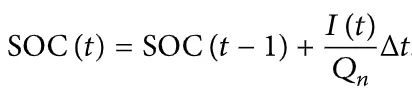
But there are several factors that affect the accuracy of Coulomb counting method including temperature, battery history, discharge current, and cycle life.
Modified Coulomb Counting
To improve the Coulomb counting method, a new technique called modified Coulomb counting method is proposed. The modified Coulomb counting method uses the corrected current to improve the accuracy of estimation.
The corrected current is the function of discharging current. There is a quadratic relationship between the corrected current and discharging current of battery. By practice of experimental data, corrected current is calculated by the following form:

where, K1, K2, K0 and are constant values obtained from the practice experimental data.
In modified Coulomb counting method, SOC is calculated by the following equation:
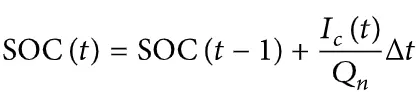
The experimental results show that the accuracy of the modified Coulomb counting method is superior to the conventional Coulomb counting method.
BMS Coulomb Counting for SOC Estimation
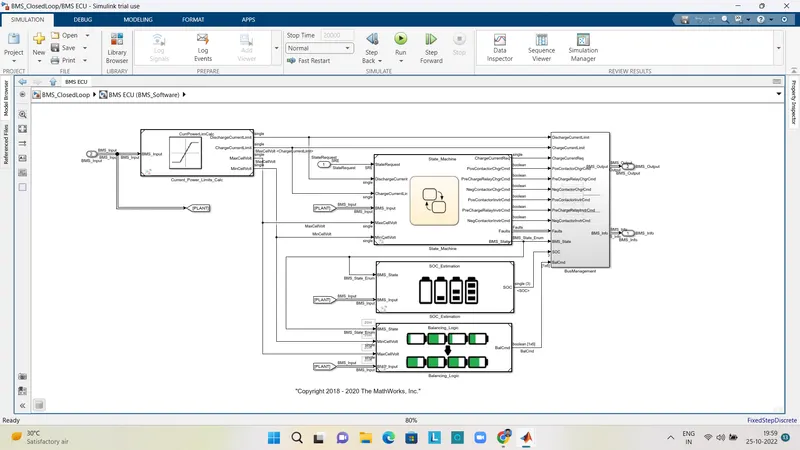
Here the are three method for calculation of SOC estimation are:-
- Coulomb counting
- Unscented Kalman filter
- Extended laman filter.