Week 7 State of charge estimation
Simulate the 3 test cases:
CASE 1:
From TEST SEQUENCE VARIANT block 1st case is seclected and model is run.
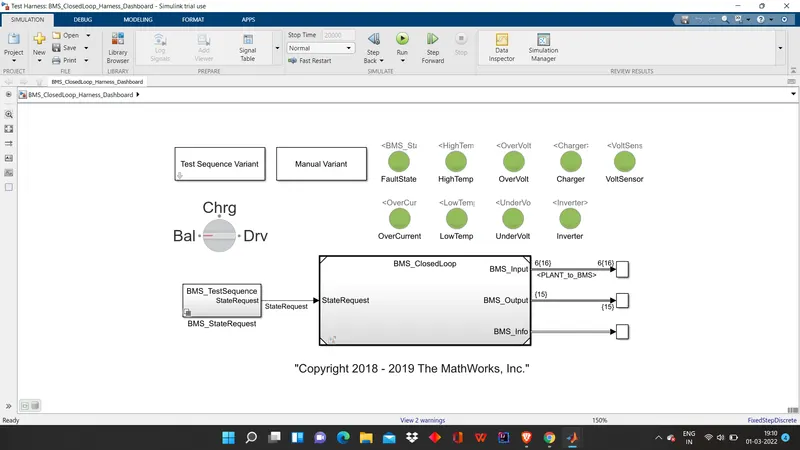
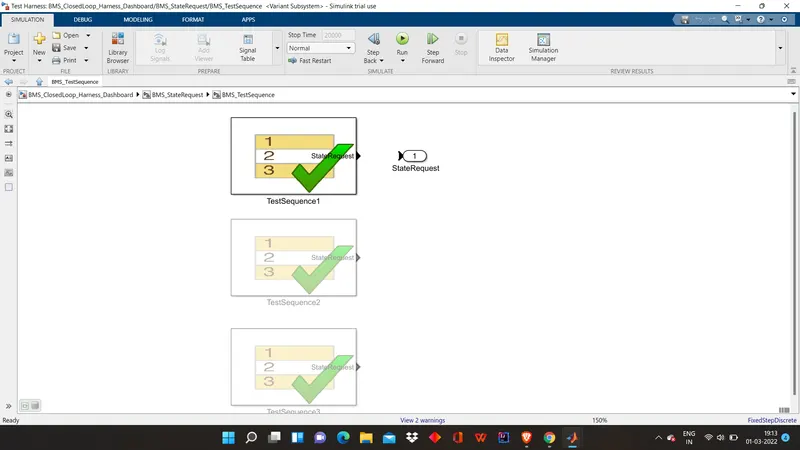
when case 1 is seclected the folowing test sequence is seclected From BMS STATE REQUEST block:
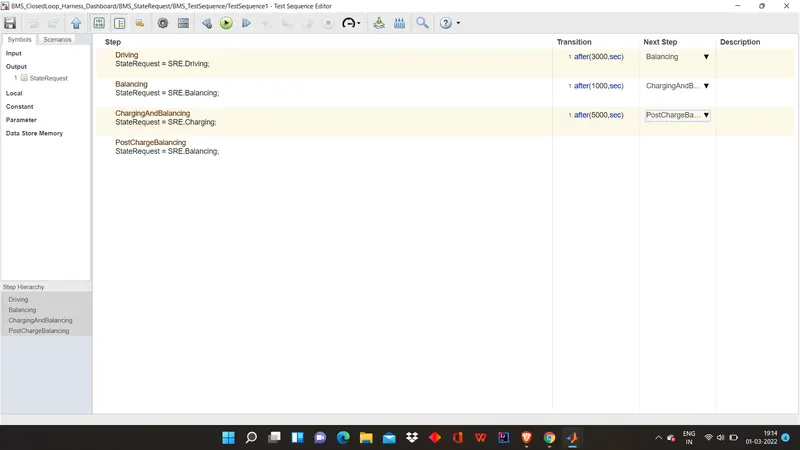
lets understand what this case actually is
the following image says about the same
1]For 1st 3000 sec driving meaning battery power will be consumed.
2]After Driving for next 1000 sec system studies the voltages of all cell and cell balancing is done.
3] After 1000 sec charging occur with balancing for 5000sec.
4] After cell balacing and charging when system indicates charging is done,BMS checks whether now all cells are at same state i.e voltage.
5]Post charging occurs till end of simulation.
PLOTS:
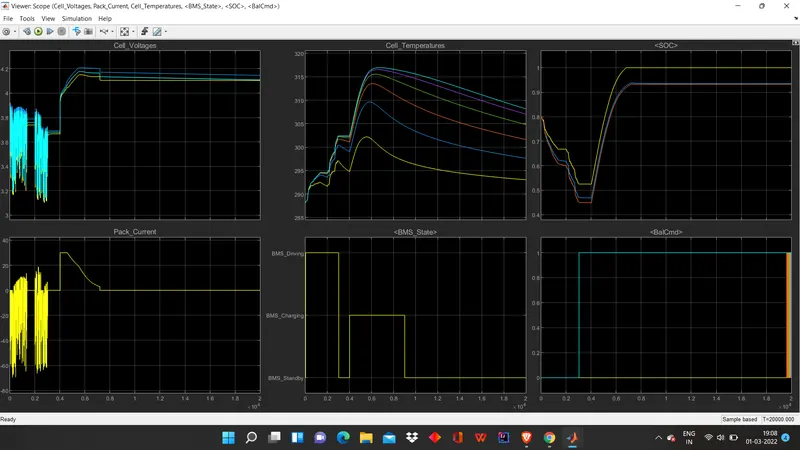
(A) VOLTAGE & CURRENT :
1] As we can see for 3000sec there is power application hence downward fluctuations in voltage and current is seen .
2]Graph line gets stable for 1000 sec this means system is studing the voltages of all cell and cell balancing is done.
3]Once the cells are balanced Charging of cell starts resulting in rise in volatge and current.
4]In our case cell2 gets charged quickly and reaches the volatge 4.2V and hence stops the charging, during this drop in current is seen as cells are about to charge .
5]Now as not all cells have reached the same voltages postCHARGE BALCING occurs by PASSIVE cell balancing and hence brings down all the cell voltages to the voltage of weakest cell in our case cell1 having voltage 4.1V, during this process current is constant at -5A
(B) TEMPERATURE:
1]As the power applications are on for 3000sec meaning CURRENT AND VOLATGE is extracted from battery this leads to heating up of cells .
2]Highest rise is seen in case of cell6 about 317k this maybe because it is at poorest ventilation point.
3]During cell balancing the temp is contstant.
4]Now as VOLTAGE and CURRENT enter the battery leads to rise in temp .
5]Once all cells are charged again balaicng occurs and hence this leads to drop down in temp.
(C)SOC :
1]Downward nature for 3000sec indicates that power from battery is extracted .
2]SOC is const for 1000sec as balancing occurs.
3]4000sec to 7000sec the SOC increases as charging occurs at that point
4] After this SOC is steady as all cells are charged , as for all cells expect cell1 voltages increases rapidly this leads them from getting 100% charged as cell with minimun resisitance to current (VOLTAGE) reaches 100%(1) value early
(D)BMS state :
1] 0 - 3000sec drive mode .
2]3000 - 4000 sec standby mode as cell balancing occurs .
3]4000- 9000sec charging occurs .
4]9000+ sec post cell balancing so in standbymode
(E)CELL balancing :
1]0-3000sec discharge occurs so no balncing occurs.
2]3000+ sec balancing , charging and post balancing ocuurs .
3]As we know cell1 is weakest and the rules the battery pack ,others cells are forced to match its state of VOLTAGE hence except cell1 every other cell plots changes to get blance condition.
CASE 2:
From TEST SEQUENCE VARIANT block 2nd case is seclected and model is run.
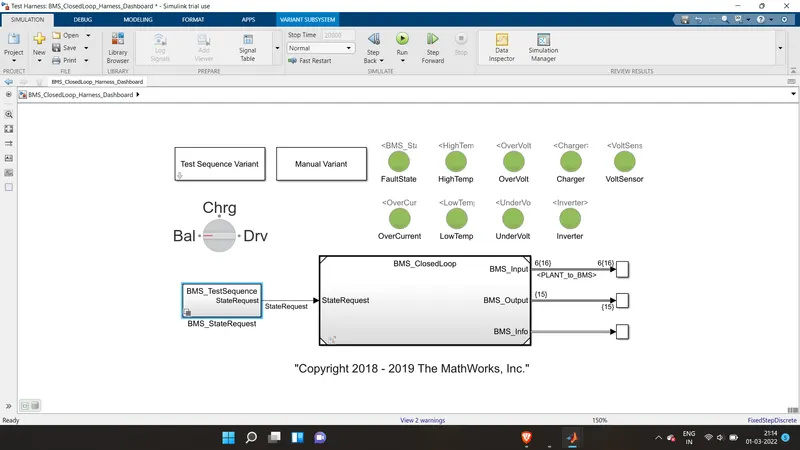
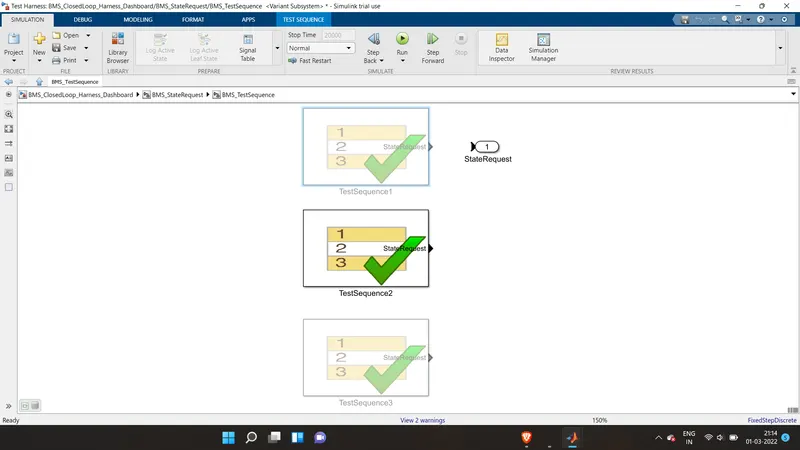
when case 2 is seclected the folowing test sequence is seclected From BMS STATE REQUEST block:
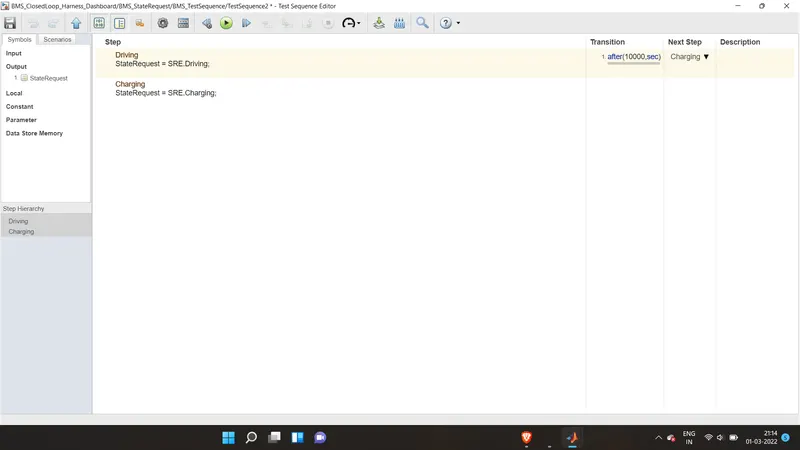
lets understand what this case actually is
the following image says about the same
1]It says drive mode till the 10000sec.
PLOTS:
(A) VOLTAGE & CURRENT :
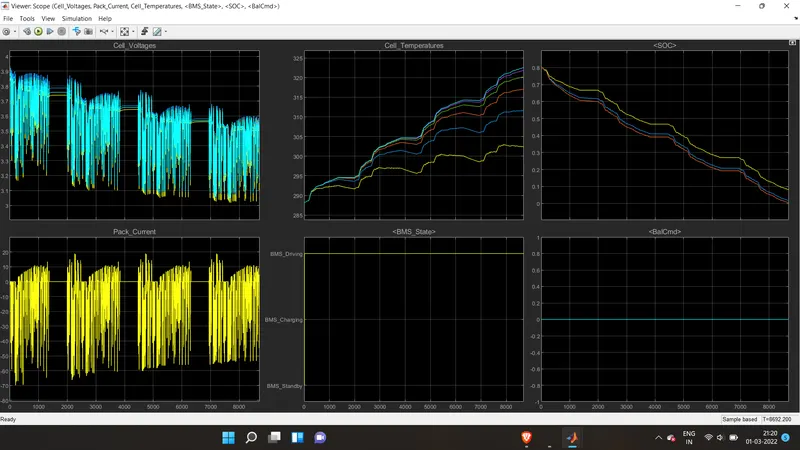
1] As we can see for 9000sec there is power application hence downward fluctuations in voltage and current is seen.
2]Flat lines are because vehicle may be at standby conditions.
(B)TEMPERATURE:
1]As vehicle is constantly at drive mode ,power is aslo continiously drawn from battery hence leads to rise in temp and reaches 322k max , which is under max temp limt so no red indicators are visible.
(C)SOC:
1]As vehicle is in drive mode throughout power is continiously and SOC goes on decreasing from 80% and reaches 0% at about 9000sec.
2]as standby modes are for very less seconds no charging occurs.
(D)BMS & CELL BALANCING:
1] As vechile is only in drive mode, no charging takes place hence no cell balancing occurs.
CASE 3:
From TEST SEQUENCE VARIANT block 3rd case is seclected and model is run.
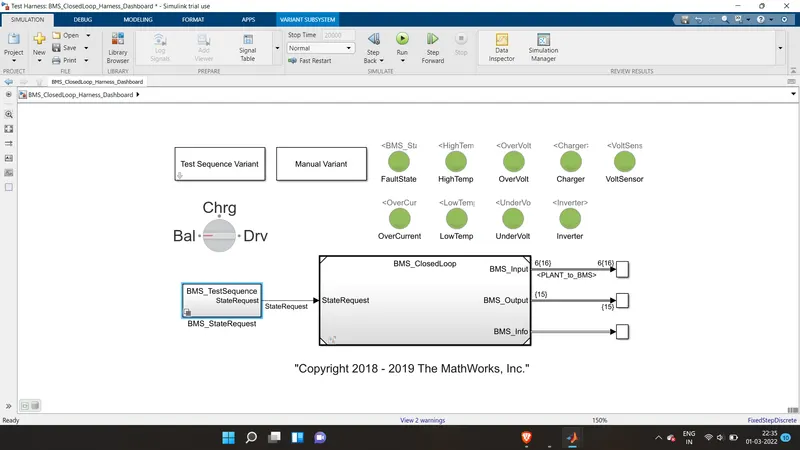
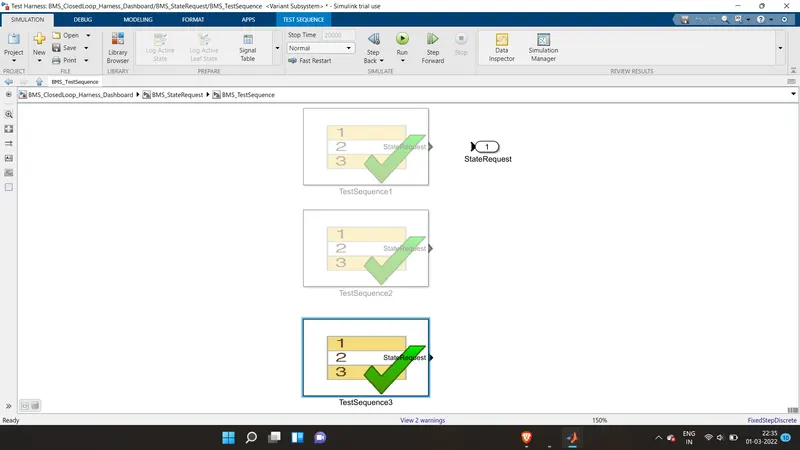
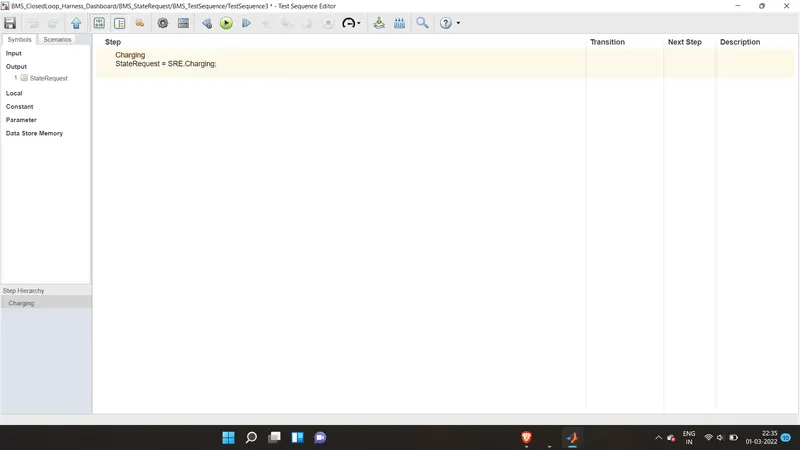
when case 3 is seclected the folowing test sequence is seclected From BMS STATE REQUEST block:
lets understand what this case actually is
the following image says about the same
1]It says charge mode till the 10000sec.
PLOTS:
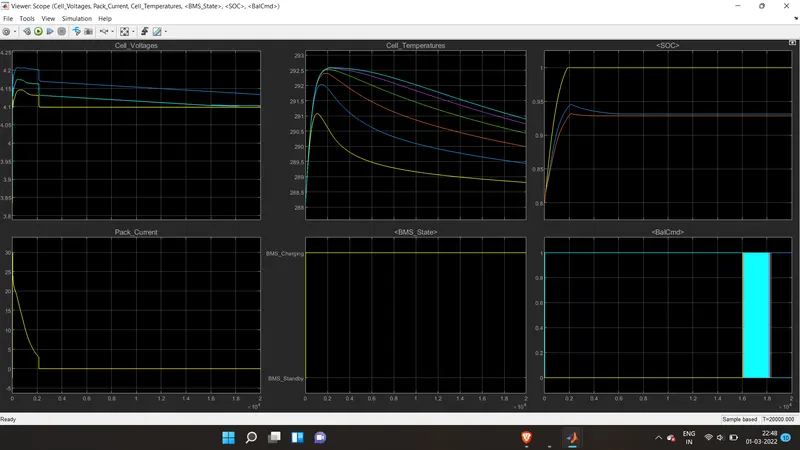
(A) VOLTAGE & CURRENT :
1]As system is under one single state that is charge mode no such noticable changes are seen in valtages and currents.
(B)TEMPERATURE:
1] As there is no such power application cells temperatures remain to their normal environmental temperature.
(C)SOC:
1] As system is in charge mode only SOC goes on increases to nearest value of 1.
(D)BMS & CELL BALANCING:
1]BMS is at only charge mode .
2]Cell balance occur as charging cells happen at different rates denpending on cell characteristics.
CONCLUSION:
1]Depending upon how the system is used or at which modes it is used the other derived parameters in system such as SOC, differ accordingly.
Coulumb counting:
It is used to calculate SOC .
SOC represents percentage of capacity that is available to use with refrence to total capacity (when all cells are at full charge )in terms of percentage .
100% SOC meaning battery/cell is fully charged and is at its 100% capacity and 0%SOC meaning cell/battery has no charge or 0 capacity in it .
The coulomb counting method measures the discharging current of the battery and integrates the discharging current over time in order to estimate SOC.
Which can be estimated from discharging current(l(t)).previously estimated SOC values(SOC(t-1)).The relation is given above.
IN OUR CASE :
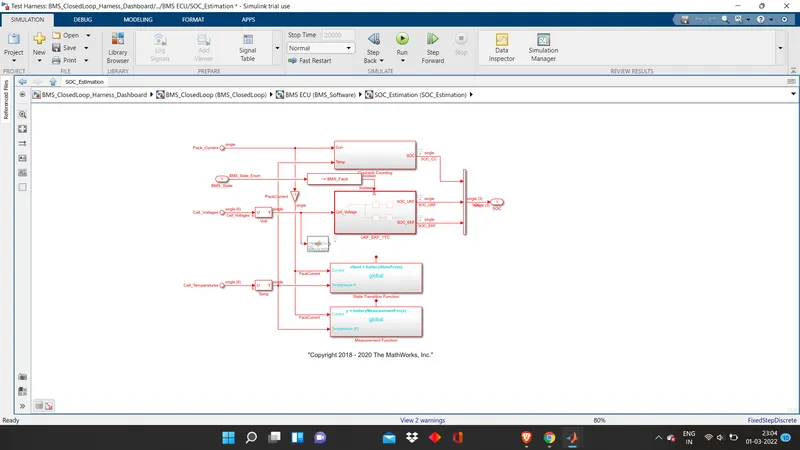
open coulumb counting block
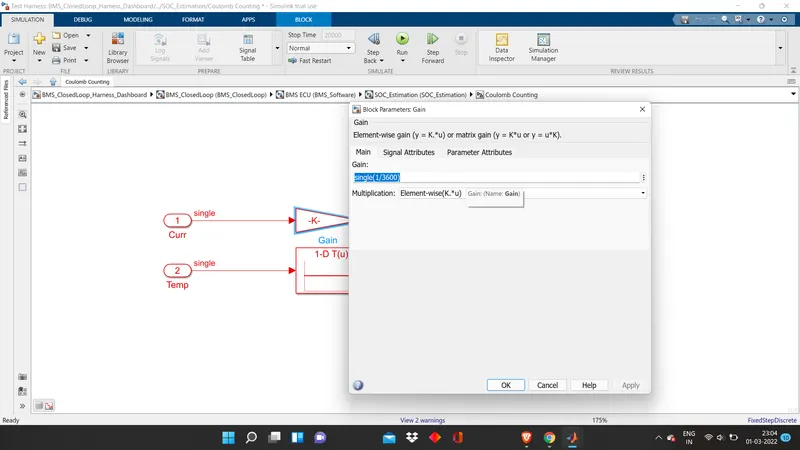
Here the discharge current from battery given to gain with value as 1/3600 to convert current to Ahr.
The value is divided by capacity due to temperature change. Then integrated with a gain value of 1 with sample time -1 as we are using discrete integrator.
The saturation limits are from 0 to 1.
We will get the SOC values from 0 to 1 multiplied with 100 to get in percentage of SOC