Week 7 State of charge estimation
1.What is coulomb counting?
Ans:
Definition and Classification of SOC Estimation
The SOC is one of the most important parameters for batteries, but its definition presents many different issues [5]. In general, the SOC of a battery is defined as the ratio of its current capacity () to the nominal capacity (). The nominal capacity is given by the manufacturer and represents the maximum amount of charge that can be stored in the battery. The SOC can be defined as follows:
The various mathematical methods of estimation are classified according to methodology. The classification of these SOC estimation methods is different in the various literatures. However, some literatures [5, 7] allow a division into the following four categories.
(i)Direct measurement: this method uses physical battery properties, such as the voltage and impedance of the battery.
(ii)Book-keeping estimation: this method uses discharging current as the input and integrates the discharging current over time to calculate the SOC.
(iii)Adaptive systems: the adaptive systems are self-designing and can automatically adjust the SOC for different discharging conditions. Various new adaptive systems for SOC estimation have been developed.
(iv)Hybrid methods: the hybrid models benefit from the advantages of each SOC estimation method and allow a globally optimal estimation performance. The literature shows that the hybrid methods generally produce good estimation of SOC, compared to individual methods.
Coulomb Counting Method:
The Coulomb counting method measures the discharging current of a battery and integrates the discharging current over time in order to estimate SOC . Coulomb counting method is done to estimate the SOC(t) , which is estimated from the discharging current,I(t) , and previously estimated SOC values,SOC(t-1) . SOC is calculated by the following equation:
`SOC(t)=SOC(t-1)+(I(t))/(Qn)*deltat`
But there are several factors that affect the accuracy of Coulomb counting method including temperature, battery history, discharge current, and cycle life.
Flow chart of Coulomb Counting Method:
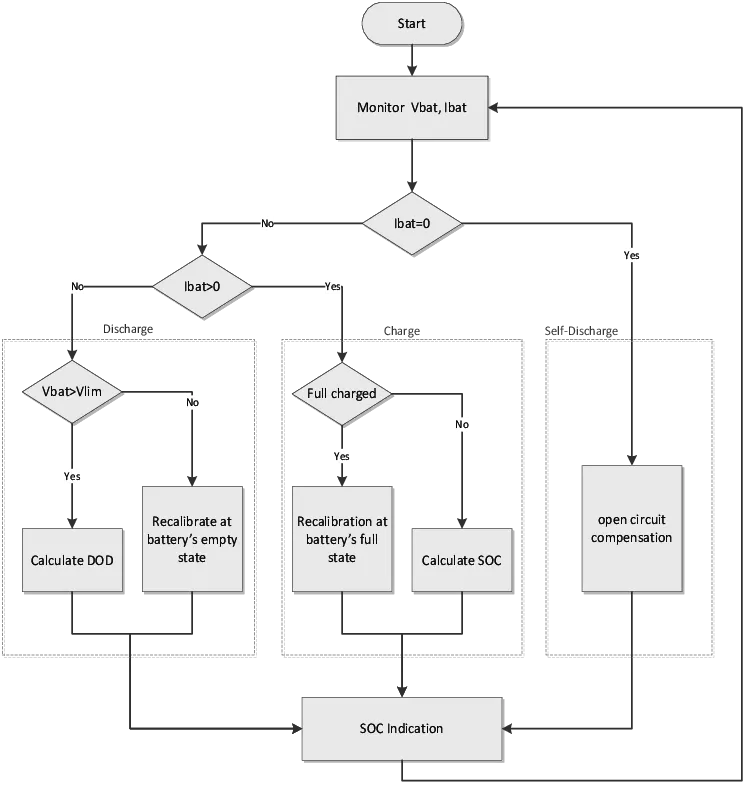
Modified coulomb Counting Method:
To improve the Coulomb counting method, a new technique called modified Coulomb counting method is proposed. The modified Coulomb counting method uses the corrected current to improve the accuracy of estimation.
The corrected current is the function of discharging current. There is a quadratic relationship between the corrected current and discharging current of battery. By practice of experimental data, corrected current is calculated by the following form:
`Ic(t)=k2I(t^2)+k1I(t)+k0`
where ,k2,k1,k0 are constant values obtained from the practice experimental data.
In modified Coulomb counting method, SOC is calculated by the following equation:
`SOC(t)=SOC(t-1)+(Ic(t))/(Qn)*deltat`
The experimental results show that the accuracy of the modified Coulomb counting method is superior to the conventional Coulomb counting method.
Kalman filter:
Using real-time measurement road data to estimate the SOC of battery would normally be difficult or expensive to measure. In , application of the Kalman filter method is shown to provide verifiable estimations of SOC for the battery via the real-time state estimation.
Yatsui and Bai presented a Kalman filter based SOC estimation method for lithium-ion batteries. Experimental results validate the effectiveness of Kalman filter during the online application. Barbarisi et al. presented an extended Kalman filter (EKF) to estimate the concentrations of the main chemical species which are averaged on the thickness of the active material in order to obtain the SOC of the battery, by using the terminal current and voltage measurements.
Based on unscented Kalman filter (UKF) theory and a comprehensive battery model, a novel SOC estimation method is proposed in . The results show that UKF method is superior to extended Kalman filter method in SOC estimation for battery. Sun et al. presented an adaptive UKF method to estimate SOC of a lithium-ion battery for battery electric vehicles. The adaptive adjustment of the noise covariance in the SOC estimation process is implemented by an idea of covariance matching in the UKF context.
Coulomb counting and Emf combination:
A new SOC estimation method that combines direct measurement method with the battery EMF measurement during the equilibrium state and book-keeping estimation with Coulomb counting method during the discharge state has been developed and implemented in a real-time estimation system .
Any battery will lose capacity during cycling. In order to calculate SOC and remaining run-time (RRT) accurately and to improve the SOC estimation system capability to cope with the aging effect, a simple Qmax adaptation algorithm is introduced. In this algorithm the stable conditions of the charge state are exploited in order to adapt Qmax with the aging effect.
This paper has proved that the Qmax adaptation algorithm can improve the SOC and RRT estimation accuracy even for a fresh battery. Since a battery loses capacity during cycling, it is concluded that the Qmax adaptation algorithm will increase substantially the SOC and the RRT estimation accuracy.
Coulomb counting and Kalman filter combination:
Wang et al. proposed a new SOC estimation method, denoted as “KalmanAh method,” which uses the Kalman filter method to correct for the initial value used in the Coulomb counting method. In KalmanAh method, the Kalman filter method is used to make the approximate initial value converge to its real value. Then the Coulomb counting method is applied to estimate the SOC for the long working time. The SOC estimation error is 2.5% when compared with the real SOC obtained from a discharge test. This compares favorably with an estimation error of 11.4% when using Coulomb counting method.
2.How BMS implements coulomb counting for SOC estimation?
ANS:
Introduction
Once considered dated technology, non-rechargeable (or “primary”) battery cells are experiencing a rebirth. Even though they are not rechargeable, these primary cells, such as the Li-SOCl2 (Lithium-Thionyl Chloride), can still provide advantages for the user, including high energy density, instant readiness, low self-discharge, reasonable lifetimes and environmental friendliness (relatively easily disposable). These cells are commonly
found in a variety of applications in which swapping out the batteries is impractical, costly, or where proximity/location/access is difficult. These include military, asset tracking, remote monitoring and wireless sensor networks. These batteries are routinely offered in a variety of chemistries with the 2 most popular being alkaline and Lithium (Li) based.
In comparison, rechargeable (or “secondary”) cells offer a different set of benefits (even if they have an initially higher cost), and come in a variety of chemistries such as leadacid, Nickel and Li-ion. Their advantages include reusability, economical to use (as the cost of a charging system can be spread out over many usage cycles), and good power density (the ability to deliver energy quickly). However, these cells are not considered environmentally friendly and have the potential disadvantage of low energy density (think of this as the amount of stored energy) depending on the system configuration. See Figure 1.
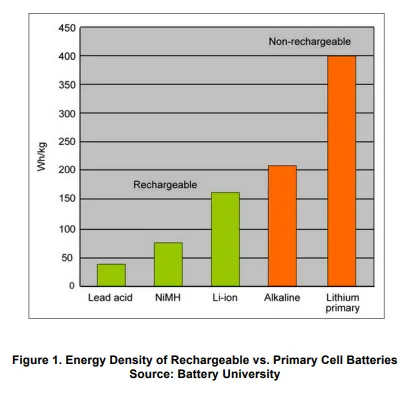
Remote location applications offer a set of conditions more conducive to primary cells - such as using a small load current over a long period of time - where replacing the battery is both costly and impractical.
Primary Cell Run Time Considerations:
Despite all of their advantages, primary cells have some characteristics which are not favorable in some applications – particularly those which cannot afford any down time due to a completely discharged battery. In these instances, ascertaining the remaining run time based on the battery’s state of charge (“SoC”) is of paramount importance. Some primary cells tend to have very flat discharge curves, such as those of the Lithium Thionyl Chloride cell, shown in Figure 2. This characteristic makes the remaining cell capacity very difficult to determine or predict.
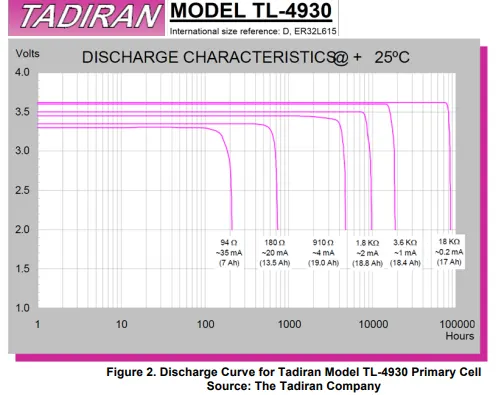
Ideally, a simple cell voltage measurement should be adequate to estimate a battery’s state of charge. However, a flat discharge curve means you can’t infer much of anything by measuring the battery voltage until the cell is about 99% dead. This common voltage measurement method for determining SoC works fine for many chemistries, but not for Lithium Thionyl Chloride or other batteries which have flat discharge curves. Another method for estimating the state of charge involves applying a load and measuring the voltage drop, then comparing the data to an equivalent series resistance
(ESR) drop lookup table which differs by battery type. A complicating factor in this method is that battery ESR tends to have a strong dependence on temperature. Therefore, in order to use this approach with even a remote sense of accuracy requires precise knowledge and measurement of battery temperature. Otherwise, changes in observed battery ESR due to changes in SoC will be indistinguishable from changes in ESR due to variations in temperature.
Another indirect way to “measure” SoC is to characterize the load conditions very well and then measure the total operating time for each battery. For example, many users replace all the batteries on a fixed time schedule which corresponds to 40% of SOC or some pre-determined level. But, this does not maximize battery run time. Also, if there is a board fault or some other condition that causes the load to be 2-3x higher than expected, then this “open loop” method falls apart as battery run time will decreasequickly. By contrast, another more accurate method is called “coulomb counting”, where the coulombs are measured as they outflow from the cell. Traditionally, the cost to implement this coulomb counting method has been expensive, so it has been seldom applied. However, it is very effective and provides the only accurate measurement of the Coulombs consumed from a battery. If the battery’s initial capacity is known and or specified, then the remaining capacity can be accurately determined based on the
Coulomb count.
Buck-Boost Converter with Coulomb Counter:
It is clear that a DC/DC converter solution that solves the primary cell system application requirements, as well as the associated issues already discussed, should have the following attributes:
1) A buck-boost DC/DC architecture with wide input voltage range to regulate Vout ,through a variety of battery-powered sources and their associated voltage ranges.
2) Ultra-low quiescent current, both in operating mode and shutdown, to increase battery run time.
3) The ability to efficiently power system rails.
4) Capably count coulombs accurately without significantly affecting IC quiescent current (battery consumption), to determine remaining battery state of charge.
5) Current limiting for attenuating inrush currents thus protecting the cells
6) Small, lightweight and low profile solution footprints
7) Advanced packaging for improved thermal performance and space efficiency.
Fortunately, a recent product introduction from Linear Technology, the nanopower LTC3335 buck-boost converter with integrated coulomb counter, has all of these
attributes already. The device was designed for primary battery applications that need really low quiescent current and also need to know something about remaining battery capacity. Or, where potential battery component or load leakage may be detected by the coulomb counter as a check for system faults. See Figure 3 below.
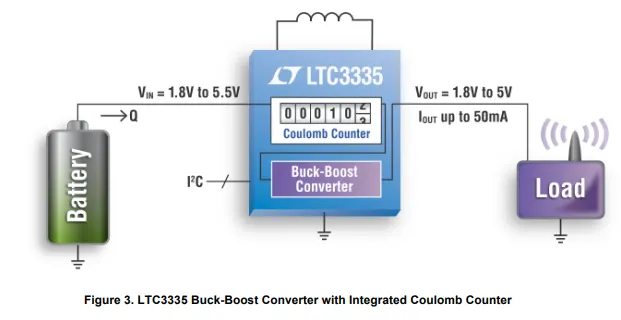
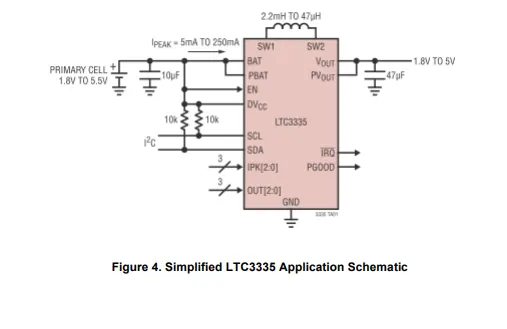
The LTC3335 is a nanopower high efficiency synchronous buck-boost converter with an onboard precision coulomb counter that delivers up to 50mA of continuous output current. With only 680nA of quiescent current and programmable peak input currents from as low as 5mA up to 250mA, the device is ideally suited for a wide variety of low power battery applications, such as those found in wearables and IoT (internet of things) devices. Its 1.8V to 5.5V input range and 8 user-selectable outputs between 1.8V and 5V provide a regulated output supply with an input voltage above, below or equal to the output. In addition, the device’s integrated precision (±5% battery discharge measurement accuracy) coulomb counter provides accurate monitoring of accumulated battery discharge in long-life non-rechargeable battery-powered applications which in many cases have extremely flat battery discharge curves. Typical applications include wireless sensors, remote monitors, and Linear Technology’s Dust Networks SmartMesh systems. The LTC3335 includes four internal low RDSON MOSFETs and can deliver efficiencies of up to 90%. Other features include a programmable discharge alarm threshold, an I2C interface for accessing coulomb count and device programming, a Power Good output, and 8 selectable peak input currents from 5mA up to 250mA to accommodate a wide range of battery types and sizes. The LTC3335 is available with an operating junction temperature range from -40°C to +125°C in a thermally enhanced, 20-lead 3mm x 4mm QFN package. Figure 4 shows a typical application circuit.
Conclusion:
Rechargeable “secondary” batteries can be found in a myriad of applications; however there has been resurgence in demand for non-rechargeable primary cell applications, such as military, remote monitoring or wireless sensor systems. Primary cells have many advantages but also have a few characteristics which make them difficult to implement in many designs: flat discharge curves, do not behave well with surges in current, and are better under light load conditions.
Coulomb counting is a reliable technique to predict remaining battery capacity. A buckboost architecture is advantageous since it regulates Vout when the input is equal to, above or below the output, which maximizes run time when battery-powered. Effectively powering a low-current remote monitoring application can prove very challenging; however, Linear Technology offers a portfolio of leading-edge products capable of very high performance at low power levels. One particular device with nanopower consumption, the LTC3335 buck-boost regulator with integrated coulomb counter and current limiting, makes for an extremely compelling solution for a variety of nonrechargeable, light load applications to save battery run time.
The Future of SOC Estimation:
Since the energy storage systems have been highlighted in portable electronics and hybrid electric vehicle applications, the estimate accuracy of SOC becomes increasingly important. In recent years, many scholars have done a lot of research on SOC estimation. The estimate accuracy has improved constantly, and it can be expected that intense research and development efforts are already on track. In order to further improve SOC estimates, combined with some literatures, anticipated improvements for the further research include the following areas.
(i)Do further research on the hybrid methods, such as combining direct measurement method and book-keeping estimation method to achieve good results in online SOC estimation.
(ii)The existing estimation method should be put into use in various kinds of batteries. Do further research on the practical universal application of the methods.
(iii)Deepen further research on improve the SOC estimation system capability to cope with the aging effect of battery.
(iv)Study on more novel artificial intelligence methods and improving their training algorithms to achieve the estimate accuracy of SOC. In addition, new methods on complex terrain are the focus of future research.
(v)To further improve the estimating performance of the neural network method, the optimal search methods for the optimal number of neurons in hidden layer need to be investigated and integrated in the neural network method.
(vi)Do further research on the adaptive parameter estimation. The models have the ability to automatically adapt to various kinds of batteries, various discharging conditions, and the different aged batteries.
(vii)Establish the more accurate evaluation system and the standard for measurement of performance of SOC estimation method.