Week 7 State of charge estimation
State of charge estimation
Coulomb counting
SOC is a measure of how much charge is available for use in the battery. For the application of rechargeable batteries in H/EVs, SOC is a crucial parameter and thus needs to be measured accurately though electronic and electric systems. It cannot be measured directly because it requires measuring the lithium content at both electrodes. Without accurate SOC measurement, the battery management system (BMS) would be unable to inform the user when the vehicle needs to be charged or what could be done to improve battery capacity. A few indirect methods have been discovered to measure the SOC:
- Chemical method: applicable only to cells that give open access to their electrolytes (non-sealed lead acid batteries for instance). The SOC can be measured from the specific gravity (hydrometer) or the pH (pH meter) of the electrolyte
- Voltage method: measures the present voltage of the battery to find its SOC using the discharge characteristics of the voltage vs SOC. Not a preferred method because temperature variations are not accounted for in this method which can cause the terminal voltage of a cell to vary from its OCV
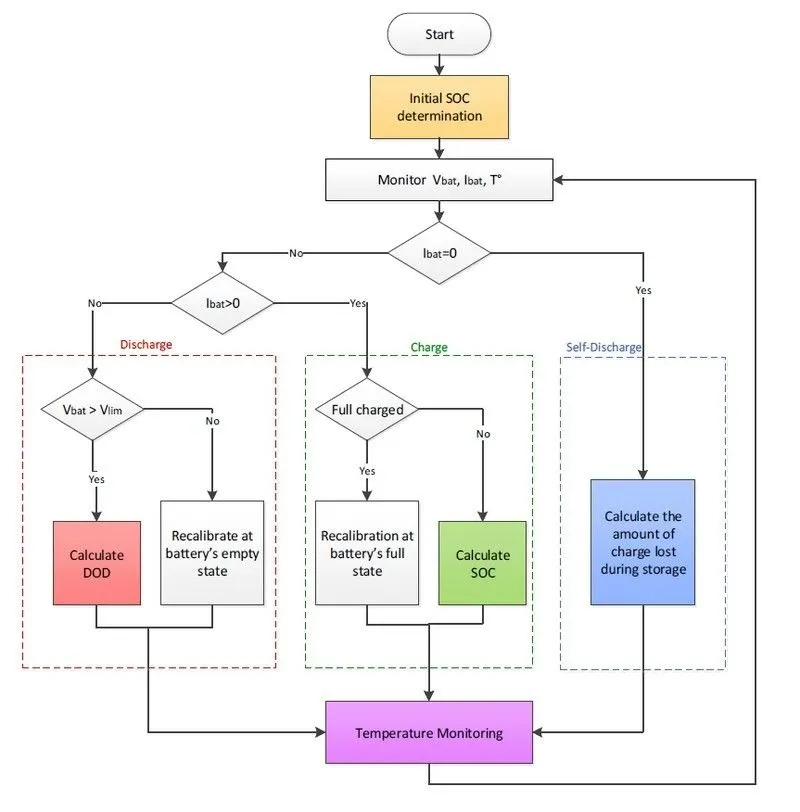
- Current integration method (also known as Coulomb counting): involves measuring the amount of current entering and leaving the battery, integrated over time. A device called a coulomb counter will measure the current supplied or removed over a period of time, and will compare it to the preprogrammed capacity of the battery, hence determining the current SOC.
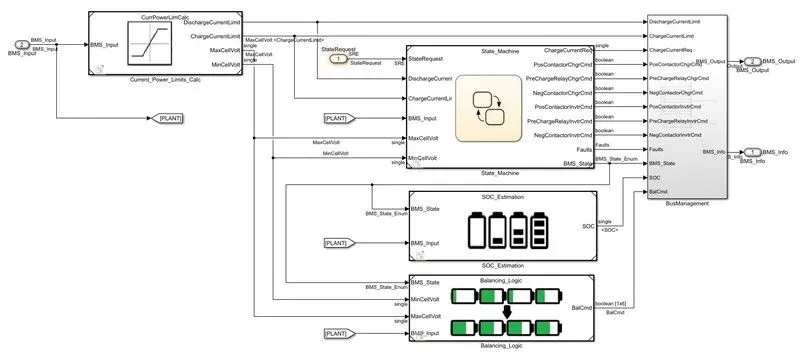
The figure below shows how SOC is modeled. The amount of current entering/leaving the battery is integrated over time and the effect of temperature on capacity is also accounted for by using a 1-D lookup table.

State of charge (SOC) is the level of charge in an electric battery relative to its capacity. The units of SOC are percentage points. An alternative form of the same measure is the Depth of Discharge (DOD), inverse of State of Charge (SOC).
SOC(t) = SOC(t0) − ∫tt0 η(t) ⋅ i(t)dt
where;
Q = declared/nominal capacity of the cell
η = present efficiency of the cell
i(t) = current flowing in or out
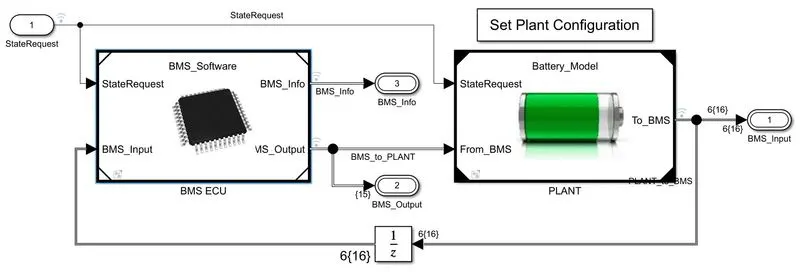
simulink model
 BMS ECU: represents the software and controls part of the model, showing how cell balancing is done, SOC is estimated, and response to different states (using stateflow)
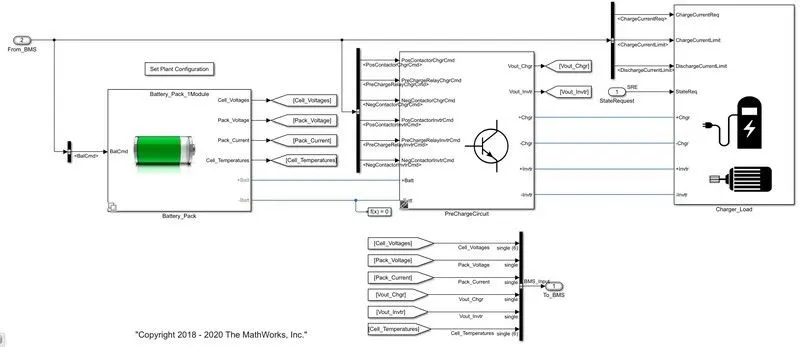
PLANT: represents the hardware part of the model, with the battery pack, precharge circuit, and charger.
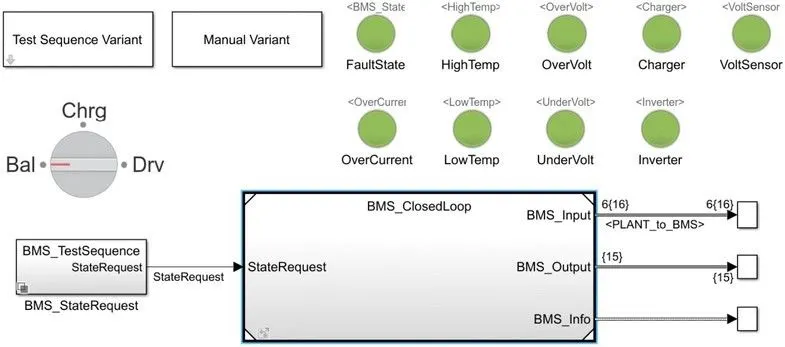
TEST HARNESS DASHBOARD: testing different scenarios and conditions

- Battery is in driving mode for first 3000 secs
- The next 1000 secs it is cell balancing as the BMS has come to a standby. This will generally only happen when the vehicle has come to a stop for a long time.
- The next 5000 seconds are for charging
- BMS continues to be in standby for the remaining 11,000 seconds
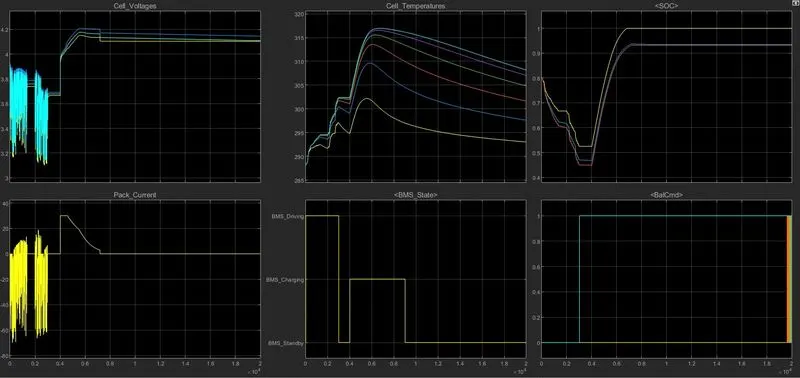
Here all the indicators are green. So we can see no errors and we check the plot for this model and is shown below.
From the plot we can see the vehicle is initially in driving state and charging was done till 90%. After charging it reaches to standby mode. It can be seen in BMS state plot.Battery temperature increases in driving and charging. Battery voltage was increased to 4.2V while charging. Current plot shows the value of current supplied to vehicle while driving. SOC decreased up to 50% in driving condition and it was increased while charging.
Test case 2: currently unable to run this test, possibly due to a bug

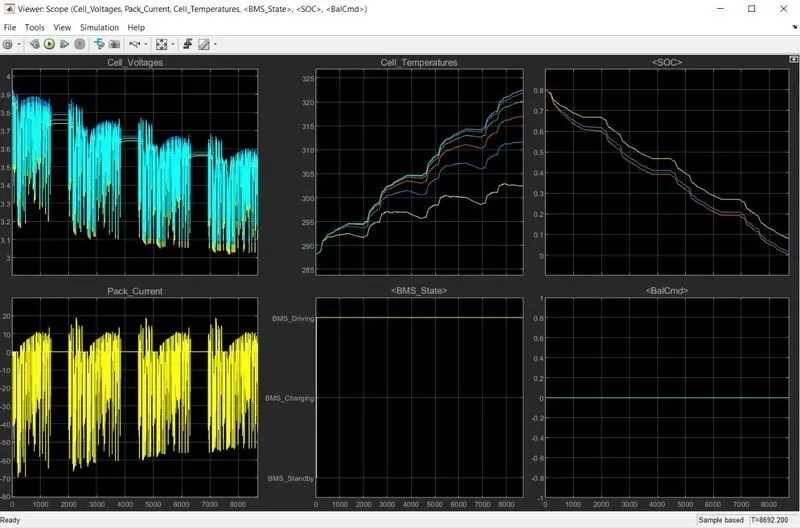
From the above graph , a fault condition occured in second case. So even after charging was started, the soc didnt increase. It continue to decrease.
Test case 3: no fault condition in the vehicle

- Battery is only in charging mode
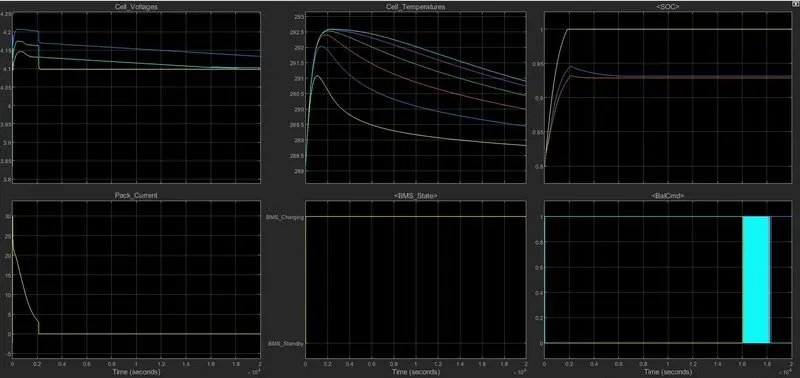
Here we can see that the soc reached 100% in charging and remained in stand by mode. Cell temperature also decrased when stsndby mode wasacheived.
From the 3 cases we observer that only charging takes place thus SOC was 80% at first , then SOC increases to 100% in 2000 seconds then SOC remainsconstant at 100%.
Flowchart for columb counting
Reference: