Week 7: Shock tube simulation project
Shock tube :
Shock tubes are devices for studying the flow of high-temperature and high-velocity compressible gas.A high-temperature supersonic gas flow is initiated in a shock tube as a result of rupture of a diaphragm separating two gases in high-pressure and low-pressure chambers.
An unsteady rarefaction wave passes into the "driver" gas in the high-pressure chamber with a velocity a few kilometers per second. This results in the drivers gas flowing into the low pressure gas, pushing the gas in the low pressure chamber ahead of it.
The shock wave propagates in the low-pressure chamber ahead of this flow of the studied gas. The velocity of the driven gas flow is equal to that of the driver gas flow.
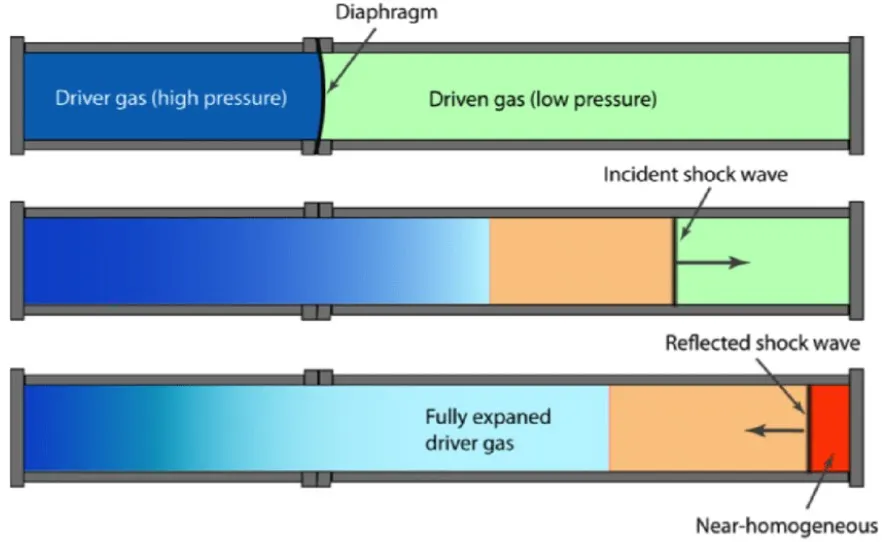
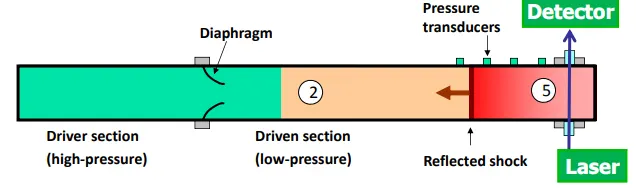
In a shock tube, the sudden expansion of a gas at high pressure into a gas at low pressure produces a plane shock wave that then propagates through a long closed tube. The shock wave is used to produce a rapid increase in the pressure and the temperature of a reactive mixture.
In most shock tubes, the shock wave is reflected at the end of the tube and produces during its way back a second rise in temperature. This technique is mainly used to study elementary steps, as well as pyrolysis and high-temperature autoignition in very dilute mixtures.
Aim :
To Setup a transient shock tube simulation and Plot the pressure and temperature history in the entire domain, Plot the cell count as a function of time and to Explain the results.
Introduction & Geometry :
To set-up a shock tube problem, consider a rectangular tube having a diaphram at the middle of the path of the tube, seperating the tube into two equal volumes.
As we cannot simulate the problem with a face seperating the two volumes, the disconnection face is not taken into account in the geometry.
As the disconnecting face is present in the given geometry, let us delete the face s connecting the two volumes of the shock tube.
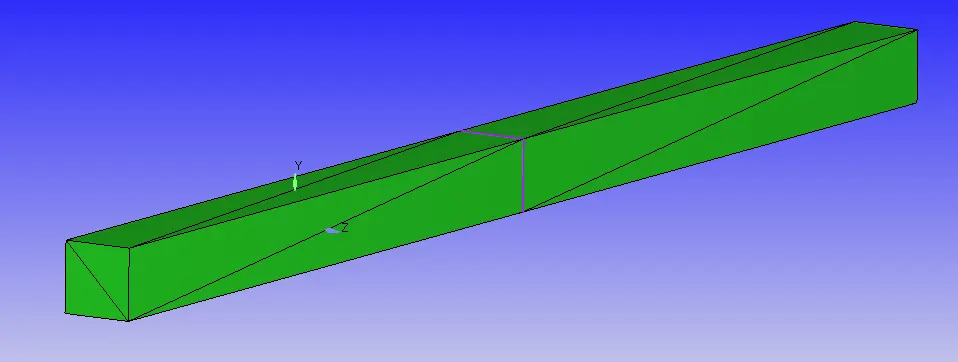
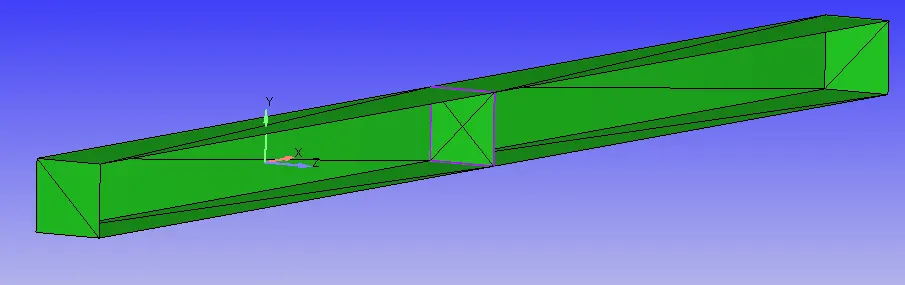
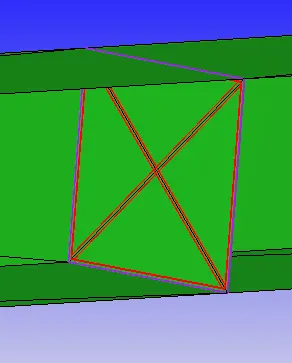
As we hide the side faces of the tube, we can see the disconnecting faces between the two volumes.
To move forward with the simulation, we can delete the faces using the delete repair tool.
The normals of the triangle are facing in the outside direction which cannot be simulated.
Thus the normals are transformed in the inside direction where the flow will be taking place.
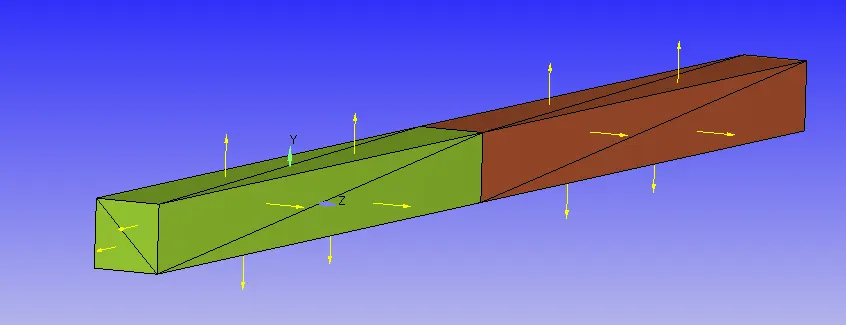
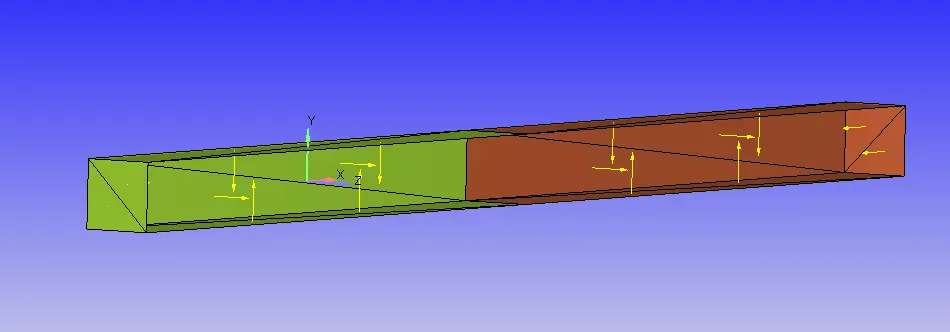
Setting up Boundary conditions :
As we are concentrated to work on the fow between two regions, There is no need for any inlet or outlet faces.
The flow takes place between the gas present in the two regions.
Each region is seperated by choosing the boundaries and filled with gases initially.
Thus each side of the two volumes are given different names to be differentiated for boundary regions.
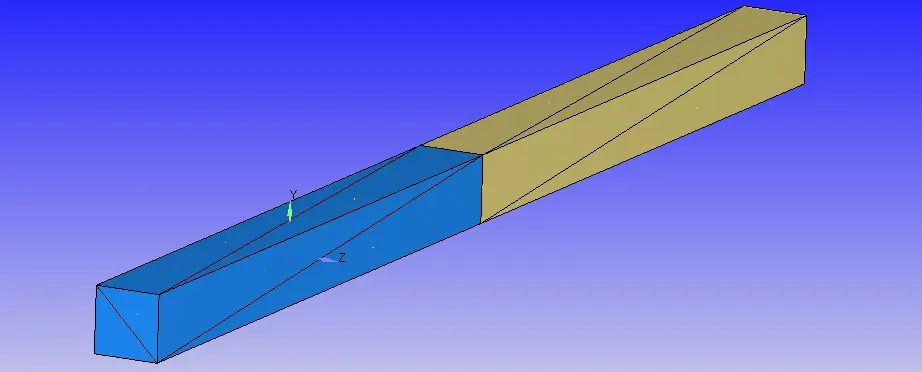
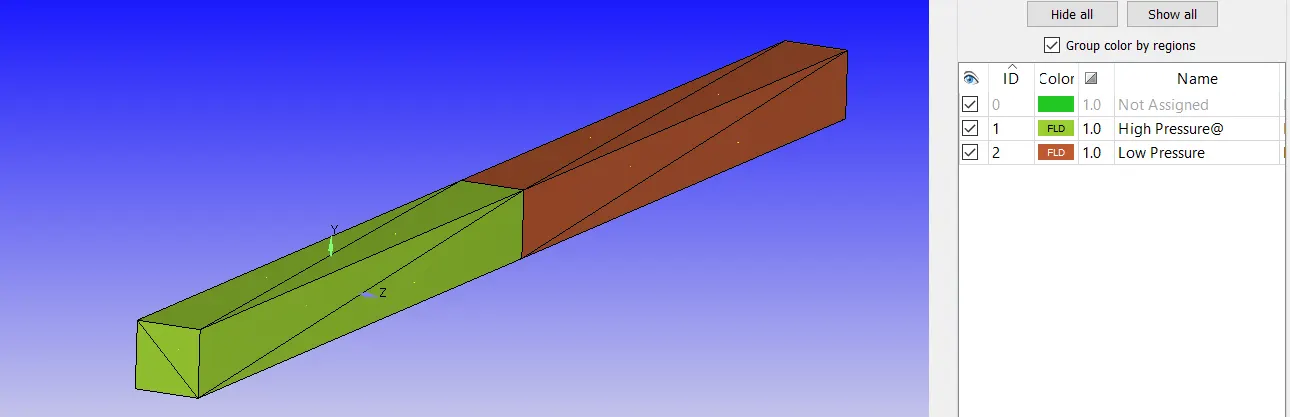
As one region has a high pressure and the other has a low pressure, let us name the regions as high pressure and low pressure.
Initialization & Boundary conditions :
Mark one of the regions of the tube with a high pressure and the other region with a low pressure.
Let us assume that the high pressure region is filled with N2 and the low pressure region is filled with O2.
Assign the above conditions in the regions and the boundaries for the regions can be set up in the boundary conditions.
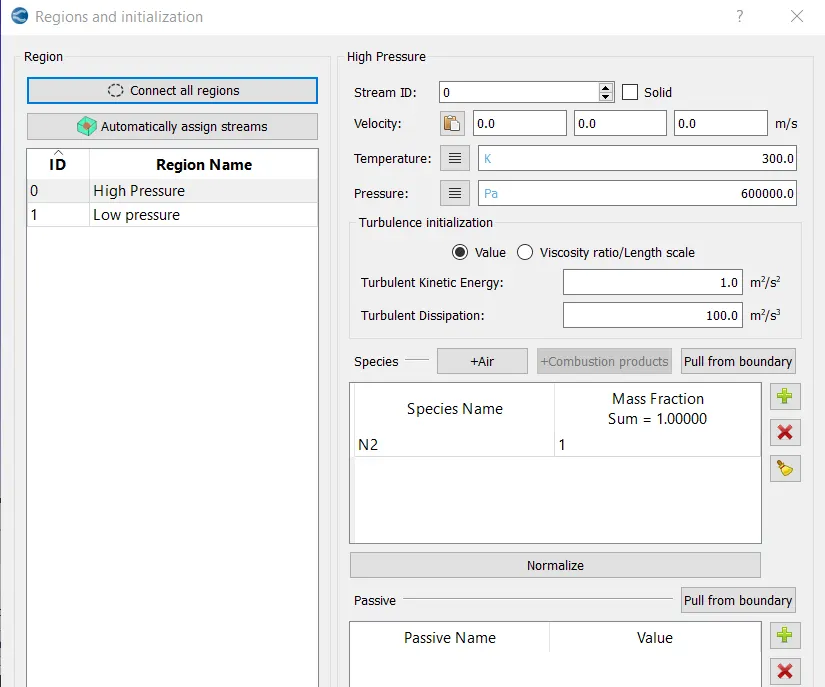
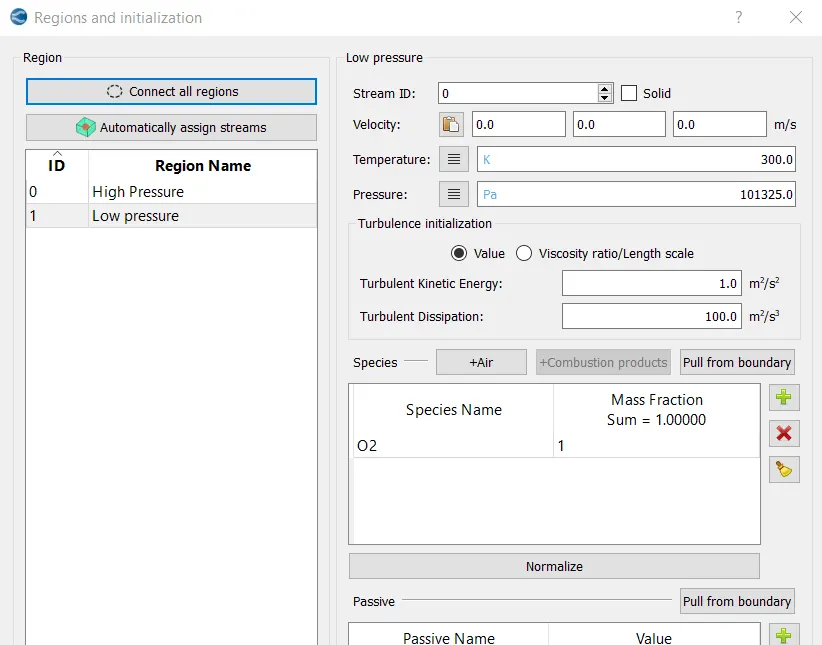
After assiging the initializations the boundary conditions for the tube can be assigned.
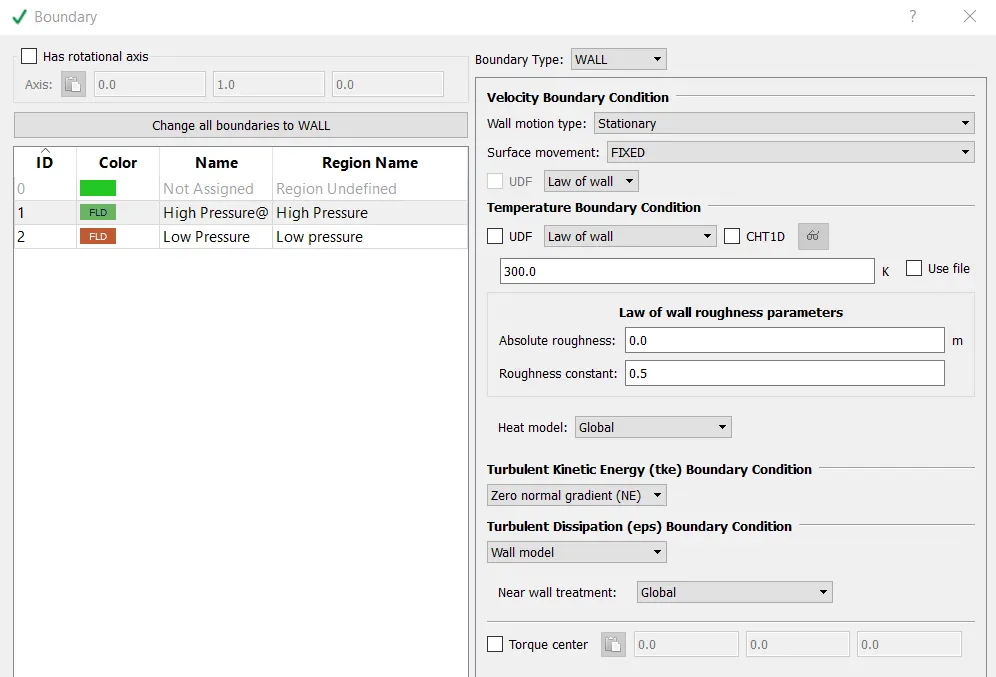
There are only two boundaries defined with the geometry.
The first set of faces represents high pressure region and the second set of faces represent the low pressure region.
We can see the difference in the selection with the coloured faces.
The blue faces are considered as high pressure region and the yellow faces are assigned to the low pressure region.
The regions specific to the conditions are assigned to the respective faces of the boundary.
Both the boundaries are set to wall and law of wall conditions are applied with a slip wall condition.
Events :
Use the Events dialog box to create custom events in certain boundaries or between two or more regions at defined intervals. Because CONVERGE cannot properly execute a simulation if surface triangles from two boundaries intersect, using the Events section is the only way to discontinue (or allow) flow between two regions.
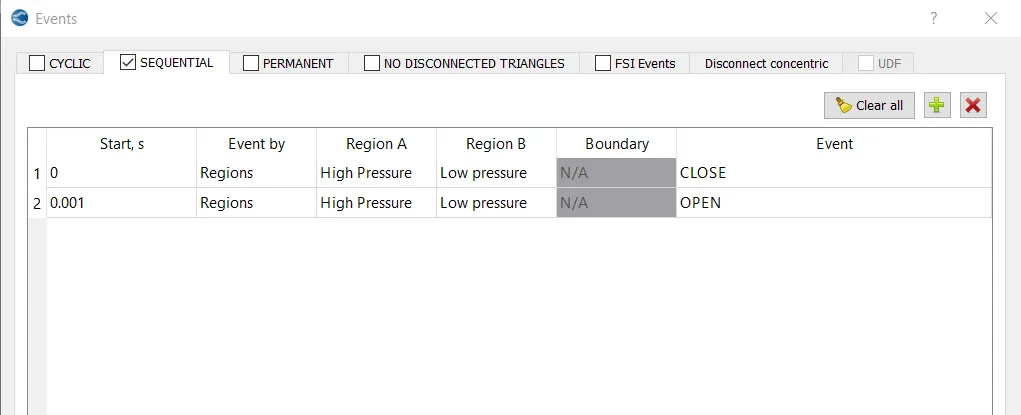
OPEN: Deactivate disconnect triangles.
CLOSE: Activate disconnect triangles.
In this case, for 0.001 second the path between the two regions are closed.
Thus initially the gases in the respective regions are not disturbed.
At 0.001 second, the path is opened and the flow takes place between the two region.
Grid Control :
The size of the grid is taken to be 0.001 m.
We are using Adaptive Mesh refinement here to capture the shock waves more accurately.
CONVERGE’s innovative Adaptive Mesh Refinement (AMR) technology automatically adjusts the grid at each time-step, adding cells in areas with complex phenomena and eliminating cells that are not needed to yield accurate results. This strategic refinement ensures that CONVERGE can resolve flame fronts and high-velocity flows while minimizing the overall cell count.
This Adaptive Mesh Refinement (AMR) process adds local refinement in areas of steep field variable gradients and is now also being pursued by many of the other leading CFD software OEMs. The company calls the process "Autonomous meshing" and argues the following benefits:
-
By eliminating the process of manual mesh creation, inspection and refinement, time is saved
-
Accuracy is improved through higher grid density where it is needed and where manual meshing strategies might not allocate it
-
AMR provides a robust method for capturing large or rapid boundary motions
-
AMR provides run-time savings due to using an optimized number of computational cells
-
Consistency and standardization can be achieved through the use of a consistent, algorithmic strategy for mesh production.
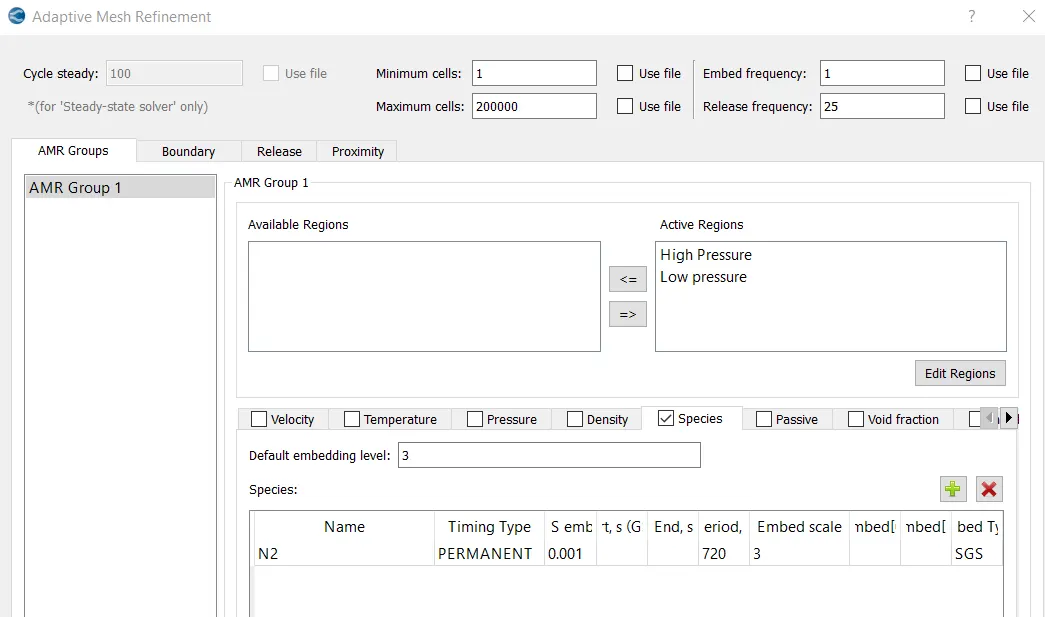
We are specifying the values of the species, so that the flow of the species can be captured with great accuracy.
Mesh :
Cell Count :
Conclusion on cell count :
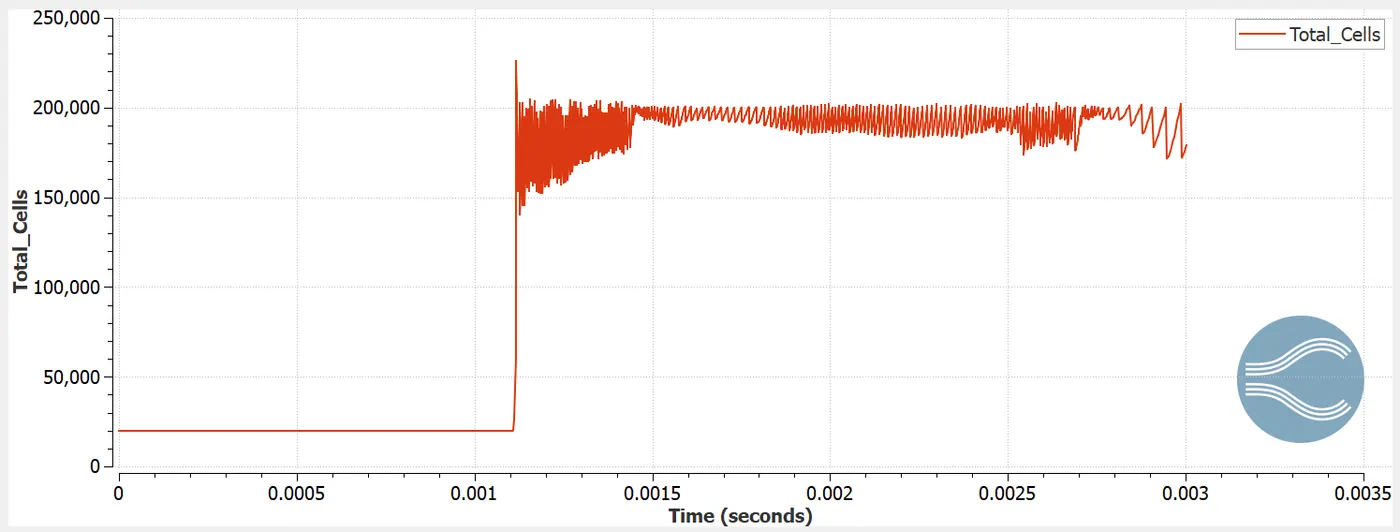
As we have specified the Adaptive meshing options under the species properties, we can see that the meshing gets refined at the areas where the Species mass fraction differs.
For 0.001 seconds both the species in the two regions stay undisturbed as the path between the regions is closed.
As the time increases the path gets opened and the flow happens from high pressure regionn to low pressure region.
Thus after 0.001 seconds the flow takes place and the mass fraction of the species changes which in turn refines the meshing at the areas where the flow occurs.
Velocity profile :
Pressure Profile :
Mass Fraction :
Conclusion on the Contours :
From the velocity contour video, we can see that the flow is static before the path is opened.
As soon as we open the path between the two regions, the velocity starts to accelarate quickly and flows with a high velocity until it reaches the reflection stage.
Due to the shock occuring inside the tube, the flow backs off from moving forward and starts to travel behind with a high velocity. As the shock reflects the flow back and forth, the velocity gradually deacreases as time goes on.
The pressure contour shows the high pressure region and low pressure region seperated in the middle of the pipe initially. As the path is opened, the pressure in the high pressure region decreases from the middle and the pressure in the low pressure region increases from the middle.
After some time the pressure state varies back and forth due to the shock and it gradually tries to adopt a overall constant pressure inside the tube.
In the mass fraction video, we can see that the N2 gas dominates the O2 as the N2 moves from a region of high pressure to low pressure.
As the region of N2 has high pressure, we can say that the amount of N2 present inside the tube is much greater than the amount of O2 present.
Thus the N2 dominates the flow into the low Pressure region as soon as the path is opened between the two regions.