Week-7 Challenge: DC Motor Control
1. A. Explain a MATLAB demo model named ‘Speed control of a DC motor using BJT H-bridge’.
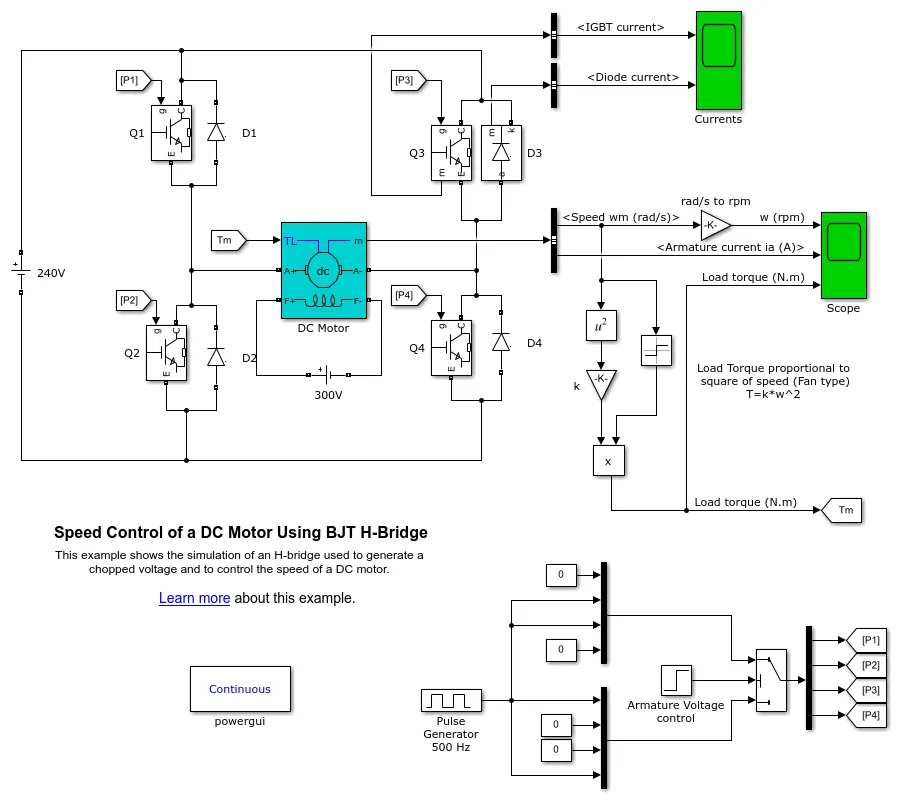
A)Working of H-bridge model:
- Here H-bridge DC chopper circuit is designed to control the speed of the motor.
- IGBT acts as BJT in power switching devices.
- Four IGBT switches are used for inverting the DC voltage 0 to 240 v supply.The current flows from collector(C) to emitter(E).
- The gate are controlled by the pulses(0 and 1) according to the armature voltge of motor given by pulse generator.
Speed of motor:
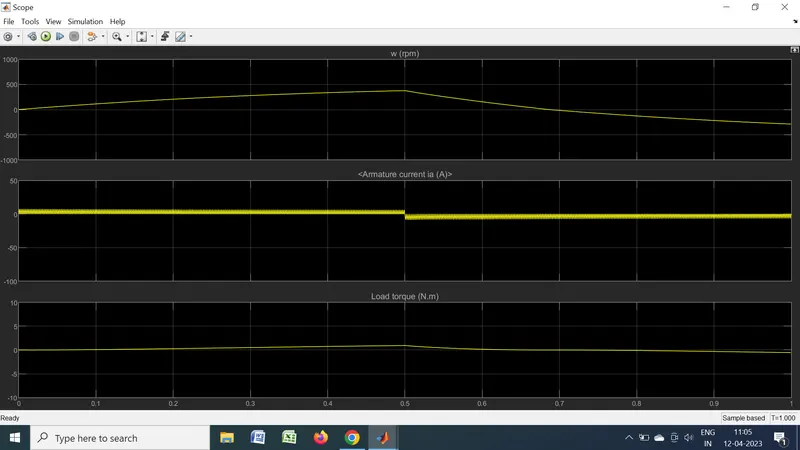
- Initially increases to 0 to nearly 900 rpm upto 0.5 secs(Forward motoring action takes place).
- Then speed reduces to 0 rpm(Forward dynamic breaking action takes place).
- Then speed increases from 0 to -900 rpm at upto 1 sec( Reverse motoring action takes place).
- Then reverse dynasmic breaking occurs(Not shown in scope).
Load torque of motor:
- Initially torque increase from 0 to 0.5 secs in forward motoring action.
- Then torque reduces to 0 Nm in forward dynamic breaking mode.
- Then torque increases in reverse direction in reverse motoring action upto 1 sec.
- Again torque reduce to zero.(Not shown in scope).
B) Armature current shoot up in motor.
Here the initial current shoot up is due to sudden increase in voltage which inurns regulated by duty cycle.In this case motor driven in 75% of duty cycle.(i.e) 0.75*240= 180 V.
We can change the duty cycle to 50%(120 V) and seen the results as,
B. Comment on the armature current shoot-up from the scope results.
Again changing duty 75,we get the result as,
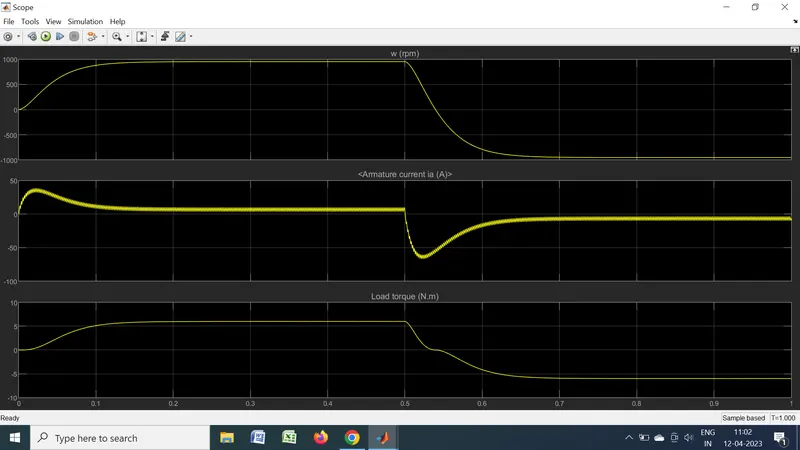
Again changing duty 50 we get the result
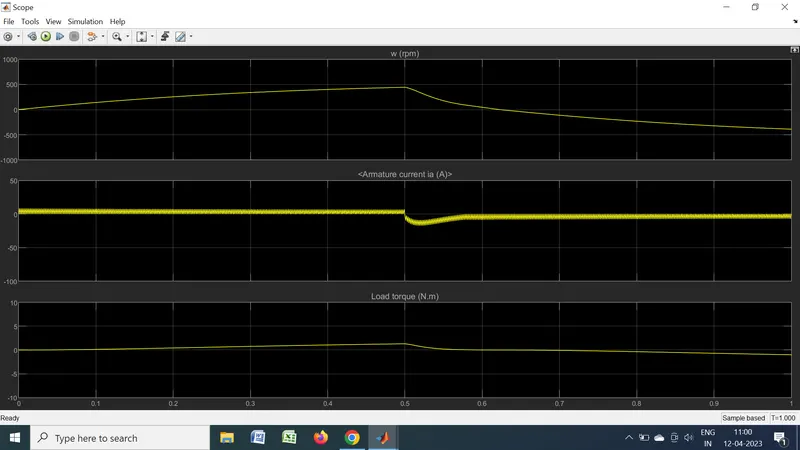
Again changing duty 45,we get the result as,
C. Refer to the help section of ‘The Four-Quadrant Chopper DC Drive (DC7) block’. Compare it with the H-bridge model.
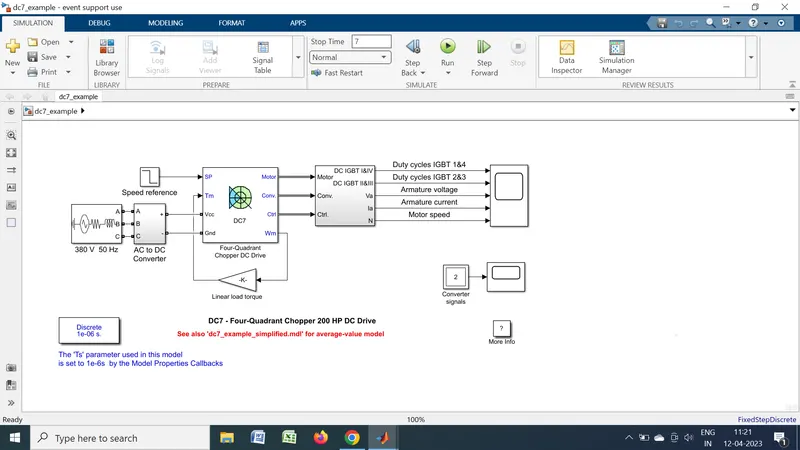
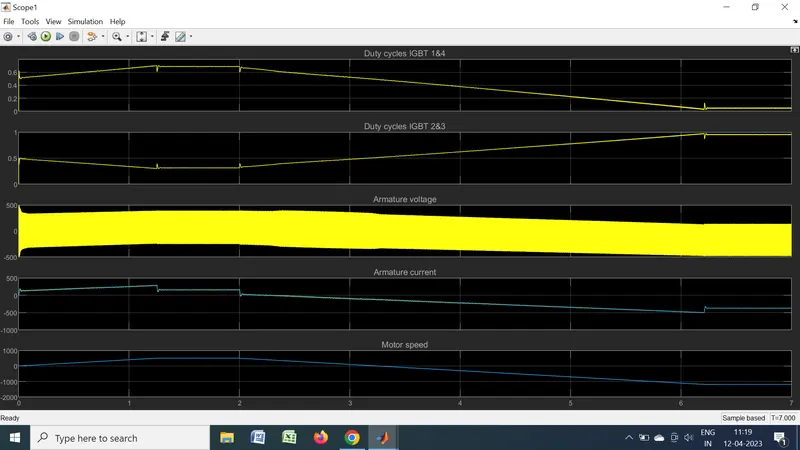
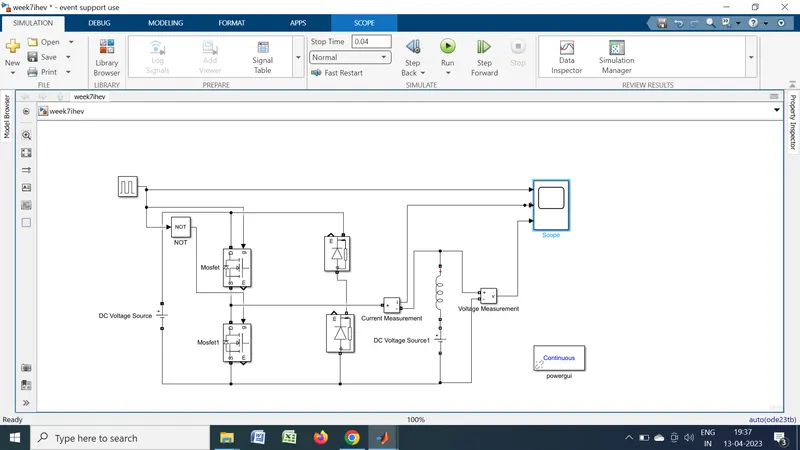
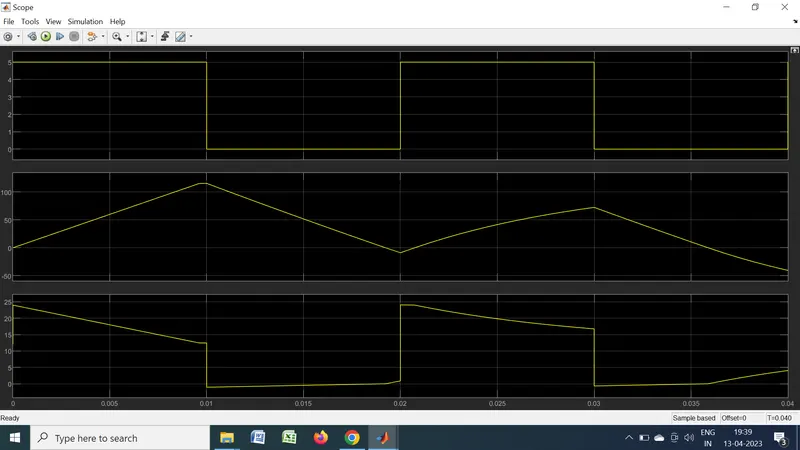
2. Develop a 2-quadrant chopper using simulink & explain the working of the same with the relevant results
simulink model
3) BLDC motor operations.
BLDC motor named as brushless dc motor having high effenciency than other types of motors.This motor is also known to be synchronous motor.
Construction:
Most of the motors are having brushes in their rotor as it transfers current into the rotor circuit.But here differently rotor is placed with permanent magnet.
The stator coil is wounded with coils,they are stationary but producing variable DC voltages for rotating the permanent magnet as changing the magnetic field of stator poles continuously.
The controlling of motor is by changing the magnitude and direction of current flowing through the stator windings.
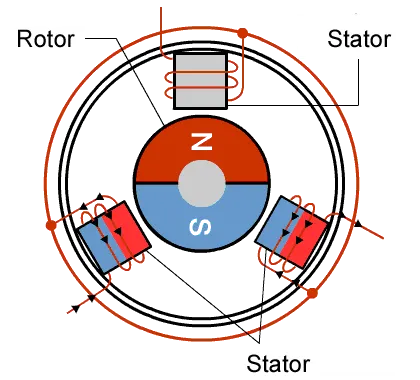
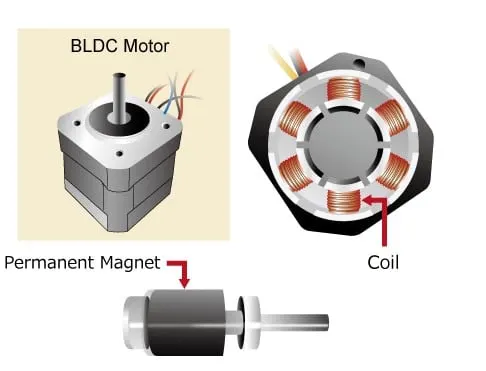
A BLDC motor with three coils on the stator will have six electrical wires (two to each coil) extending from these coils. In most implementations three of these wires will be connected internally, with the three
remaining wires extending from the motor body. Wiring in the BLDC motor case is more complicated than simply connecting the power cell’s positive and negative terminals. we will look more closely at how
these motors work in the second session of this series.
Operation of BLDC motor:
We can consider three winding trminal are comming out as U,V,W and their another ends are connected in single point as shown in below figure.The angle shift between two coils makes 120 degree.
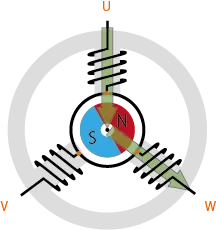
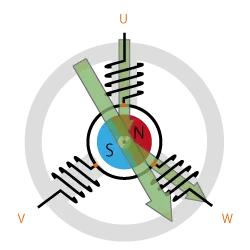
The current moves from U to W makes magnetizing the coils attracts the rotor consisting of permanent magnet makes moment as shown above to align with the resultant arrow(larger arrow).
North pole of magnet towards arrow mark of resultant arrow.
Rotation is maintained by continually switching the flux so that the permanent magnet is constantly chasing the rotating magnetic field induced by the coils. In other words, energizing of U, V, and W must be
continually switched so that the resultant flux keeps moving, producing a rotating field that continually pulls on the rotor magnet.
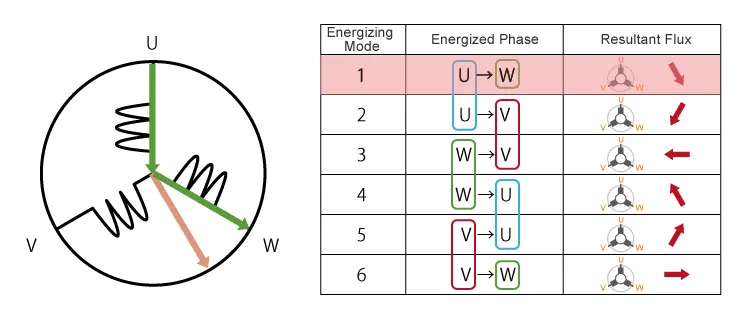
The above movement are acheived by continuous change in current direction over two poles of stator at single time.But this is slightly not continuous in their rotation.
This makes motor vibration and noice will be produced.
So, to attain smooth continuous rotation of rotor we have to control the current flow through all the three poles in same time.
As shown below we can acheive continuous change in current flow in all stator poles at same time in 120 degree phase shift.
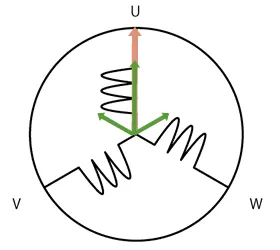
As we have seen, we drive BLDC motors by continually changing the directionality of the flux produced by the coils. The permanent magnets on the rotor continually chase the shifting rotating magnetic field,
causing the rotor to turn.
This is the working of BLDC motor.
Advantages of BLDC motor:
- One big advantage is efficiency, as these motors can control continuously at maximum rotational force (torque).
- Even small BLDC motors can deliver considerable power.
- BLDC motors can be controlled, using feedback mechanisms, to delivery precisely the desired torque and rotation speed.
- Reduce energy consumption and heat generation.
- BLDC motors also offer high durability and low electric noise generation.
- The sparks will not be produced as brushed motor between brushes and commutators.
Control of BLDC motor:
By using the inverter circuitry to also adjust the voltage into each coil, we can control the magnitude of the current.
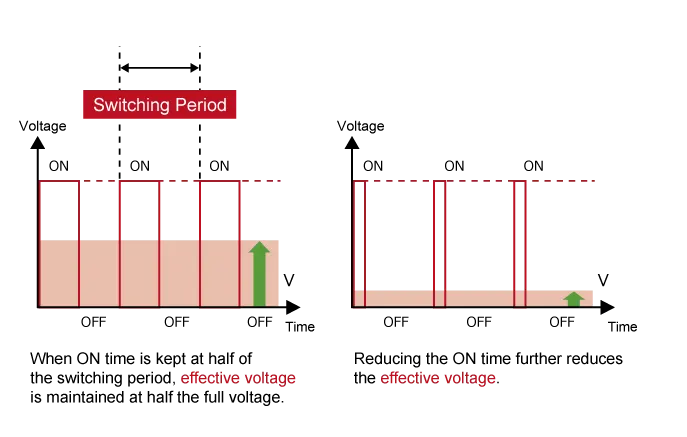
A typical way to adjust the voltage is with pulse width modulation (PWM). We alter the voltage by lengthening or reducing the pulse ON time ( “Duty cycle”: the ON time
expressed as a ratio of the ON+OFF switching interval). Increasing the duty cycle has the same effect as raising the voltage,reducing the duty cycle has the same effect as lowering the current.
PWM can be implemented using MPUs equipped with dedicated PWM hardware. While 120-degree conductiong control only requires two-phase voltage control.
sinusoidal control uses three-phase voltage control and is considerably more complicated as appropriate inverter circuitry is therefore essential for driving BLDC motors.