Week-7 Challenge: DC Motor Control
ANS-1 :-
A) MATLAB demo model ‘Speed control of a DC motor using BJT H-bridge’.
Simulation :-
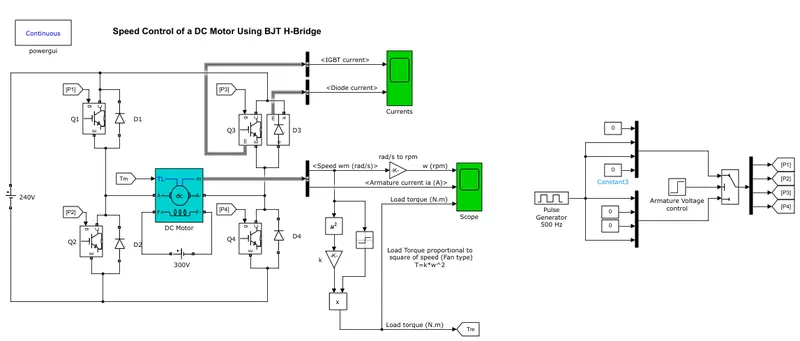
The Bipolar Junction Transistor (BJT) when used for power switching applications, operates as an IGBT.
When it is conducting a forward voltage Vf is developed between collector and emitter.
Therefore, the IGBT block can be used to model the BJT device.
The IGBT block does not simulate the gate current controlling the BJT or IGBT.
The switch is controlled by a Simulink signal.
The DC motor uses in the preset model is 5 HP, 24V, 1750 rpm.
It simulates a fan type load. The armature mean voltage can be varied from 0 to 240 V when the duty cycle is varied from 0 to 100%.
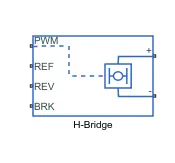
The H-bridge consists of four BJT.
Two transistors are switched simultaneously: Q1 and Q4 or Q2 and Q3.
When Q1 and Q4 are operates, a positive voltage is applied to the motor and diodes D2-D3 operate as free-wheeling diodes when Q1 and Q4 are switched off.
When Q2 and Q3 are operates, a negative voltage is applied to the motor and diodes D1-D4 operate as free-wheeling diodes when Q2 and Q3 are switched off.
Result :-
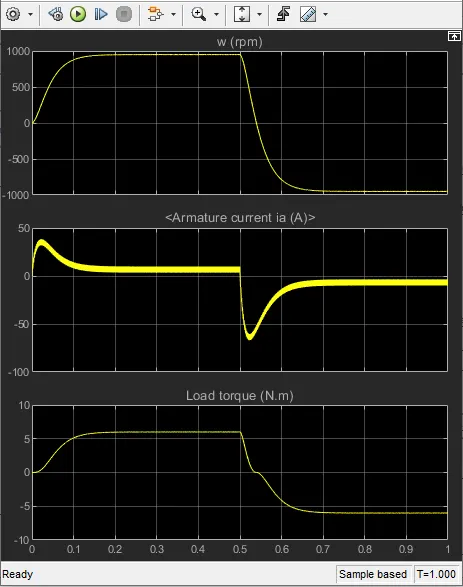
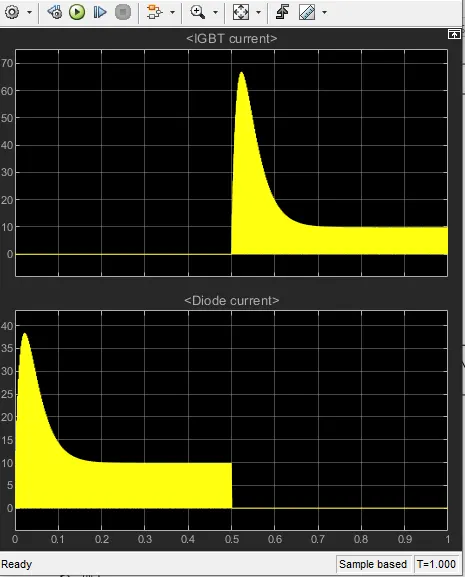
B) Armature current shoot up in motor
Here, the initial current shoot up is due to sudden change in voltage which is regulated by duty cycle.
in this case motor driven in 75% duty cycle. so, voltage of the motor is 0.75*240 = 180 V.
if we decrease the duty cycle to 50% then the voltage of the motor is 0.50*240 = 120 V.
so, by decreasing the duty cycle armature current shoot up will decrease.
C) Four quadrant chopper DC drive (DC7) block & compare with H-bridge model
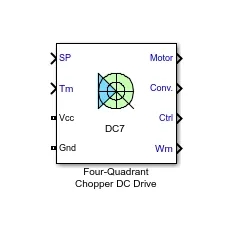
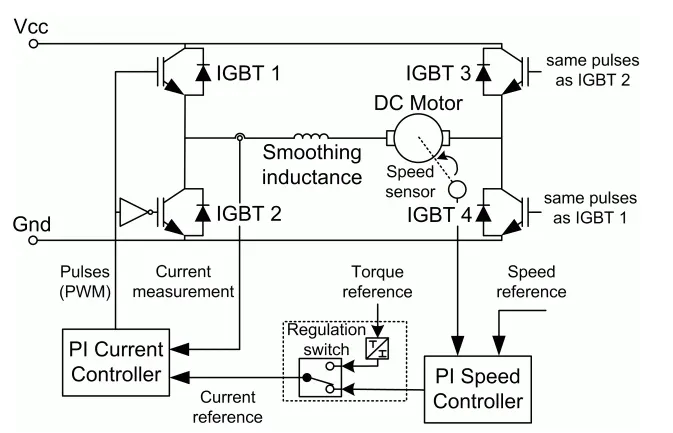
1) four quadrant chopper DC drive (DC7)
H-bridge
comparison :-
# In DC7 chopper model speed controlled by varying current pulses from PI current controller.
In H-bridge model speed controlled by varying duty cycles voltages.
# Here, regenerative breaking in occring while in H-bridge model breaking is occured by changing polarity of current flow, dynamic breaking occurs in it.
# In four quadrant DC chopper model smoothing inductance is used for smooth increase and decrease in current flow which inturns controlling the motor speed smoothly.
while in H-bridge it is not present.
# here the operation is discreat an in H-bridge model it is continuous.
# Hence, 4 quadrant DC choppers are used mostly in electric vehicles.
ANS-2 :-
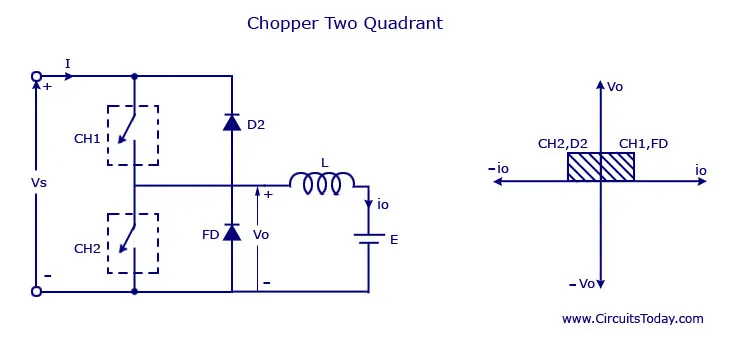
circuit diagram of 2-quadrant chopper shown in fig,
now, we can make the simulation for the 2-quadrant chopper in matlab simulink
Simulation :-
DC 1 = 24 V
DC 2 = 12 V
L = 1e-3
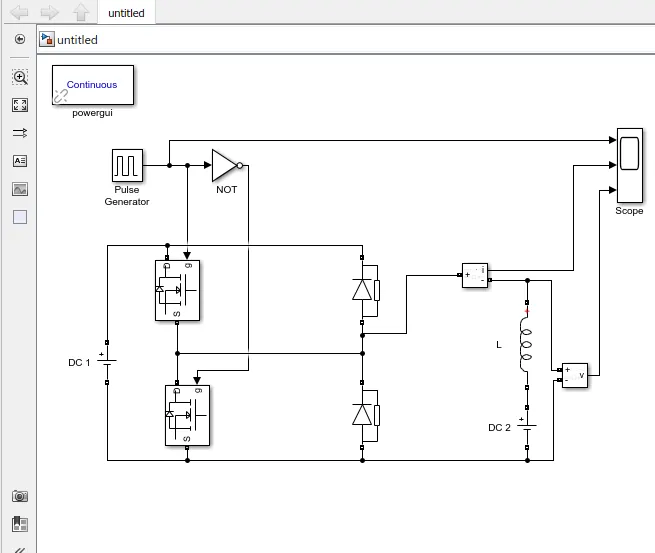
here, we used below components
1) Power gui
2) Pulse generator
3) DC voltage source
4) NOT operator
5) Mosfet
6) Diode
7) Current measurement
8) Series RLC branch with only inductor
9) Voltage measurement
10) Scope
Result :-
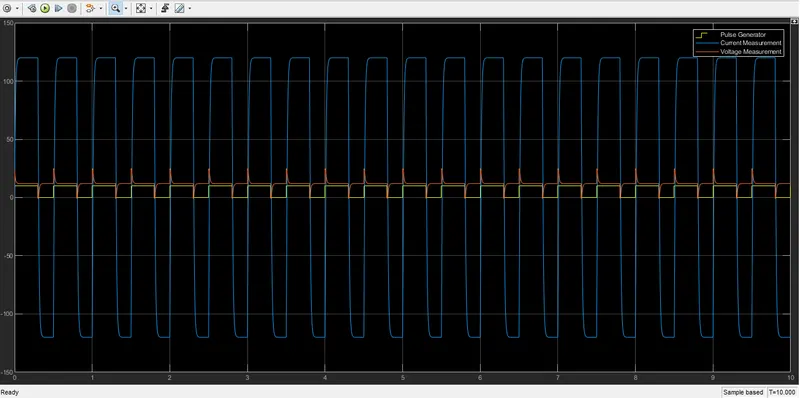
as we shown in result , we can see that voltage is never going to zero and always laying on positive side of the axis
Current is increase amd decrease and also laying in both positive and negative axis.
ANS-3 :-
Brushless DC Motors :-
BLDC - Brushless DC motor
DC motor does not have brushes and controller provides current pulses to the motor winding which controls the torque and speed of the motor is called BLDC.
in brushless motors, the problem of connecting current to the armature is overcome by permanent magnets rotating around a fixed armature.
over a fast speed range, these type of motors is very efficient in producing large amount of torque.
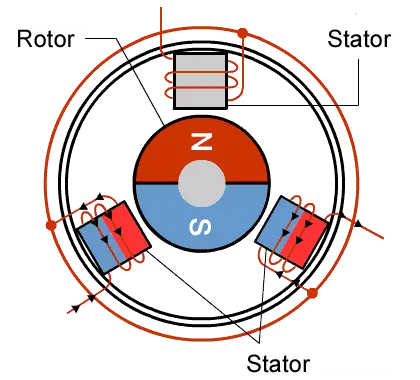
working principle :-
there are only two parts in BLDC motor they are stator and rotor.
the stator is fixed and it contains windings, and the rotor contains permanent magnet.
In BLDC permanent magnets are atteched to the rotor and move the electromagnets to the rotor.
To activate electromagnets for the shaft turns high power transistors are used.
using a solid-state circuit the controller performs power distribution.
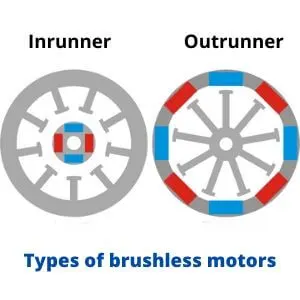
Types fo BLDC
1) Inner rotor design
2) Outer rotor design
Advantages of BLDC motor :-
1) more efficient because the velocity of the BLDC is determined by the frequency at which the current is applied and does not depend on voltage.
2) mechanical loses are less because of friction are less due to the absence of bruses.
3) it can operates at high speed at any condition.
4) less noise and no sparking under any condition.
5) for more precise controls, more magnets are used.
Disadvantages of BLDC motors :-
1) Cost is higher then the brused dc motors.
2) Only limited power could be supplied to the motor because the high amount of heat weakens the magnets and insulation may damaged.