Week-7 Challenge: DC Motor Control
Q1.Speed controll of DC motor BJT H-bridge.
The H-bride is basically a combination of four BJT and diode pairs, BJT simulated by IGBT models.Two transistors are switched simultaneously depending on the spin direction of the motor required.
CASE 1 : When Q1 and Q4 are turned on,a positive voltage is applied to the motor and diodes D2 and D3 behave as free-wheeling diode when Q1 and Q4 are turned off.
CASE 2 : When Q2 and Q3 are turned on,a negative voltage is applied to the motor and diode D1 and D4 behave as free-wheeling diodes when Q2 and Q3 are turned off.
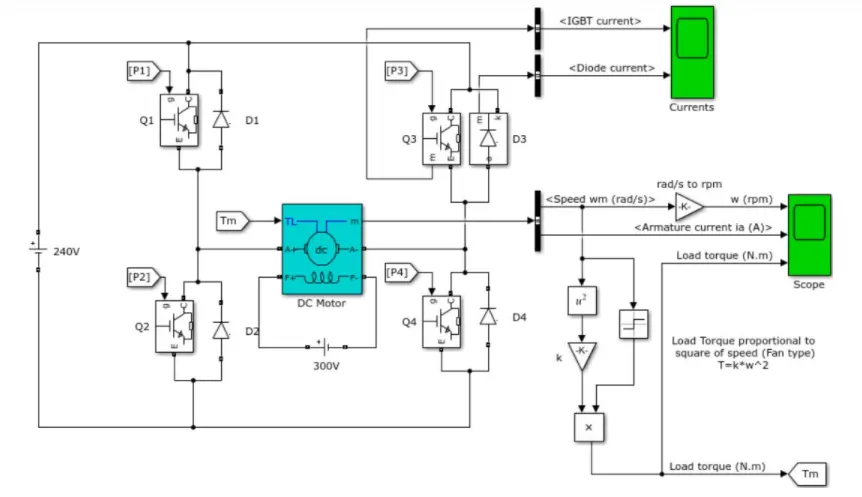
The above picture is the Simulink model of Speed control of a Dc motor Using BHT H-bridge.
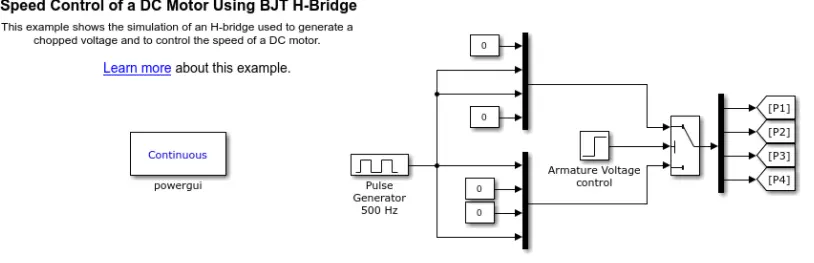
The motor starts in the positive direction with a dyty cycle of 75% at t=0.5 sec.The armaturevoltage is suddenly reversed and the motor runs in the negative direction.
after connecting a scope we get the following output :
this is with default conditions.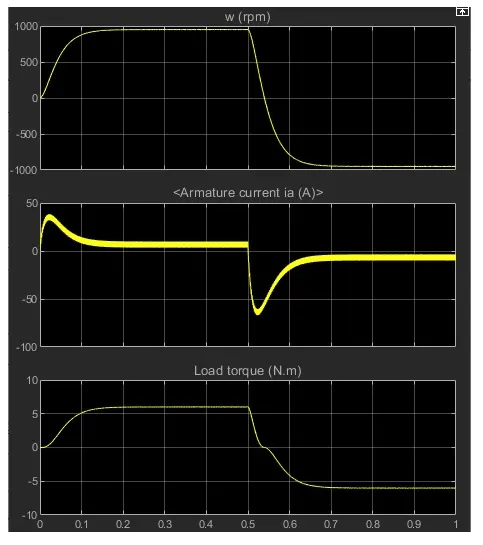
as we can observe, the armature current is changing significantly.in order to controll the variation of current, we changed the duty cycle of the battery and observed the variation is armature current.now we will try with reduced duty cycle at 40%.
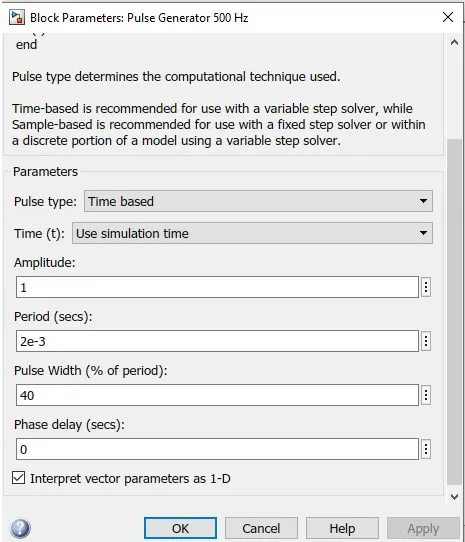
now we can observe the changes in the scope again
as we can see fromt he figure the armature current drop reduces by reducing the duty cycle.
Q2)
The four quadrant chopper Dc drive block in SIMULINK represents a four four quadrant,dc supplied chopper drive for dc motors.It features closed loop speed control with four quadrant operation, this will be the output of the armature current of machine.Using a PI controller, the chopper duty cycle corresponds to the commanded aramture current is found.the duty cycle is then compared with sawtooth carrier signal to obtain the req PWM signals for the chopper.
The comparison between DC7 chopper mpdel and H-bridge model using BJT :
H-bridge model using BJT
1) the H-bridge consists of a four IGBT-diode pairs.The maximum voltage achived is 300-350v.
2) The torque and hence output power bandwidth are narrower as it is restricted to use single pulse generator.
3) The range of armature current has less values comparatively since only two pairs of IGBT and diode models are functioning at time
4) Regenerative braking is not possible
DC7 chopper model
1)Due to teh presence of DC-AC converters, DC7 model has the ability to vary the magnitude of voltage to desired level.The maximum value of voltage can be achived is 400v which on phase rehersal becomes 200v.
2) it has a broader range of torque and output power compared to the former.
3) The use of four quadrants in DC7 model gives the armature current more degrees of freedom.
4) Regenrative braking is possible
Q3)
We make use of the dc7 matlab example and make modification as follows:
first we modify the batterly inputs by using the inputs of a pre-existing model from simulink.
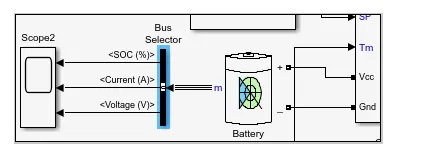
we nonw connect the bus selector to port M of this battery , the bus selector has three output signals SOC, current and voltage of battery.this can be observed with scope.
next we make our own speed table and feed it our drive train block replacing the pre-existing refrenece speed block.
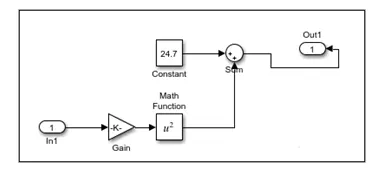
We have taken the vehicle characteristics equation for the relating Torque and speed of vehicle.
linear load torque block has been replaced with a sub system model according to the load characteristics equation.
now we can abserve the result through scope:
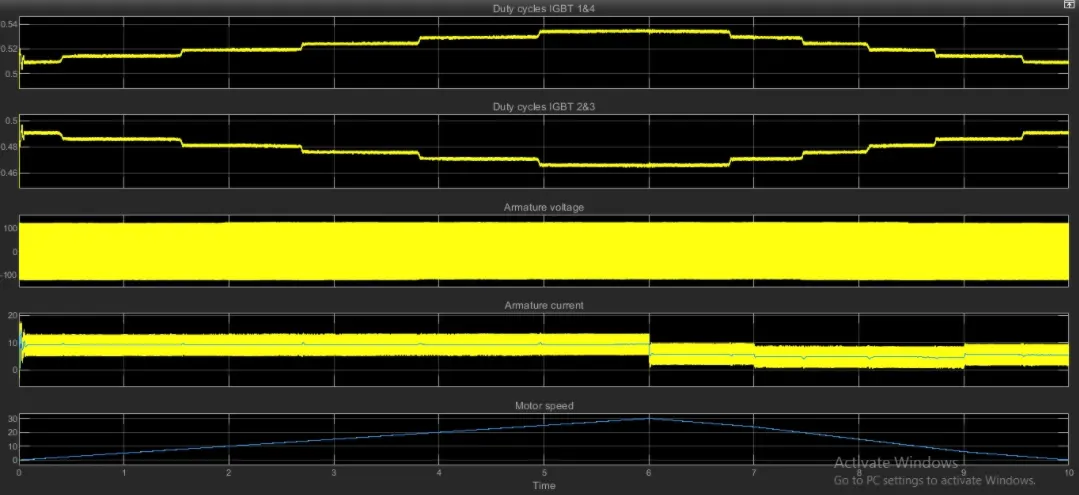
In the duty cycle IGBT 1-4 and 2-3 have initially step increments and decreaments to provide suitable voltage to the motor
after t = 20 sec, the reverse direction in armature current is seen, this is due to braking torque and speed decreses.
after this motor speed also started decreasing as it clearly matches the driving cycle.