Week 7 Challenge - Assembly Workbench
CATIA Assembly Assignment:
- Created individual components part by part.
- Started a new assembly in CATIA.
- Inserted all the parts into the assembly, one by one.
- Used the manipulation command to orientate the parts correctly.
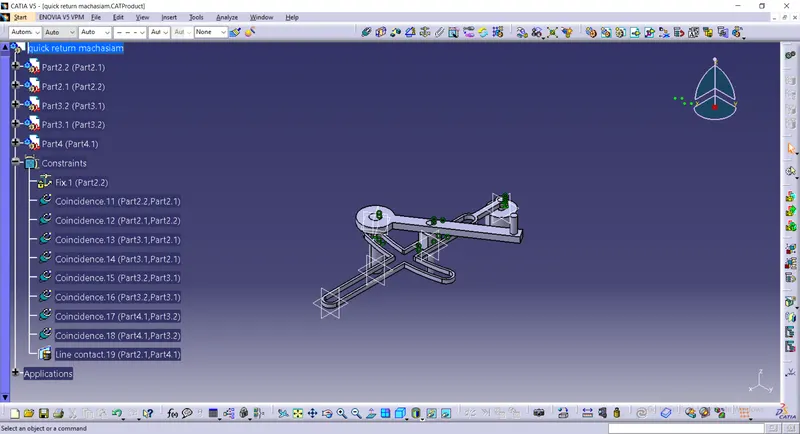
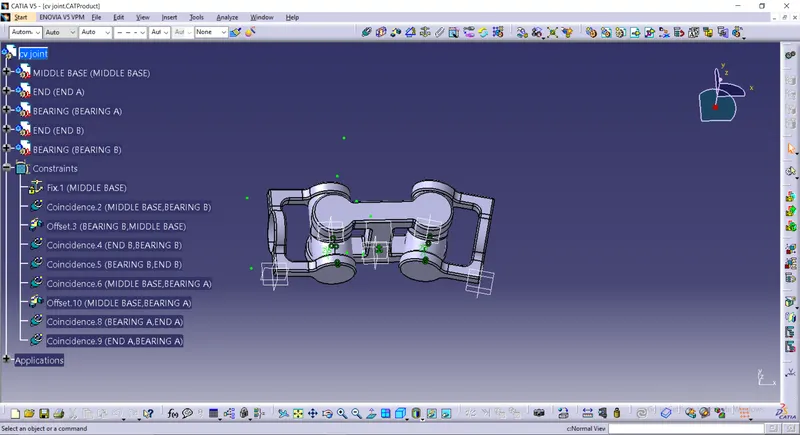
- Fixed one part in its position as a reference.
- Placed the remaining parts in their respective positions using constraints or connections.
- Defined and managed constraints between parts to ensure proper alignment and movement.
- Conducted interference detection to identify clashes or overlaps between parts.
- Simulated the motion and behavior of the assembly using CATIA's kinematic analysis tools.
- Verified the functionality, motion, and performance of the assembly through analysis and simulation.
- Generated a Bill of Materials (BOM) listing all the components required for the assembly.
- Reviewed and finalized the assembly design, ensuring accuracy and completeness.
- Submitted the completed CATIA Assembly assignment.
Reflection:
- The procedure involved a step-by-step approach, starting with component creation and concluding with the submission of the assembly design.
- Creating the components individually allowed for greater control and accuracy in the assembly process.
- Using manipulation commands helped to orientate the parts correctly, ensuring proper alignment.
- The fixed part acted as a reference, facilitating the placement of other parts.
- Constraints and connections were employed to establish the desired relationships between parts.
- Interference detection helped identify and resolve any clashes or overlaps in the assembly.
- The simulation and analysis tools provided valuable insights into the assembly's behavior and performance.
- Generating a Bill of Materials aided in material procurement and assembly planning.
- Overall, following this procedure resulted in a well-organized and functional CATIA assembly for the assignment.