Week 7 Challenge
Aim :
1)To explain how to fix no. of piles in the deep foundations in a flyover in Delhi, and to list all the loads acting on it and making all the combinations as per IRC 6.
2)To explain about different factors that can impact the number of piles and its depth and how it is different in wall type abutment and pier (free and fix).
3) To explain how to fix the diameter of well in the deep foundation in a river bridge in Delhi and to list all the loads acting on it and making all the combinations as per IRC 6.
4) To mention what are the different factors that can impact the diameter of well and its depth and how it is different in wall type abutment , fixed and free pier.
5)To explain what is free standing length in a pile system and how to determine it and to list all the applicable code clauses from IRC and IS codes.
6)To explain the impact of free-standing length on the full length of the pile.
7) To roughly determine no. of piles on abutment of height 5 m and width of 12 m.
8) To list out failures in deep foundations and their remedies as per the codal provisions.
9) To explain all construction parameters need to be taken care of before planning a deep foundation
Introduction : The given abutment for calculating no of piles is of 5m height and 12m width with a Vertical capacity – 250 tonnes Horizontal capacity-35 tonne.Other data to be assumed. Codes to be used for references of pile and well foundations are IRC 78 , IS 2911 and IRC 112. Pile and well types of foundations come under deep foundations category where required safe bearing capacity of soil is available at deeper depth. It has depth more than width of foundation. It is used in places where soil strata is weak or I'm rivers with large discharge areas.
Procedure:
1)To explain how to fix no. of piles in the deep foundations in a flyover in Delhi, and to list all the loads acting on it and making all the combinations as per IRC 6.
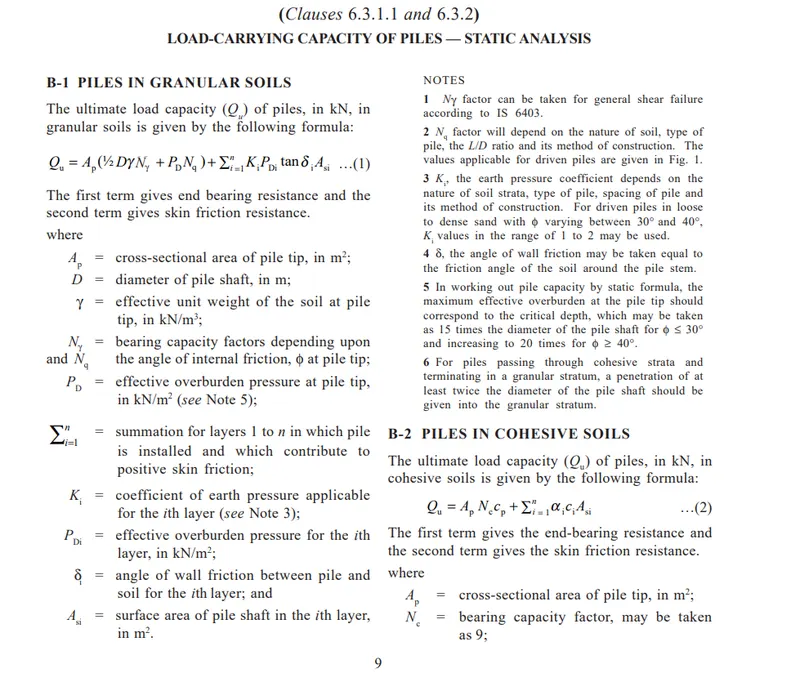
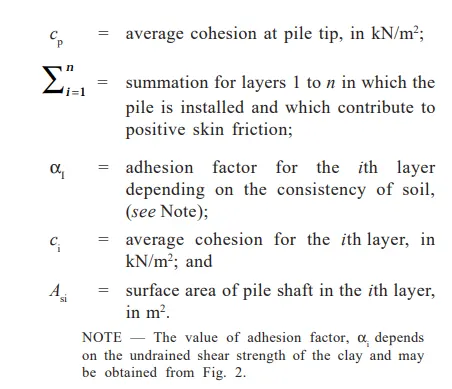
Pile foundations shall be designed in such a way that the load from the structure can be transmitted to the sub-surface with adequate factor of safety against shear failure of sub-surface and without causing such settlement (differential or total), which may result in structural damage and/or functional distress under permanent/transient loading. The pile shaft should have adequate structural capacity to withstand all
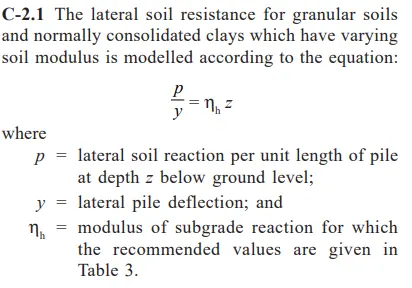
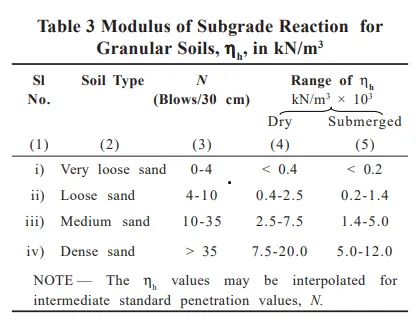
loads (vertical, axial or otherwise) and moments which are to be transmitted to the subsoil .The load-carrying capacity of a pile depends on the properties of the soil in which it is embedded. Axial load from a pile is normally transmitted to the soil through skin friction along the shaft and end-bearing at its tip. A horizontal load on a vertical pile is transmitted to the subsoil primarily by horizontal subgrade reaction generated in the upper part of the shaft. Lateral load capacity of a single pile depends on the soil reaction developed and the structural capacity of the shaft under bending. It would be essential to investigate the lateral load capacity of the pile using appropriate values of horizontal subgrade modulus of the soil.
For Delhi area the type of soil found there is sandy, loamy, sand or sandy loam and loam silty loam. Hence pile foundation is suitable for such type of soil. Piles transmit the load of a structure to competent sub-surface strata by the resistance developed from bearing at the toe or skin friction along the surface or both. The piles may be required to carry uplift and lateral loads besides direct vertical load. So the no.of piles should be able to take the load of structure and resist the uplift and lateral loads.
Capacity of single pile is to be based on static formula considering ground characteristics.
| Dead load (Superstr.) |
| Super Imposed dead load |
| Live load of vehicle |
| Footpath live load |
| Thermal Load |
| Substructure Weight |
| Footing/Cap Weight |
| Weight of soil on footing/cap |
| Wind |
| Water current force/Earth pressures |
Combinations as per IRC 6.
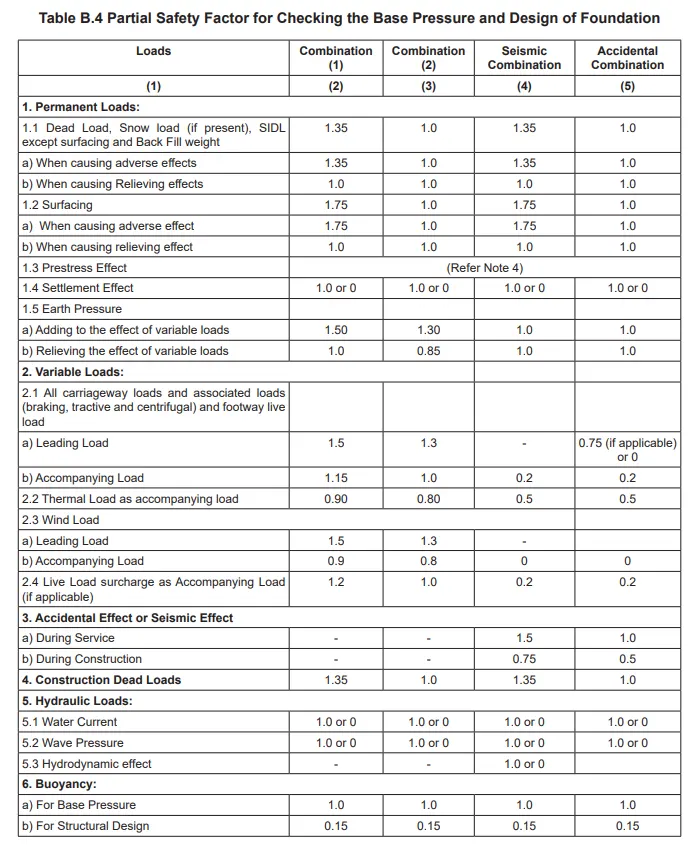
2)To explain about different factors that can impact the number of piles and its depth and how it is different in wall type abutment and pier (free and fix).
Factors that can impact no.of piles are loading from superstructure and substructures, soil weight, if it is present in a water body then water current force, bearing capacity of soil & friction in soil.
For pile-
In soil, the minimum depth of foundations below the point of fixity should be the minimum length required for developing full fixity as calculated by any rational formula. In rocks, the pile should be taken down to rock strata devoid of any likely extension of erosion and properly socketed as required by the design.
For abutment-
The embedment of foundations in soil shail be based on correct assessment of anticipated scour considering the values given under Clause 703 of IRC 78. Foundation may be taken down to a comparatively shallow depth below the bed surface provided good bearing stratum is available, and the foundation is protected against scour. The minimum depth of open foundations shall be upto stratum having safe bearing capacity but not less than 2.0 m below the scour level or the protected bed level.
For pier -
The foundations shall be taken to such depth that they are safe against scour or protected from it. Apart from this, the depth should also be sufficient from consideration of bearing capacity, settlement, liquefaction potential, stability and suitability of strata at the founding level and sufficient depth below. For fix pier longitudinal moment created in the superstructure should be taken into consideration generated due to worst possible load combination for deciding depth of foundation. For free pier only superstructure and substructure loadings are considered for determining depth of foundation.
For abutment, it is important to consider overall stability of the structure and abutment. The piles should also be designed to sustain surcharge effect of embankment.
3) To explain how to fix the diameter of well in the deep foundation in a river bridge in Delhi and to list all the loads acting on it and making all the combinations as per IRC 6.
The minimum dimensions of dredge-hole shall not be less than 3 m as per IRC 78 Cl.708.
It also depends on the bearing capacity of the soil and the lateral loading due to water current or earth pressure.
If the external diameter of single circular well exceeds 12 m then Engineer in-charge may take recourse to any of the following:
a) Stress in steining shall be evaluated using 3-Dimensional Finite Element Method (3D FEM) or any other suitable analytical method.
b) Stiffening by compartments may be done for the single circular well. Design of such stiffened wells shall call for supplemental design and
construction specifications,
c) Twin D-shaped well may be adopted
Loads acting on well
| Dead load (Superstr.) |
| Super Imposed dead load |
| Live load of vehicle |
| Footpath live load |
| Thermal Load |
| Substructure Weight |
| Footing/Cap weight |
| Weight of soil on footing/cap |
| Wind |
| Water current force/Earth pressure |
| Buoyancy |
4) To mention what are the different factors that can impact the diameter of well and its depth and how it is different in wall type abutment , fixed and free pier.
Factors that can impact diameter of well are loading from superstructure and substructures, soil weight, if it is present in a water body then water current force, bearing capacity of soil & friction in soil.
For well foundation in soil,
Well foundations shall be taken down to a depth which will provide a minimum grip of 1/3rd the maximum depth of scour below the design scour level specified in Clause 703.3 of IRC 78.
In rocks
As far as possible, the wells shall be taken by all the methods of sinking including pneumatic sinking (where considered necessary), dewatering, etc. to foundation level and shall be evenly seated all around the periphery on sound rock (i.e., devoid of fissures, cavities, weathered zone, likely extent of erosion, etc.) by providing adequate embedment. The extent of seating and embedment in each case shall be decided by the Engineer-in-charge keeping in view the factors mentioned above to ensure overall and long-term safety of the structure. It is advisable to make a sump (shear key) of 300 mm in hard rock or 600 mm in soft rock inside the well by chiseling/blasting. Diameter of sump may be 1 .5 to 2 m less than inner dredge-hole subject to a minimum size of 1 .5m . Six dowel bars of 25 mm dia deformed bars may be anchored 1 .5 m in rock and projected 1.5 m above. These may be anchored in minimum 65 mm dia boreholes and grouted with 1:172 cement mortar.
For abutment-
The embedment of foundations in soil shail be based on correct assessment of anticipated scour considering the values given under Clause 703 of IRC 78. Foundation may be taken down to a comparatively shallow depth below the bed surface provided good bearing stratum is available, and the foundation is protected against scour. The minimum depth of open foundations shall be upto stratum having safe bearing capacity but not less than 2.0 m below the scour level or the protected bed level.
For pier -
The foundations shall be taken to such depth that they are safe against scour or protected from it. Apart from this, the depth should also be sufficient from consideration of bearing capacity, settlement, liquefaction potential, stability and suitability of strata at the founding level and sufficient depth below. For fix pier longitudinal moment created in the superstructure should be taken into consideration generated due to worst possible load combination for deciding depth of foundation. For free pier only superstructure and substructure loadings are considered for determining depth of foundation.
5)To explain what is free standing length in a pile system and how to determine it and to list all the applicable code clauses from IRC and IS codes.
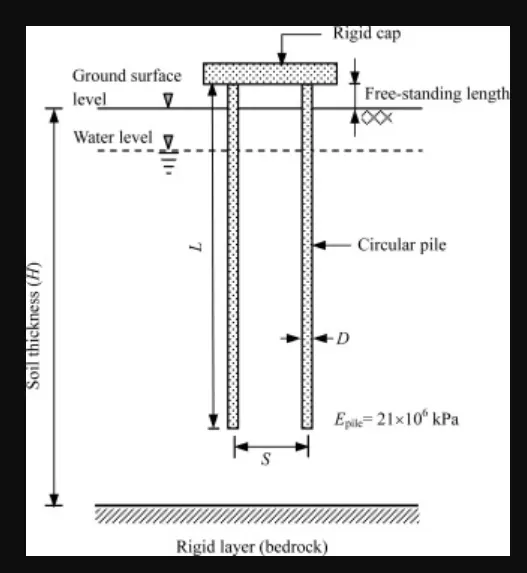
As shown in the image free standing length is the distance of pile from ground surface level to the pile cap.
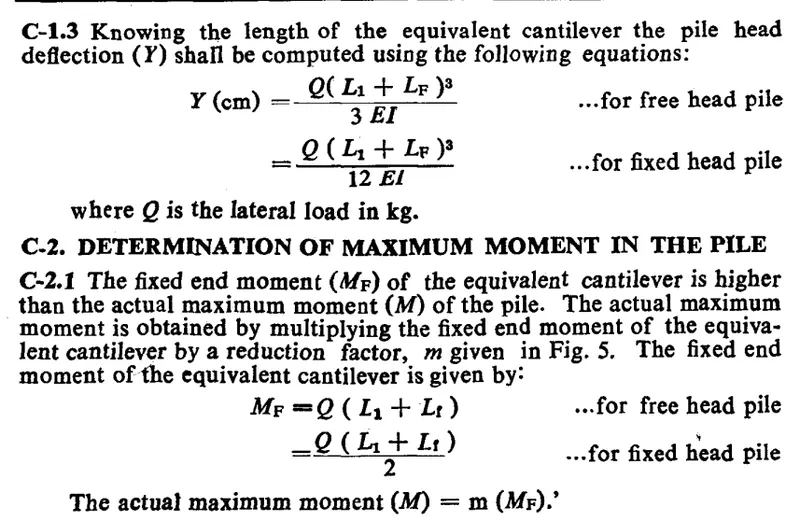
6)To explain the impact of free-standing length on the full length of the pile.
The capacity of piles may be reduced by slenderness effects when a portion of the pile is free standing or when the soil is too weak to provide lateral support
A group of free standing piles is likely to settle more than a single pile.
7) To roughly determine no. of piles on abutment of height 5 m and width of 12 m.Vertical capacity – 250 tonnes Horizontal capacity-35 tonnes
Loading from above =12*5*25=1500kN
Assuming 50% increase in load for superstructure and other vertical loading due to earthpressure, therefore load = 2250 kN
Capacity of pile = 2500kN
No.of piles = Total load from above/Capacity of 1 pile = 2250/2500 = 1, Therefore providing 1 pile.
8) To list out failures in deep foundations and their remedies as per the codal provisions.
Failures in deep foundation are:
Unequal settlement of the sub soil - The soil beneath the foudation may settle unequally, so proper care must be taken during installation.
Horizontal movement of the soil adjoining the structure- During earthquakes, horizontal movement may occur due to seismic waves of the soil surrounding the structure.
Tilt and tolerance failures - During sinking of foundation boulders beneath the structure may tilt the foundation so proper supervision must be followed.
Lateral pressure tending to over turn the structure- Uneven soil strata may vary the lateral surrounding the foundation due to which uneven pressures can be generated tending to overturn.
Lateral escape of the soil below the foundation
RCC failures - During construction errors may occur resulting into improper mix of RCC concrete which may result in RCC failure.
9) To explain all construction parameters need to be taken care of before planning a deep foundation
Protective works (Cofferdam,sheet piles) to be done around foundation.
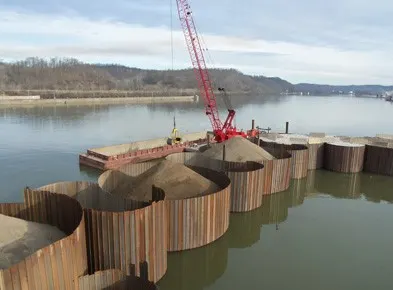
Site clearance and boring shall be done as per IS code.
Lowering the steel cage after clearing
Casting the pile by pouring wet concrete.
Bottom plug, sinking and top plug in case of well.