Week 7 Challenge
Vehicle Model in MATLAB SIMULINK:
Vehicle model is nothing but the equation of forces which comes under velocity when vehicle moves from its rest position for motorized vehicles such as automobile aircraft and watercraft. Vehicle dynamics is the study of vehicle motion. For example, how a vehicle's forward motion change in response to driver inputs, propulsion system outputs, ambient conditions air, surface and water conditions. Figure (1) shows the forces act on an automobile.
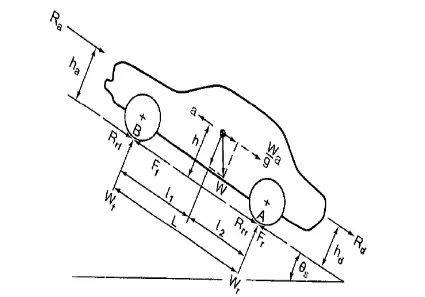
Figure (2) also shows the different types of traction forces.
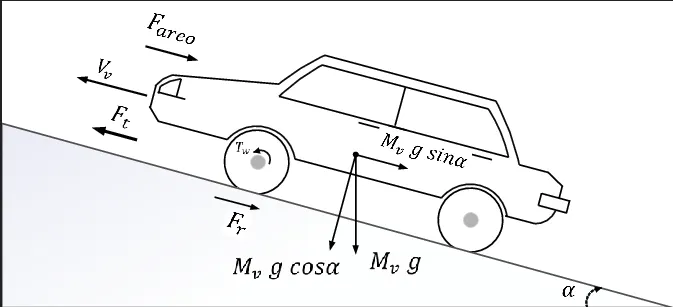
The following are the forces which would be acting on a vehicle:
Rolling Resistance Force (Fr):
Rolling resistance force in a vehicle refers to the force that opposes the forward motion of a vehicle as its tires roll on the road surface, primarily caused by the deformation of the tire and the friction between the tire and the ground, essentially acting as a resistance that needs to be overcome to keep the vehicle moving forward. It is directly related to the vehicle's weight and tire design and contributes significantly to fuel consumption. When a tire rolls, it experiences deformation as it contacts the road, causing energy to be lost due to internal friction within the tire material, leading to a resistive force against the direction of motion. The following factors affect the rolling resistance force:
i) Tire pressure: Lower tire pressure results in greater deformation and higher rolling resistance.
ii)Tire tread design: Tread pattern and material can impact rolling resistance.
iii) Road surface condition: Rougher roads create more friction and higher rolling resistance.
iv) Vehicle weight: Heavier vehicles experience greater rolling resistance due to increased contact force with the load.
Minimizing rolling resistance is important for fuel efficiency as it reduces the amount of energy needed to overcome this force while driving. The rolling resistance force can be expressed as follows:
Fr = Cr*mg*cos(x)
Where,
Fr = Rolling resistance
Cr = The rolling resistance coefficient
m = Mass of the vehicle
g = Acceleration due to gravity
Aerodynamic Drag Force:
As the vehicle speed increase, the aerodynamic drag force opposes the vehicle motion as the air as is forced to flow around the moving vehicle. It can be calculated as the half of the product of the aerodynamic drag coefficient Cd the front area of the vehicle A, the air density and the square of the vehicle speed, V. The aerodynamic drag force is expressed as follows:
F(aero) = (1/2)*(Cd*A*'rho'*(V)^2)
It is hence important to note that the aerodynamic drag in independent of vehicle mass but has a strong dependence on the vehicle speed. That is why in a car, the aerodynamic drag force is higher than the rolling resistance force at higher speeds.
Force of Acceleration:
The acceleration force refers to the vehicle resistance to speed variations. This force holds us back when we increase our speed and move forward when we slow down. In other words, it means that we consume energy to accelerate up to as certain speed but can recover part of that energy when we decelerate allowing us to drive a certain distance without consuming fuel in equations it is simply expressed as,
F = m*a
where,
F = Force
m = Mass
a = Acceleration.
Gradient Force:
The gradient force occurs when the vehicle is driving on an uphill or a downhill road. The gradient force is due to the longitudinal component of gravitational force namely m*g where 'theta' is the inclination angle of the road. The cosine component of the gravity contributes to the normal force and the corresponding rolling resistance force. The gradient force and the angle 'theta' are negative when driving downhill and positive when driving uphill. Road gradients are expressed as a percentage in terms of tangent 'theta' and have a value typically between +/- 10%.
Fgrad = m*g*sin('theta')
Tractive Force:
Tractive force is the force applied or produced by the vehicle powertrain. The force that moves a vehicle forward by overcoming friction and other resisting force. The tractive force can be calculated using torque and other parameters. The tractive force is calculated as follows:
Ftract = Mu*W
Where,
Mu = Coefficient of traction
W = Load on the driving wheel
The following equation represents the net force acting on a vehicle,
FNet = Ftract - (Faero + Fr + Fgrad)
Simulation of Vehicle Model:
Following figures (3) to (7) shows the subsystem and blocks for the vehicle model and we have used the above force equations for the traction control.
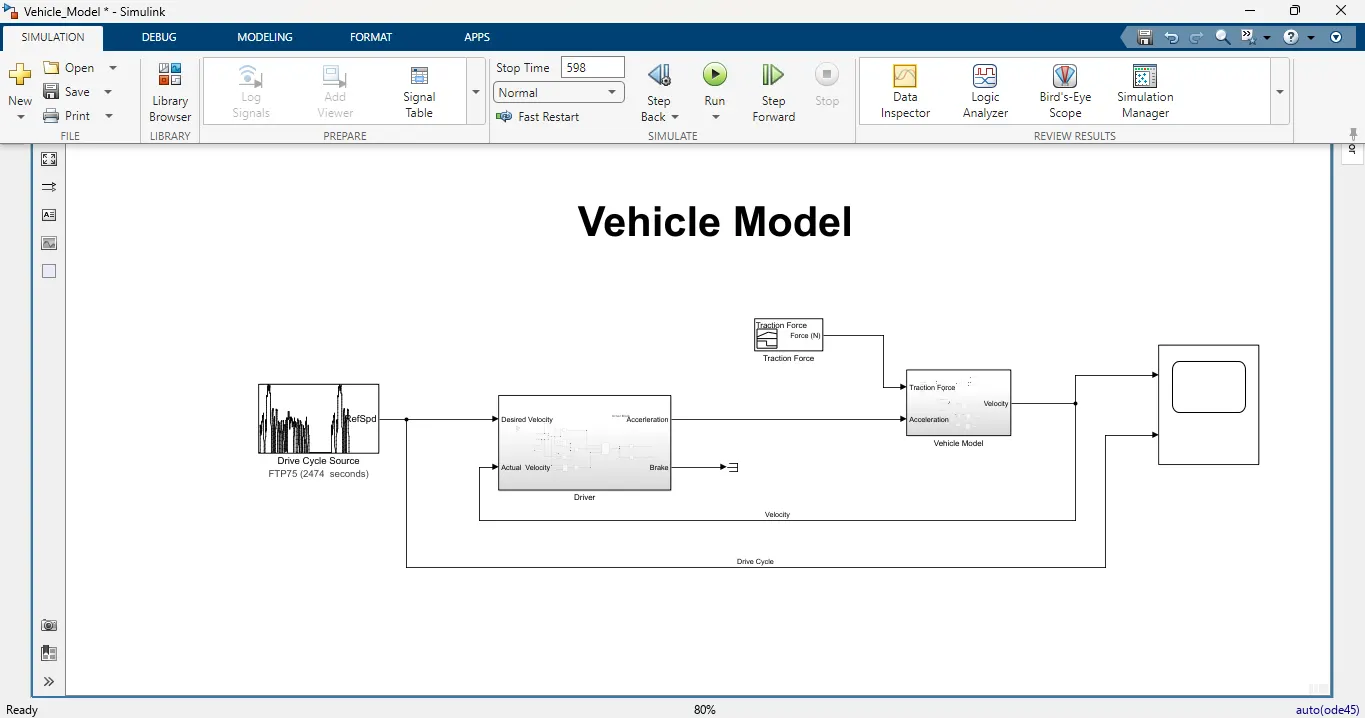
Figure (3): Vehicle Model
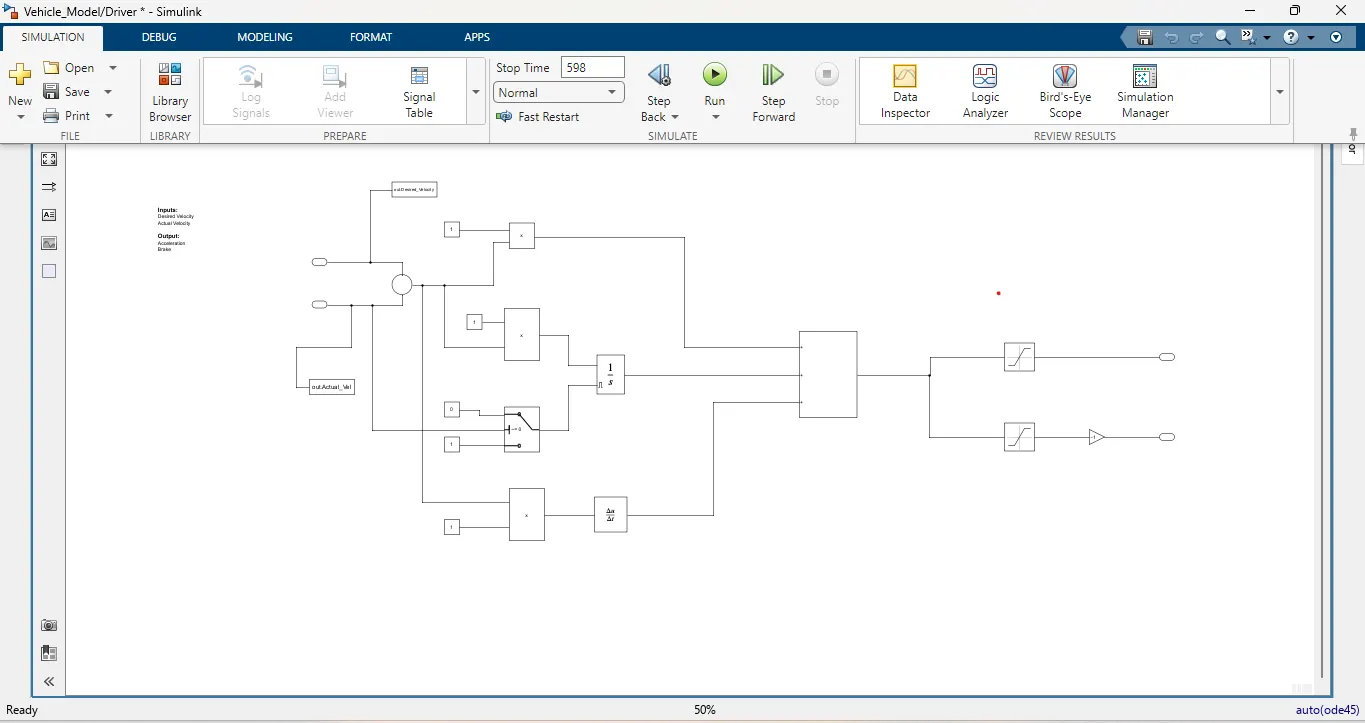
Figure(4): Driver Subsystem
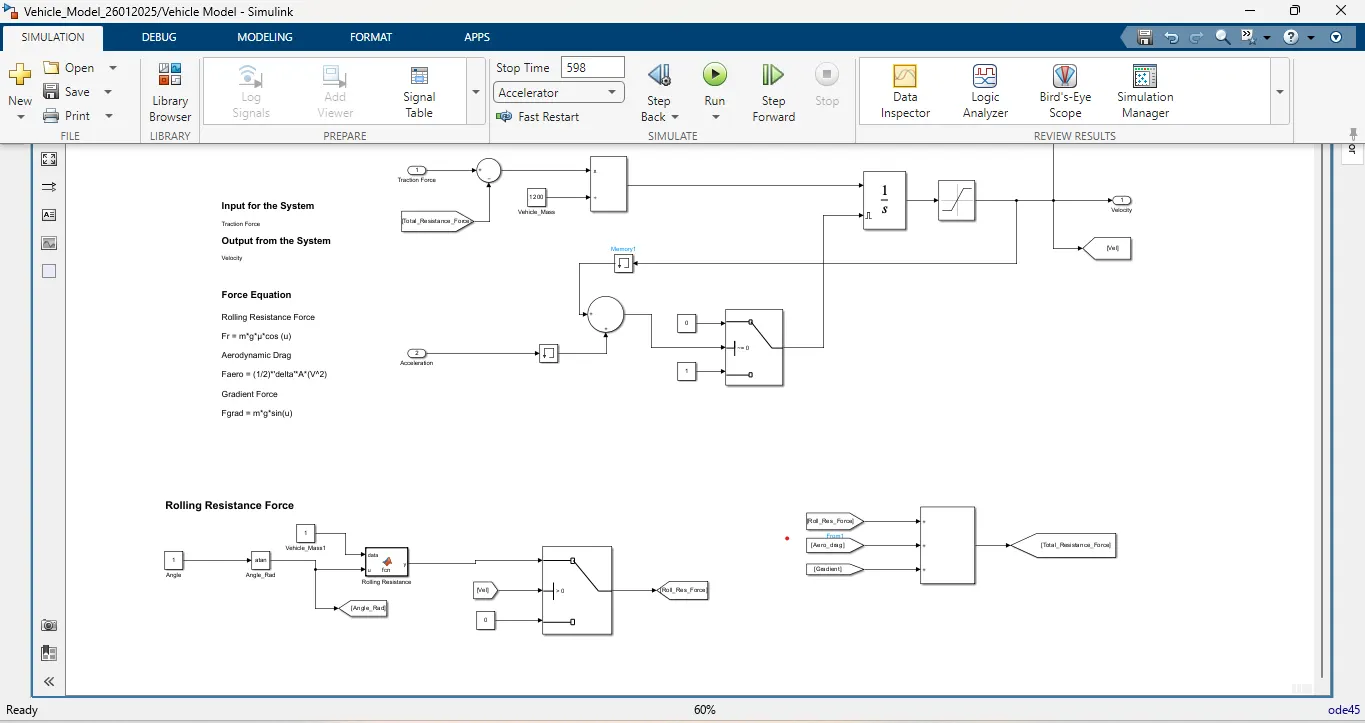
Figure (5): Force calculation Subsystem
Figures (6) and (7) shows the traction force signal in the signal builder block and Scope waveforms respectively.
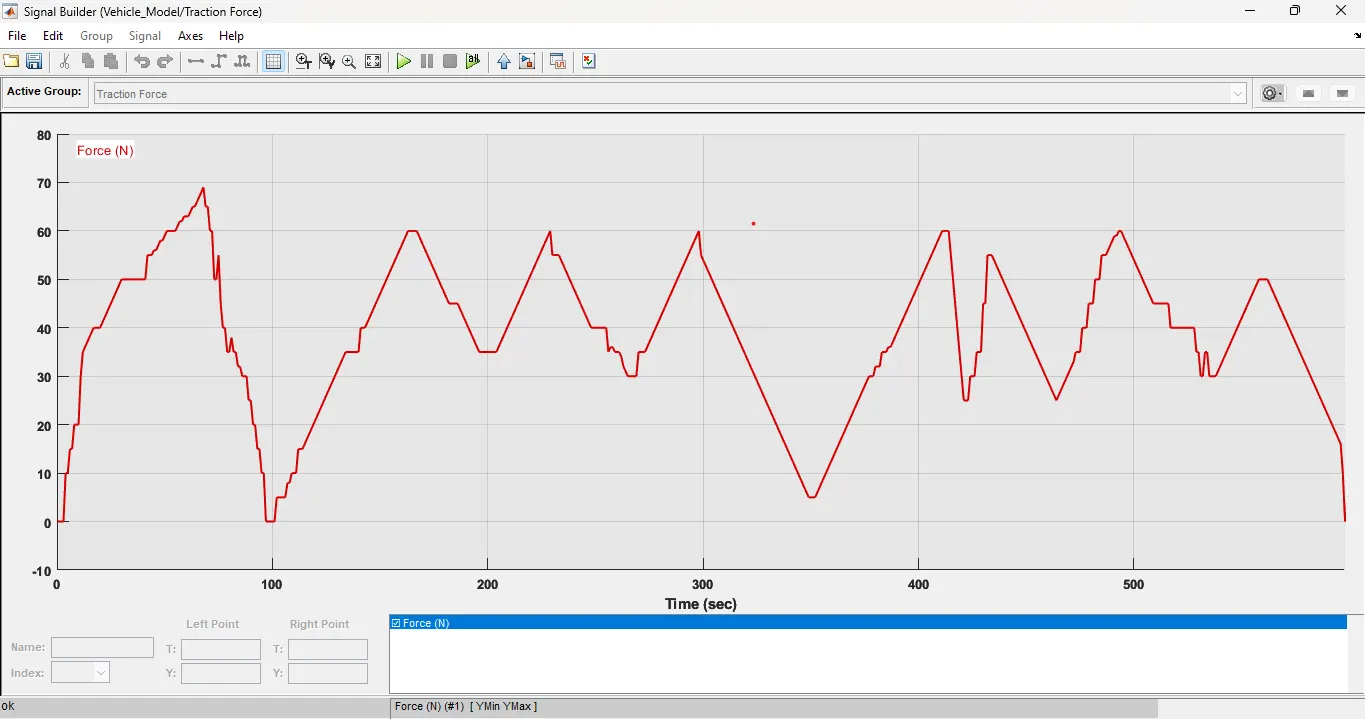
Figure (6): Traction Force Signal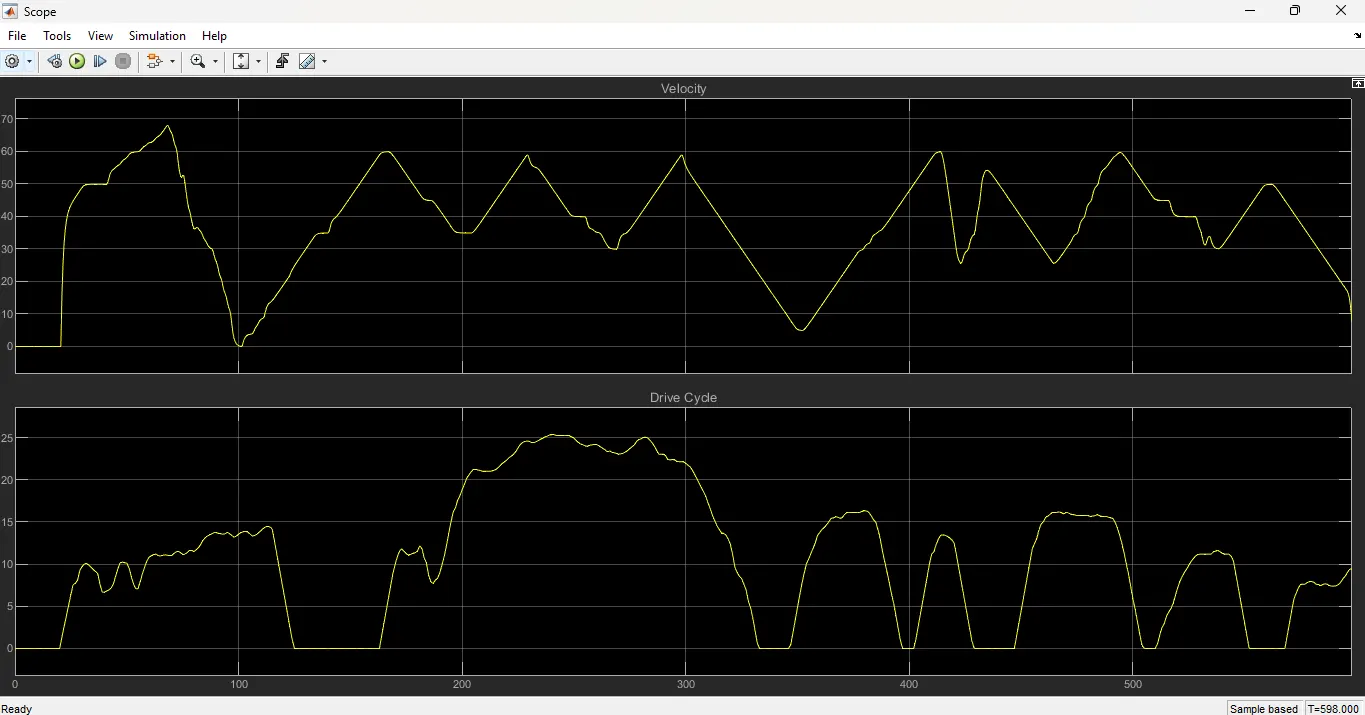
Figure (7): Scope Output