Week 6 Session 13
1. Battery Swapping
Picture this, you are in your brand new swanky EV and cruising down the highway when suddenly, you get an alert saying that your battery capacity is rapidly reaching zero. Search for a plug-in charging station and find one within the acceptable range of the remaining battery charge. Reaching there you find that there is a long line in front of the charging station and will take an average of 2 hours to charge your battery.
Charging an EV takes a long time, a really long time. The only models to buck this trend are the EVs released by Tesla, and only if the cars are connected to the Tesla superchargers.
For the EV market to expand rapidly, the time taken to charge batteries will be a huge deterrent. But what if you could remove your dead battery and swap it with a fully charged one?
This is the technology that the Government of India has proposed in its annual budget for 2021-22. Battery swapping. A technology in which users can exchange the expended batteries from their vehicles with new fully charged batteries. This technology significantly reduces the charging time while also decreasing the load on the electric grid. Currently, the technology only supports integration in two-wheelers and three-wheelers.
While Niti Aayog, the think tank of India, has not released any concrete numbers regarding the expected subsidies and investments in the technology, one can make an educated guess based on the global trends.
The global battery swapping market is projected to rise to US$ 850 million by 2030 rising by an estimated CAGR of 24.5% during 2021-2030 of which, India, China, and SEA countries will be a big part.
One of the success stories in the battery-swapping space that can be emulated across India is that of Gogoro. A Taiwanese company that is changing the way EVs are viewed across SEA and have to date swapped over 300 million batteries.
2. Solid-State Batteries
Every single Electric Vehicle on the road requires a source of energy; typically, in the case of an all-electric vehicle, a Lithium-Ion battery pack provides this energy. Rechargeable batteries in use around the world have similar physical structures and share a few similarities viz are,
- Cathode, the negative terminal. These electrodes are usually constructed from metal oxides of Manganese, Cobalt, Nickel, and Aluminum
- Anode, the positive terminal. Usually constructed from Graphite or Carbon 3. An electrolyte allows for the movement of lithium ions from the anode to the cathode. The electrolyte is, generally, the heaviest part of the battery apparatus 4. Separator, which arrests the flow of electrons from the anode to the cathode
Batteries are generally considered to be lightweight and durable. But, powering an Electric Vehicle requires enormous wattage, and this increase in capacity comes with an increase in the weight of the battery. The lion’s share of the weight of the battery comes from the electrolyte and swapping out the electrolyte will reduce the overall weight of the battery.
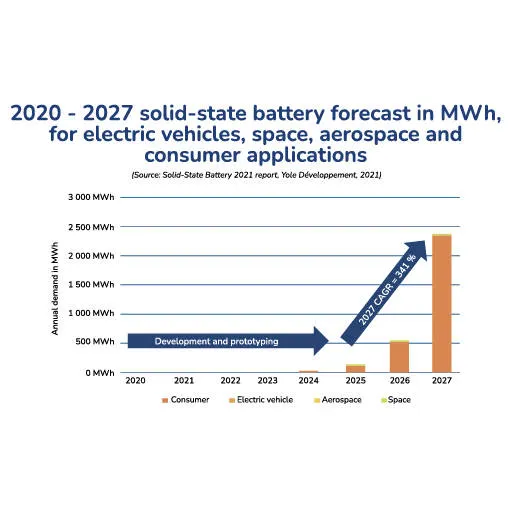
Solid-state batteries replace the liquid electrolyte with a solid like glass or ceramic significantly reducing the weight of the battery pack. Solid-state batteries are also much smaller in size, this allows battery manufacturers to stack more cells per meter. A property that when combined with the higher energy density of solid-state electrolytes increases the capacity of the battery. Liquid electrolytes are prone to a phenomenon known as vaporization at high temperatures, where the liquid turns to gas, resulting in the combustion of the battery pack. Solid-state batteries are much safer to operate at higher temperatures and can handle larger loads.
This US$6 Billion solid-state battery market is primed to take over the world by 2030. Driven primarily by the Electric Vehicle boom, the solid-state battery is soon coming to a battery pack near you.
3. Lithium-Sulfur Battery
The cathode in Lithium-Ion batteries is composed of metal oxides from Lithium, Nickel, Manganese, and Cobalt. Among the three metal oxides, Cobalt accounts for up to 20% of the total weight of the cathode. However, it is mined from the Democratic Republic of Congo, a country that allegedly uses practices that are not socially responsible. As EV production increases around the world, the global supply chain of Cobalt has been severely hit.
Over the decade, significant progress has been made to reduce the dependence on a metal that is prone to supply shocks. Among all the technologies that are being currently studied, the Sulfur-Lithium battery is the one that is leading the race to replace Lithium-ion batteries as the source of energy storage in the future.
In the Lithium-Sulfur battery, the anode is replaced with metallic Lithium while Sulfur serves as the cathode. Discharging the battery produces Lithium-ions that move through the electrolyte. These ions interact with sulfur at the cathode end converting the sulfur into Lithium Polysulphides. This process is reversed while charging.
The primary reason why Lithium-Sulfur is one of the battery trends to expect in the future is due to its high specific energy, in the order of 450W/kg. The higher energy density of Lithium-Sulfur renders itself viable to be used in electricity storage from renewable sources.
But, Sulfur has low conductivity and requires additional carbon to help create polysulphides during the discharging phases. Repeated creation of polysulphides in the cathode end leads to an eventual decrease in the concentration of sulfur and the number of recharges.