Week 6 Session 13
AIM:
Discuss two new trends in battery system field.
Solution:
New Trends in Battery System:
- The world needs more power, preferably in a form that’s clean and renewable. Our energy-storage strategies are currently shaped by lithium-ion batteries at the cutting edge of such technology.
- A battery is a pack of one or more cells, each of which has a positive electrode (the cathode), a negative electrode (the anode), a separator and an electrolyte. Using different chemicals and materials for these affects the properties of the battery – how much energy it can store and output, how much power it can provide or the number of times it can be discharged and recharged (also called cycling capacity).
- Battery companies are constantly experimenting to find chemistries that are cheaper, denser, lighter and more powerful.
NEW GENERATION LITHIUM-ION BATTERIES:
- In lithium-ion (li-ion) batteries, energy storage and release is provided by the movement of lithium ions from the positive to the negative electrode back and forth via the electrolyte.
- In this technology, the positive electrode acts as the initial lithium source and the negative electrode as the host for lithium. Several chemistries are gathered under the name of li-ion batteries, as the result of decades of selection and optimization close to perfection of positive and negative active materials.
- Lithiated metal oxides or phosphates are the most common material used as present positive materials. Graphite, but also graphite/silicon or lithiated titanium oxides are used as negative materials.
- With actual materials and cell designs, li-ion technology is expected to reach an energy limit in the next coming years. Nevertheless, very recent discoveries of new families of disruptive active materials should unlock present limits. These innovative compounds can store more lithium in positive and negative electrodes and will allow for the first time to combine energy and power.
- In addition, with these new compounds, the scarcity and criticality of raw materials are also taken into account.
Advantages:
- Today, among all the state-of-the-art storage technologies, li-ion battery technology allows the highest level of energy density. Performances such as fast charge or temperature operating window (-50°C up to 125°C) can be fine-tuned by the large choice of cell design and chemistries.
- Li-ion batteries display additional advantages such as very low self-discharge and very long lifetime and cycling performances, typically thousands of charging/discharging cycles.
New generation of advanced li-ion batteries is expected to be deployed before the first generation of solid state batteries. They’ll be ideal for use in applications such as Energy Storage Systems for renewables and transportation (marine, railways, aviation and off road mobility) where high energy, high power and safety is mandatory.
LITHIUM-SULFUR BATTERIES:
- In li-ion batteries, the lithium ions are stored in active materials acting as stable host structures during charge and discharge.
- In lithium-sulfur (Li-S) batteries, there are no host structures.
- While discharging, the lithium anode is consumed and sulfur transformed into a variety of chemical compounds; during charging, the reverse process takes place.
-
The main attraction is that they can store much more energy than a similar battery using current lithium-ion (Li-ion) technology. That means they can last substantially longer on a single charge. They can also be manufactured in plants where Li-ion batteries are made – so it should be relatively straightforward to put them into production.
-
Rather than using costly cobalt, which is vulnerable to fragile global supply chains, they use sulphur, which is a cheap raw material available as a by-product of the oil industry. And their costs per unit of power can offer substantial savings. Lithium-sulphur batteries promise to be a cheap alternative to pricey lithium-ion options. Sulphur is cheap, and abundant.
-
The anode of a lithium-sulphur battery would be an extremely thin (and light) sliver of lithium metal. The cathode would be sulphur (well, a mixture of sulphur and carbon). This combination has a very good potential voltage, and both electrodes would be lighter than those found in conventional lithium-ion batteries, making the battery’s energy density up to five times greater.
- The reaction occurring during discharge involves the oxidation of lithium at the anode, and formation of lithium sulphide. At the same time, electrons are released, providing the electric current. At the cathode, sulphur is reduced and also reacts with lithium, forming a sequential range of compounds with varying amounts of sulphur in them (polysulphides).
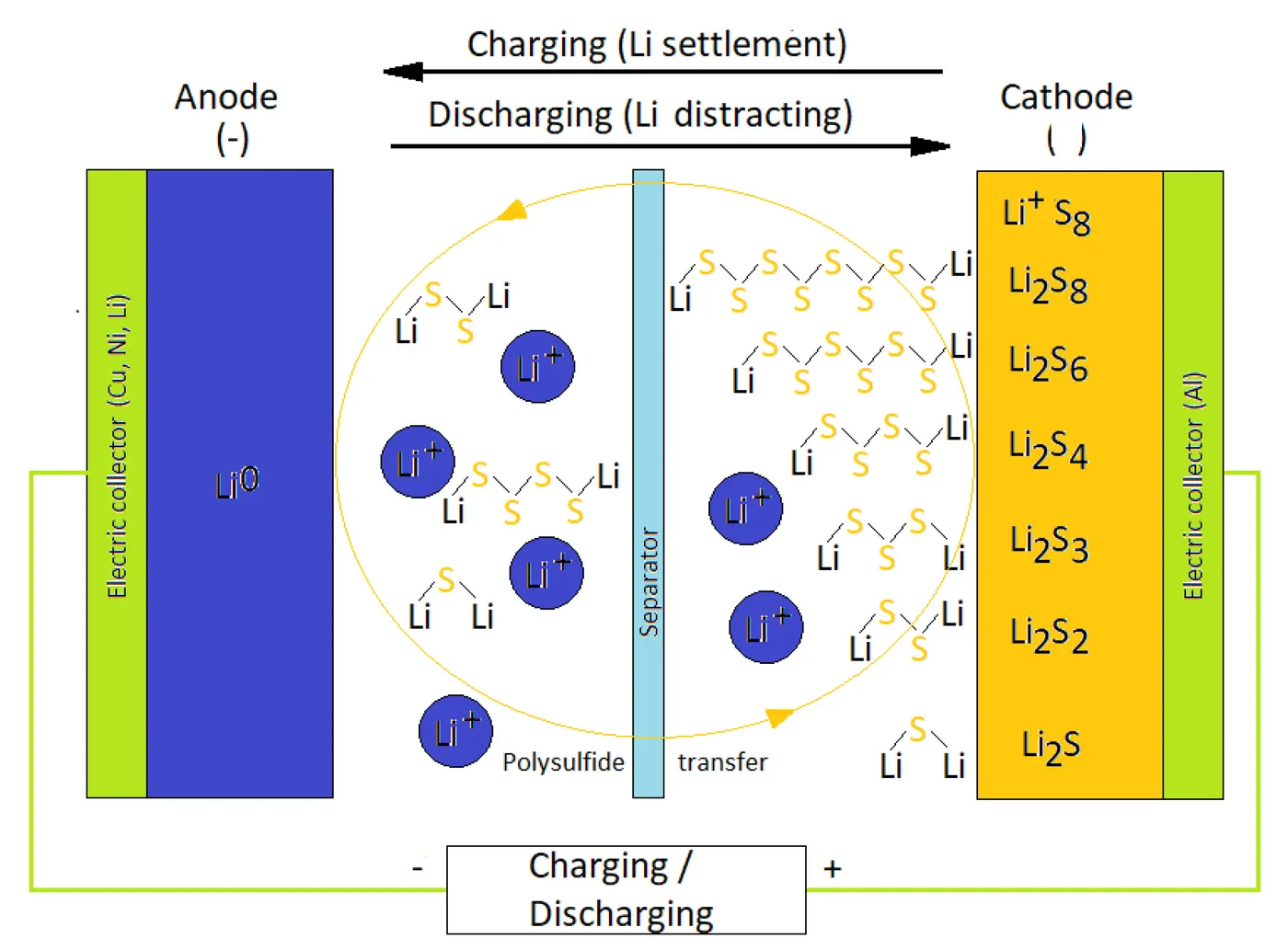
S8→Li2S8→Li2S6→Li2S4→Li2S2
- The problem is that this battery doesn’t last very long, as the sulphur cathode is not very long lived. Many of the polysulphides dissolve easily within the electrolyte solution, which means that, during each discharge cycle, some of the sulphur from the cathode is irretrievably lost into the solution.
- Another issue is that, as lithium reacts with the sulphur of the cathode, the volume of the lithium sulphur compound created is around 80 per cent greater than that of the sulphur cathode before the reaction. This expansion causes the cathode to deteriorate.
- Whatever their composition, batteries are indispensable to our everyday lives, and are going to remain so in the future. They will be crucial for powering the ongoing advances in portable technology, enabling the improvement and practicality of electric vehicles, and providing what’s often described as the ‘missing link’ of renewable energy—the ability to store excess electricity generated from wind, solar and other sources for later use.
Advantages:
- A Li-S battery uses very light active materials: sulfur in the positive electrode and metallic lithium as the negative electrode. This is why its theoretical energy density is extraordinarily high: four times greater than that of lithium-ion. That makes it a good fit for the aviation and space industries.
- This technology is supplementary to solid state lithium-ion thanks to its superior gravimetric energy density (+30% at stake in Wh/kg).
Major technology barriers have already been overcome and the maturity level is progressing very quickly towards full scale prototypes. For applications requiring long battery life, this technology is expected to reach the market just after solid state lithium-ion.
SOLID STATE BATTERIES:
- Solid state batteries represent a paradigm shift in terms of technology. In modern li-ion batteries, ions move from one electrode to another across the liquid electrolyte (also called ionic conductivity).
- In all-solid state batteries, the liquid electrolyte is replaced by a solid compound which nevertheless allows lithium ions to migrate within it. This concept is far from new, but over the past 10 years thanks to intensive worldwide research, the new families of solid electrolytes have been discovered with very high ionic conductivity, similar to liquid electrolyte, allowing this particular technological barrier to be overcome.
Structure of a solid-state battery:
- The internal structure of a solid-state cell is very different, as all its parts are solid. While in traditional lithium batteries, the electrolyte is a liquid, solid-state cells are formed of:
- A cathode (or positive electrode), which can be made with the same compounds as a lithium-ion battery (eg. LFP, NMC, LMO, etc).
- A separator, generally ceramic or solid polymer, which also works as the electrolyte.
- An anode made of lithium metal (pure lithium).
- The grey central layer is the solid-state separator which, on its own, acts both as the separator between the anode and cathode and as the electrolyte. It therefore becomes the medium through which the ions move and also has electric insulating properties and as a mechanical separator between the anode and cathode.
- The fact that there is this solid, resistant support allows the removal of the graphite structure on the anode part and ensures that lithium metal accumulates directly on the anode (there are also semi-solid solutions where the electrolyte is a gel).
Working of Solid State Batteries:
- When the cell is charging, the lithium particles move from the cathode, through the structure of the atoms that form the separator, and then move in between the separator itself and the anode’s electrical contact, thus forming a solid layer of pure lithium.
- In this way, the anode will only be formed of lithium particles and will have a smaller volume than a lithium-ion technology anode, which contains the graphite structure.
Advantages:
- The first huge advantage is a marked improvement in safety at cell and battery levels: solid electrolytes are non-flammable when heated, unlike their liquid counterparts.
- Solid-state batteries promise many improvements over the current batteries on sale; in fact, solid electrolytes seem to offer greater energy density, a longer life and greater safety, all in a smaller size.
- Second, it permits the use of innovative, high-voltage high-capacity materials, enabling denser, lighter batteries with better shelf-life as a result of reduced self-discharge. Moreover, at system level, it will bring additional advantages such as simplified mechanics as well as thermal and safety management.
- As the batteries can exhibit a high power-to-weight ratio, they may be ideal for use in electric vehicles.
Key factor of safety:
- Solid-state batteries do not have a liquid electrolyte, which in lithium-ion batteries is one of the most challenging components in terms of safety, because it is volatile and therefore more flammable.
- Furthermore, this is replaced by a thicker separator layer formed of a material that is mechanically more resistant to high temperatures (because it has a ceramic composition with various additives); this makes the separation between the anode and cathode more reliable, so much so that it prevents short circuits, even in the event of misuse or deterioration, and therefore the intrinsic safety of the cells increases.
Several kinds of all-solid state batteries are likely to come to market as technological progress continues. The first will be solid state batteries with graphite-based anodes, bringing improved energy performance and safety. In time, lighter solid state battery technologies using a metallic lithium anode should become commercially available.