Week 6 Fuel cell powered vehicle model
Make a MATLAB model of fuel cell powered electric vehicle and comment on results.
ANS:What is a fuel cell?
A fuel cell is a device that converts chemical potential energy (energy stored in molecular bonds) into electrical energy. A PEM (Proton Exchange Membrane) cell uses hydrogen gas (H2) and oxygen gas (O2) as fuel. The products of the reaction in the cell are water, electricity, and heat. This is a big improvement over internal combustion engines, coal burning power plants, and nuclear power plants, all of which produce harmful by-products.
Since O2 is readily available in the atmosphere, we only need to supply the fuel cell with H2 which can come from an electrolysis process (see Alkaline electrolysis or PEM electrolysis).
There are four basic elements of a PEM Fuel Cell:
The anode, the negative post of the fuel cell, has several jobs. It conducts the electrons that are freed from the hydrogen molecules so that they can be used in an external circuit. It has channels etched into it that disperse the hydrogen gas equally over the surface of the catalyst.
The cathode, the positive post of the fuel cell, has channels etched into it that distribute the oxygen to the surface of the catalyst. It also conducts the electrons back from the external circuit to the catalyst, where they can recombine with the hydrogen ions and oxygen to form water.
The electrolyte is the proton exchange membrane. This specially treated material, which looks something like ordinary kitchen plastic wrap, only conducts positively charged ions. The membrane blocks electrons. For a PEMFC, the membrane must be hydrated in order to function and remain stable.
The catalyst is a special material that facilitates the reaction of oxygen and hydrogen. It is usually made of platinum nanoparticles very thinly coated onto carbon paper or cloth. The catalyst is rough and porous so that the maximum surface area of the platinum can be exposed to the hydrogen or oxygen. The platinum-coated side of the catalyst faces the PEM.
As the name implies, the heart of the cell is the proton exchange membrane. It allows protons to pass through it virtually unimpeded, while electrons are blocked. So, when the H2 hits the catalyst and splits into protons and electrons (remember, a proton is the same as an H+ ion) the protons go directly through to the cathode side, while the electrons are forced to travel through an external circuit. Along the way they perform useful work, like lighting a bulb or driving a motor, before combining with the protons and O2 on the other side to produce water.
How does it work? Pressurized hydrogen gas (H2) entering the fuel cell on the anode side. This gas is forced through the catalyst by the pressure. When an H2 molecule comes in contact with the platinum on the catalyst, it splits into two H+ ions and two electrons (e-). The electrons are conducted through the anode, where they make their way through the external circuit (doing useful work such as turning a motor) and return to the cathode side of the fuel cell.
Meanwhile, on the cathode side of the fuel cell, oxygen gas (O2) is being forced through the catalyst, where it forms two oxygen atoms. Each of these atoms has a strong negative charge. This negative charge attracts the two H+ ions through the membrane, where they combine with an oxygen atom and two of the electrons from the external circuit to form a water molecule (H2O).
All these reaction occurs in a so called cell stack. The expertise then also involves the setup of a complete system around core component that is the cell stack.
The stack will be embedded in a module including fuel, water and air management, coolant control hardware and software. This module will then be integrated in a complete system to be used in different applications.
Due to the high energetic content of hydrogen and high efficiency of fuel cells (55%), this great technology can be used in many applications like transport (cars, buses, forklifts, etc) and backup power to produce electricity during a failure of the electricity grid.
Advantages of the technology:
- By converting chemical potential energy directly into electrical energy, fuel cells avoid the “thermal bottleneck” (a consequence of the 2nd law of thermodynamics) and are thus inherently more efficient than combustion engines, which must first convert chemical potential energy into heat, and then mechanical work.
- Direct emissions from a fuel cell vehicle are just water and a little heat. This is a huge improvement over the internal combustion engine’s litany of greenhouse gases.
- Fuel cells have no moving parts. They are thus much more reliable than traditional engines.
- Hydrogen can be produced in an environmentally friendly manner, while oil extraction and refining is very damaging.
Why Study Fuel Cells?
Fuel cells can be used in a wide range of applications, including transportation, material handling, stationary, portable, and emergency backup power applications. Fuel cells have several benefits over conventional combustion-based technologies currently used in many power plants and passenger vehicles. Fuel cells can operate at higher efficiencies than combustion engines, and can convert the chemical energy in the fuel to electrical energy with efficiencies of up to 60%. Fuel cells have lower emissions than combustion engines. Hydrogen fuel cells emit only water, so there are no carbon dioxide emissions and no air pollutants that create smog and cause health problems at the point of operation. Also, fuel cells are quiet during operation as they have fewer moving parts.
Automotive fuel cells can have one or all of the following characteristics:
• A fuel cell is sized to provide all of the power to a vehicle. A battery may be present for startup.
• A fuel cell typically supplies a constant amount of power, so for vehicle acceleration and other power spikes, additional devices are typically switched on such as batteries, ultra or supercapacitors, and so on.
• A fuel cell can be used as the secondary power source. A system can be set up where batteries power the vehicle, and the fuel cell recharges the batteries when needed.
• A fuel cell can run part or all of the vehicle’s electrical system. Sometimes another engine is used for propulsion.
The main components of a fuel cell: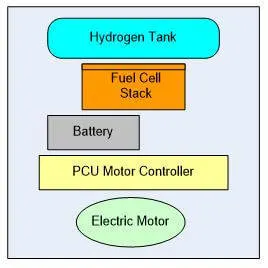
An automotive fuel cell system can use a variety of fuels, and the selection of a fuel depends on factors such as the fuel supply infrastructure, the cost of fuel, the complexity and cost of storage, safety, environmental implications, and the national energy policy. The proper storage of hydrogen is critical for the mass commercialization of fuel cell vehicles. Hydrogen can be stored in many forms, such as compressed gas, liquid, or as metal hyrides. Tanks that hold compressed gases are large and bulky. The average fuel efficiency of new cars is between 20 and 30 mpg; European and Japanese cars average even less. Current vehicles hold 10 to 16 gallons of gasoline, or 30 to 45 liters of space. Since hydrogen has twice the efficiency of gasoline vehicles, they can theoretically store between 5 to 8 kg of hydrogen, which is equivalent to between 200 and 400 L—a sizable reduction in the space needed for fuel. Liquid hydrogen tanks are less bulky but must be stored at extremely low temperatures.
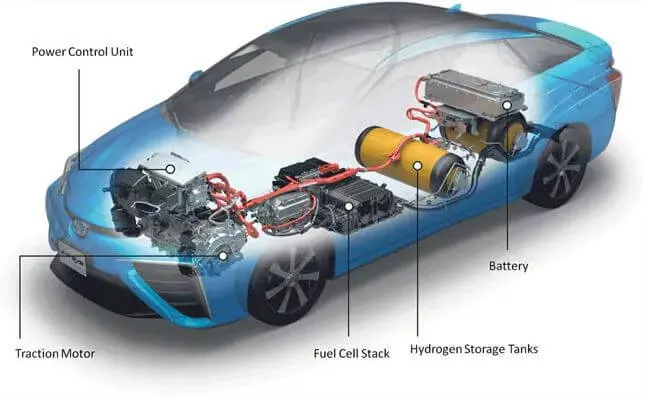
Certain automobile manufacturers have resorted to using other fuels for fuel cells, but most manufacturers still choose pure hydrogen as the option for the future. Another option for hydrogen is the onboard reforming of various fuels or directly feeding various fuel types into the fuel cell. Onboard reforming may eliminate the problem of onboard storage and the lack of hydrogen infrastructure. However, fuel cell vehicles with onboard processors present several issues:
• The vehicles do not have zero emissions.
• Reformed hydrogen is not pure, and therefore decreases the fuel cell’s efficiency.
• Onboard reforming increases the complexity, size, weight, and cost of the entire system.
• The long-term effects of fuel impurities on the fuel cell stack.
How do fuel cells work?
The purpose of a fuel cell is to produce an electrical current that can be directed outside the cell to do work, such as powering an electric motor or illuminating a light bulb or a city. Because of the way electricity behaves, this current returns to the fuel cell, completing an electrical circuit.
The chemical reactions that produce this current are the key to how a fuel cell works.
There are several kinds of fuel cells, and each operates a bit differently. But in general terms, hydrogen atoms enter a fuel cell at the anode where a chemical reaction strips them of their electrons. The hydrogen atoms are now "ionized," and carry a positive electrical charge. The negatively charged electrons provide the current through wires to do work. If alternating current (AC) is needed, the DC output of the fuel cell must be routed through a conversion device called an inverter.
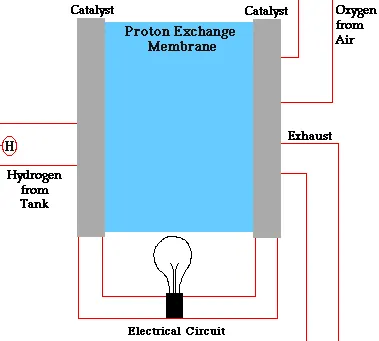
Oxygen enters the fuel cell at the cathode and, in some cell types (like the one illustrated above), it there combines with electrons returning from the electrical circuit and hydrogen ions that have traveled through the electrolyte from the anode. In other cell types the oxygen picks up electrons and then travels through the electrolyte to the anode, where it combines with hydrogen ions.
The electrolyte plays a key role. It must permit only the appropriate ions to pass between the anode and cathode. If free electrons or other substances could travel through the electrolyte, they would disrupt the chemical reaction.
Whether they combine at anode or cathode, together hydrogen and oxygen form water, which drains from the cell. As long as a fuel cell is supplied with hydrogen and oxygen, it will generate electricity.
Even better, since fuel cells create electricity chemically, rather than by combustion, they are not subject to the thermodynamic laws that limit a conventional power plant (see "Carnot Limit" in the glossary). Therefore, fuel cells are more efficient in extracting energy from a fuel. Waste heat from some cells can also be harnessed, boosting system efficiency still further.
MATLAB model of fuel cell powered electric vehicle
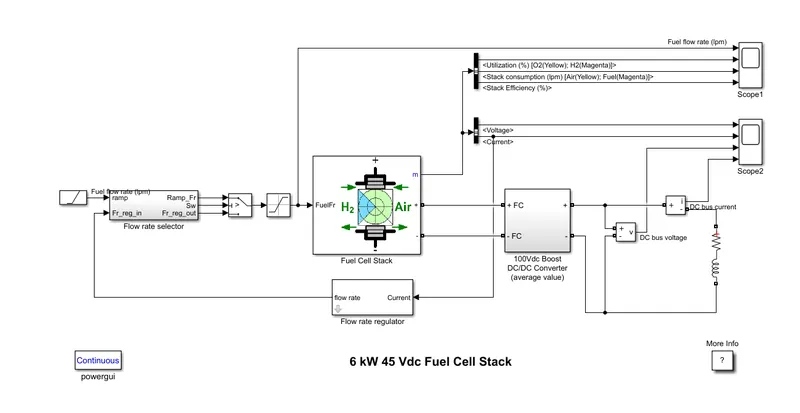
Blocks and parameters that are used in this model:
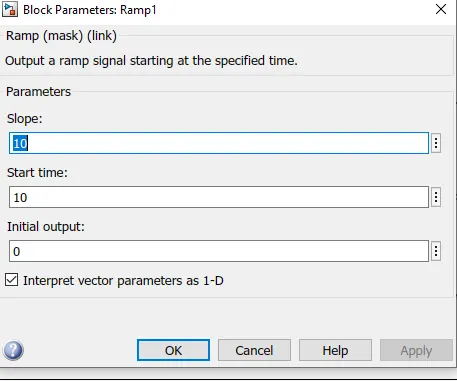
1.Ramp:The Ramp block generates a signal that starts at a specified time and value and changes by a specified rate. The block's Slope, Start time, and Initial output parameters determine the characteristics of the output signal. All must have the same dimensions after scalar expansion.

2.Flow rate selector:
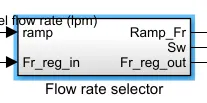
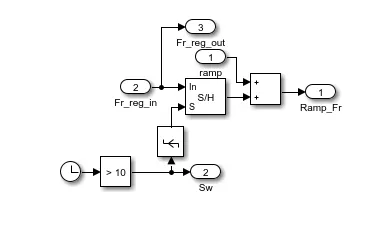
It selects and provide the required output,for any input to understand this block more clearly.
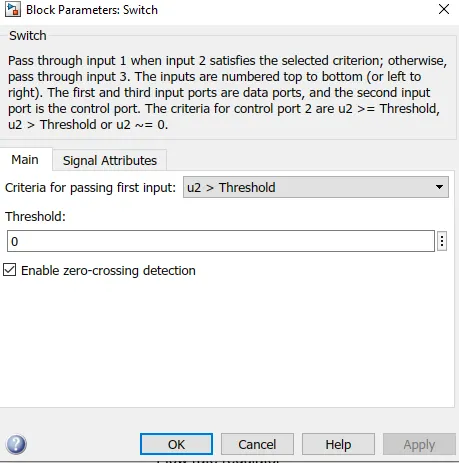
3.Switch:
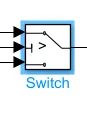
The Switch block models a switch controlled by an external physical signal. If the external physical signal PS is greater than the value specified in the Threshold parameter, then the switch is closed, otherwise the switch is open.
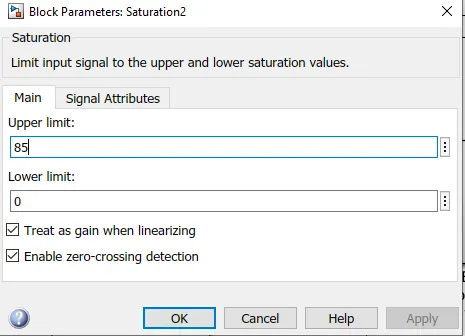
4.Saturation:

saturation creates a default saturation nonlinearity estimator object for estimating Hammerstein-Wiener models. The linear interval is set to [NaN NaN]. The initial value of the linear interval is determined from the estimation data range during estimation using nlhw.
5.Fuel cell stack:
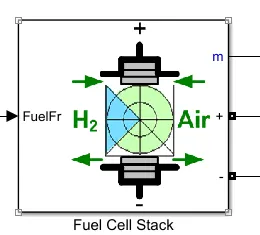
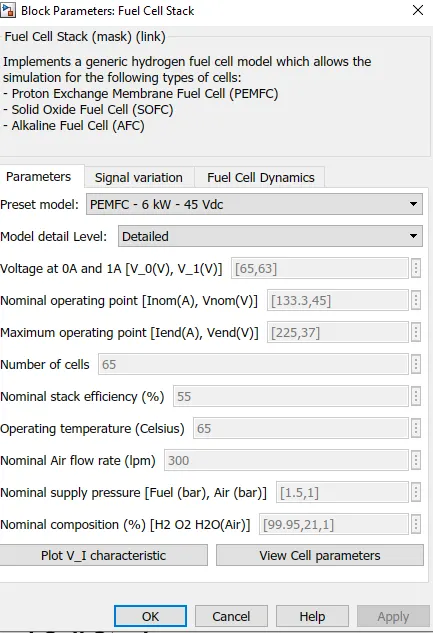
The Fuel Cell Stack block implements a generic model parameterized to represent most popular types of fuel cell stacks fed with hydrogen and air.
6.DC/DC boost converter:
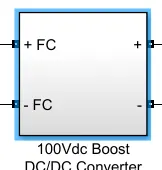
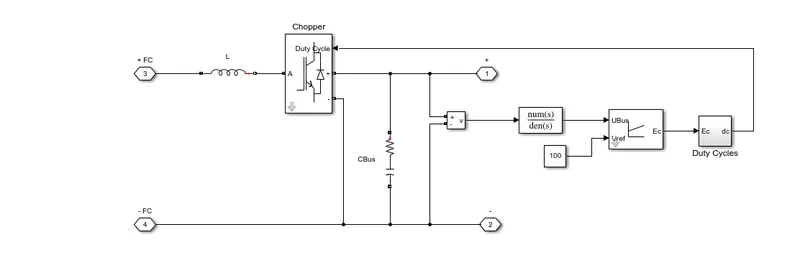
The Average-Value DC-DC Converter block represents a controlled average-value DC-DC converter. You can program the block as a buck converter, boost converter, or buck-boost converter by providing the duty cycle. The diagram shows the equivalent circuit for the block with duty cycle as input. The converter contains a controlled current source and a controlled voltage source. Use the duty cycle, the current reference, or the voltage reference ports as control input to convert the electrical energy between the connected components on either side of the converter.
The powergui block allows you to choose one of these methods to solve your circuit:
-
Continuous, which uses a variable-step solver from Simulink
-
Discretization of the electrical system for a solution at fixed time steps
-
Continuous or discrete phasor solution
RESULTS:
Scope1:
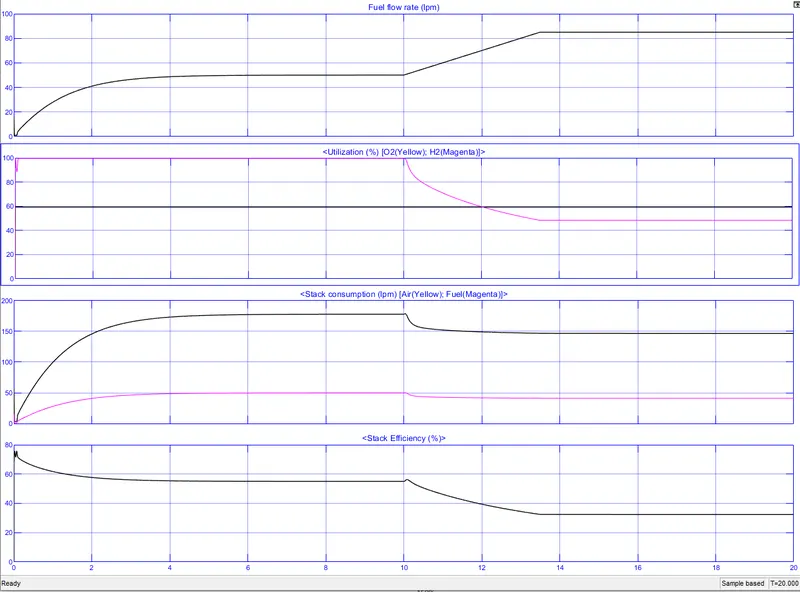
1.Flow rate:From 0 to 10 sec of the time,the flow rate starts increasing and remains constant,until it reaches 50 lpm.After 10sec of the time,the flow rate increases upto 95 lpm which is attrained in 3.5 sec of the time.
We are controlling the voltage and current required for the system by changing the flow rate of the hydrogen and oxygen.
2.Utilization:As the flow rate is increased to 95lpm,ther ecan be seen a reduction in the utilzation of hydrogen 100% to 42% where as oxygen remains constant with the value of 60%.
3.Stack consumption(lpm):We can see in the plot that upto 10 sec,the oxygen and hydrogen consumption gradually increases and remains constant uoto 10 sec again after 10 sec the hydrogen and oxygen consumption decreases and reamins constant.
4.Stack efficiency(%):At time t=0 due to transient state the efficiency first increases and then decreases and remains constant,with the constant stack consumption,efficiency again,decreases and remains constant after 10 sec.
Scope 2:
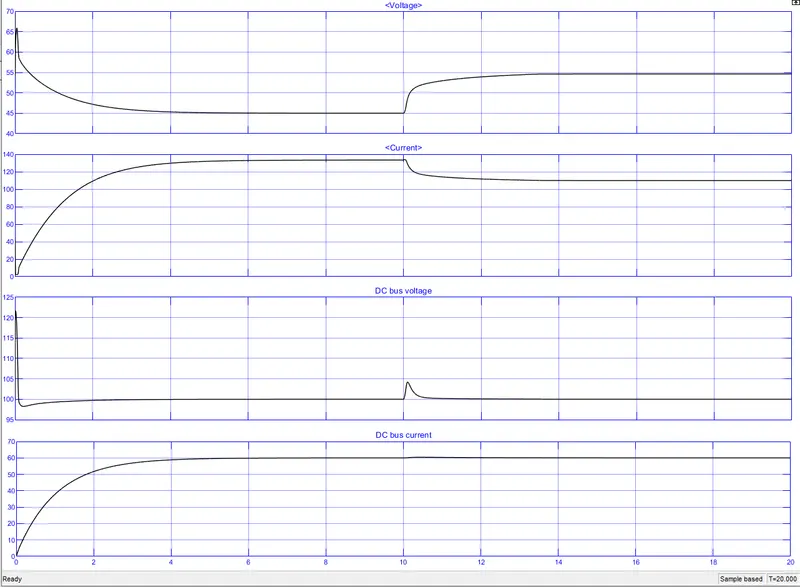
1.Voltage and Current:Both voltage and cuurent changes its value due to transient state.We can see voltage gets down and remians constant,where as current goes up gradually and remains constant upto 10 sec of simulation.After 10 sec with the increase in flow rate voltage of the system increases and to compensate with that currentvalue got decreased.
2.DC bus Voltage and Current:The only change in voltage and current can be seen at transient state of the system.Otherwise there is no change in the DC bus voltage as DC/DC converter of 100 V dc is taken into consideration.