Week 6 Fuel cell powered vehicle model
Fuel cell powered vehicle model
A MATLAB model of fuel cell powered electric vehicle
FCEVs use a propulsion system like that of electric vehicles, where energy stored as hydrogen is converted to electricity by the fuel cell. Unlike conventional internal combustion engine vehicles, they produce no harmful tailpipe emissions. There is no charging , range, life span problems.
- The most common type of fuel cell for vehicle applications is the polymer electrolyte membrane (PEM) fuel cell.
- In the fuel cell stack Keep the type of cell as PEM because it is the standard type of fuel cell used for EV vehicle
- In a PEM fuel cell, an electrolyte membrane is sandwiched between a positive electrode (cathode) and a negative electrode (anode).
- Hydrogen is introduced to the anode,
- oxygen (from air) is introduced to the cathode.
- The hydrogen molecules break apart into protons and electrons due to an electrochemical reaction in the fuel cell catalyst.
- Protons then travel through the membrane to the cathode.
At higher flow rate the fuel stack eff is low.
This model allows us to understand its power delivery performance to a various kind of load.
- Boost convertor :- discharges the battery which is at lower level
We use the MATLAB Command to open the model
"power_fuel_cell"
The nominal Fuel Cell Stack voltage is 45Vdc and the nominal power is 6kW. The converter is loaded by an RL element of 6kW with a time constant of 1 sec. During the first 10 secs, the utilization of the hydrogen is constant to the nominal value (Uf_H2 = 99.56%) using a fuel flow rate regulator. After 10 secs, the flow rate regulator is bypassed and the rate of fuel is increased to the maximum value of 85 lpm ( litre per minute ) in order to observe the variation in the stack voltage. That will affect the stack efficiency, the fuel consumption and the air consumption.
Ramp signal is used as load reference. it act as the flow rate reference. To model an EV, a defined flow rate data of a UDDS drive cycle is given as input.
- The default value given in the block is 85 which is the upper limit value for the ramp signal. The maximum speed value attained during the drive cycle can be given as the upper limit value here.
- The duration for this to run is set to 100 sec with all other default parameters.
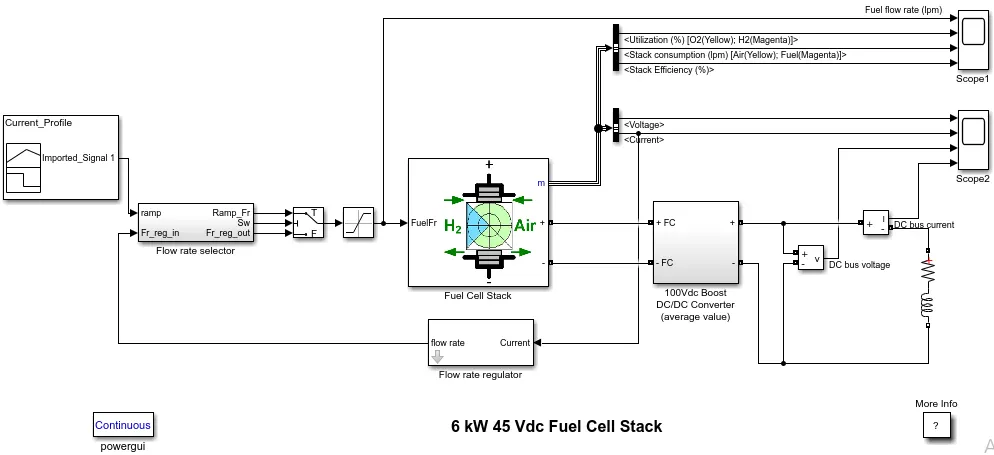
Results:-
Scope2:- Fuel cell voltage, current, DC/DC converter voltage and DC/DC converter current signals are available.
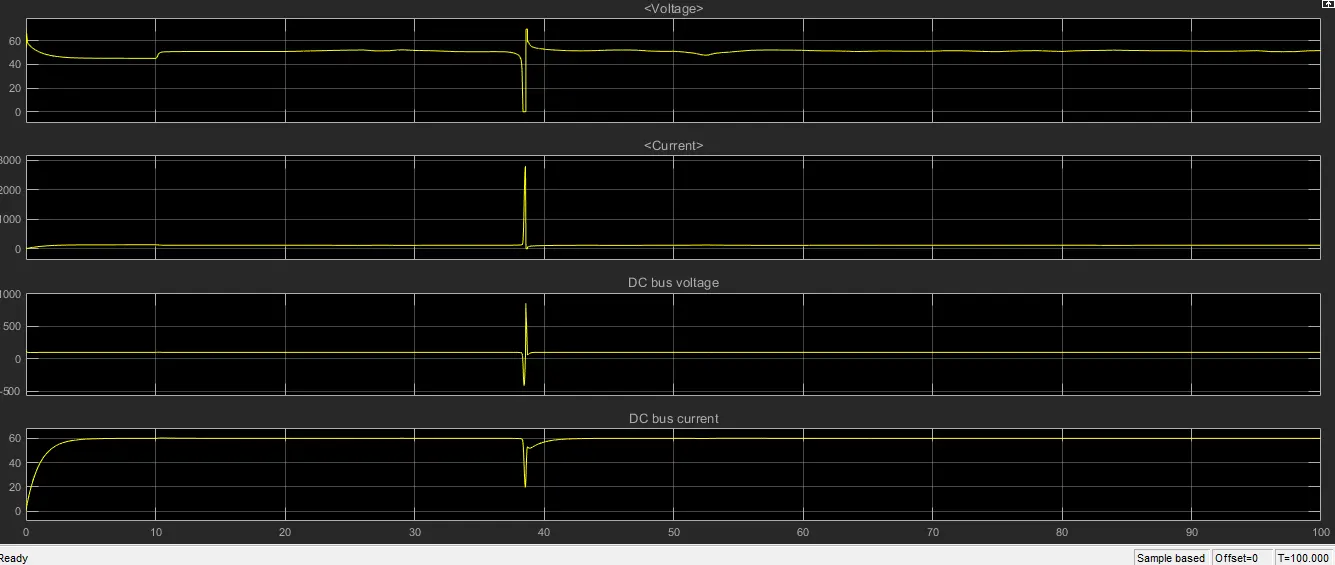
- Initially the Voltage is at 45v for 10 second as it is a RL load which gives exponential rise to current and drop to voltage. That is why current increases.
- After 10 sec voltage increases as the flow rate increases the current rate decreases very less and the load is not going to feel much change.
- DC voltage and current are kept almost constant to avoid the fluctuations due to load.
- The dc bus voltage is also giving a constant 100 v as it is preset to do so, it faces a drop and rise at 38 seconds due to deacceleration and it happens always during significant deviation in vehicle acceleration.
- which also results in stack efficiency and dc bus current reduction.
Scope1:- Fuel flow rate, Hydrogen and oxygen utilization, fuel and air consumption, and efficiency are available.
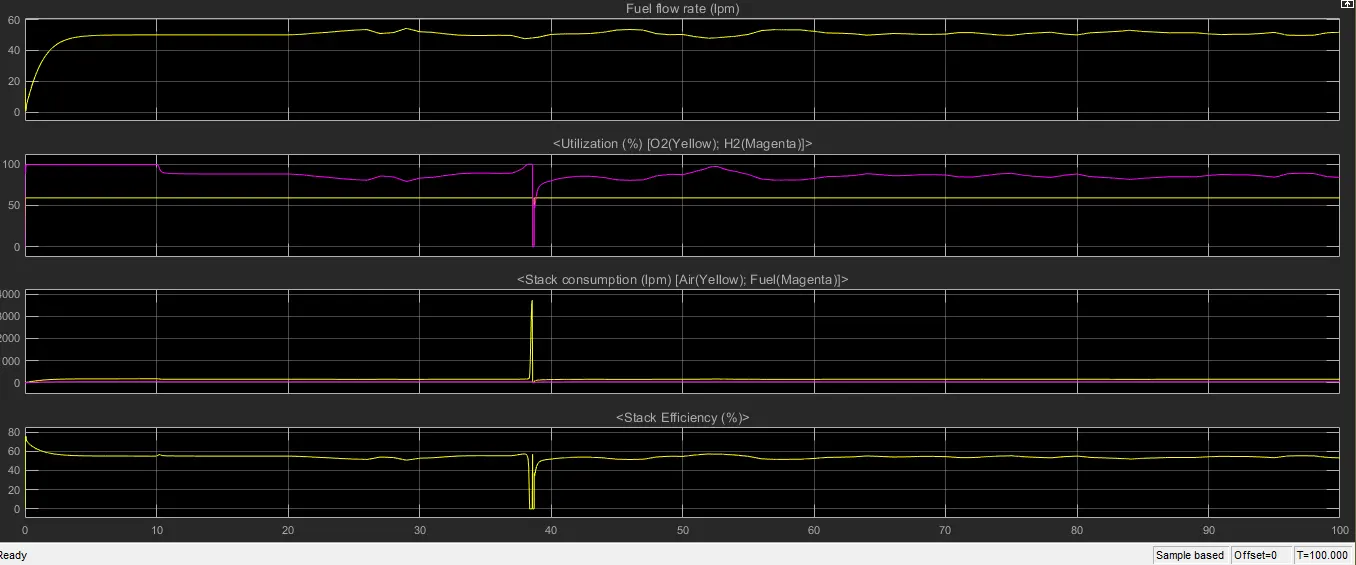
- The fuel flow is 50lpm initially then at 38 second it reduces and stack air c0nsumption increase rapidly and fuel consumption also increase very less.
- During this as we increase the flow rate the efficiency lowers.
- AS we increase fuel flow the voltage also increases.
- The H2 supply kept constant through out this drive cycle to provide vehicle a fixed demand.
- During acceleration the O2 supplied less to give power to vehicle and during deacceleration O2 supplies more as less power required.
Reference:-
https://skill-lync.freshdesk.com/support/solutions/articles/43000572974-how-to-model-fuel-cell-powered-electric-vehicle