Week-6 Challenge: EV Drivetrain
1. Which types of power converter circuits are employed in electric and hybrid electric vehicle?
DC-DC Converters:
Boost Converters: Increase the voltage from the low-voltage battery to the high-voltage level required by the electric motor.
Buck Converters: Decrease the voltage for accessories or subsystems that operate at lower voltages than the main battery.
Inverters:
Motor Inverters: Convert DC power from the main battery to three-phase AC power for driving the electric motor.
Grid-Tie Inverters: In plug-in hybrid electric vehicles (PHEVs) and electric vehicles with bidirectional charging capabilities, inverters can also be used to convert DC power from the battery to AC power for feeding back into the electrical grid (vehicle-to-grid or V2G functionality).
Battery Chargers:
On-Board Chargers (OBC): Convert AC power from the grid to DC power for charging the traction battery.
DC-AC Converters:
Accessory Inverters: Convert DC power from the main battery to AC power for powering various accessories or charging other devices within the vehicle.
Power Factor Correction (PFC) Converters:
Used in battery chargers to improve power factor and efficiency.
Bi-Directional Converters:
Enable bidirectional power flow, allowing energy to be transferred between the vehicle's battery and the grid. This is important for vehicle-to-grid (V2G) applications.
Isolation Converters:
Provide electrical isolation between different parts of the vehicle's electrical system for safety reasons.
Resonant Converters:
Used in some applications to achieve higher efficiency and reduce electromagnetic interference.
2. An Electric Vehicle's powertrain with 72V battery pack in shown in the diagram below. The duty ratio for acceleration operation is 'd1' and for the braking operation the duty ratio is 'd2'.
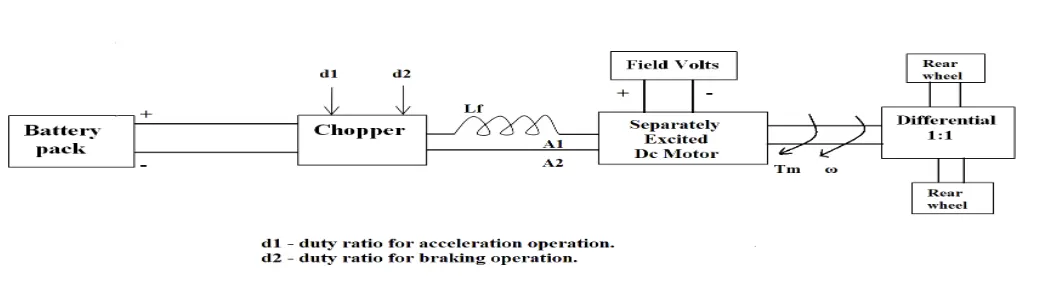
Given that:-
Rated Armature voltage (V)= 72 V
Rated armature current= 400 A
Ra= 0.5Ω,
KΦ= 0.7 Volt second
Chopper Switching frequency= 400 Hz
Duty cycle (dc)= 70% = 0.7
The Average Voltage is given by the product of the battery voltage and the duty cycle,
Vs=V×dcVs=V×dc
Vs=72×0.7Vs=72×0.7
Vs=50.4Vs=50.4
The Average voltage is 50.4 V.
The Vehicle Characteristics are given in the form of the equation,
Tv=24.7+(0.0051)⋅ω2Tv=24.7+(0.0051)⋅ω2---------(1)
The derived formula for the motor speed characteristics
T=Vs×kϕRa−((kϕ)2×ωRa)T=Vs×kϕRa-((kϕ)2×ωRa)
By substituting the Values,
50.4×0.70.5−((0.7)2×ω0.5)50.4×0.70.5-((0.7)2×ω0.5)
T=70.56−0.98⋅ωT=70.56-0.98⋅ω----------(2)
Compare the Equations (1) and (2), we get
70.56−0.98⋅ω=24.7+(0.0051)⋅ω270.56-0.98⋅ω=24.7+(0.0051)⋅ω2
0.0051⋅ω2+0.98⋅ω−45.86=00.0051⋅ω2+0.98⋅ω-45.86=0
By using the Quadratic Equation Formula we get
ω=−b±√b2−4⋅a⋅c2⋅aω=-b±b2-4⋅a⋅c2⋅a
ω=−0.98±√0.982−(4⋅0.0051⋅(−45.86))2⋅0.0051ω=-0.98±0.982-(4⋅0.0051⋅(-45.86))2⋅0.0051
ω=−0.98±1.3770.0102ω=-0.98±1.3770.0102
We get two solutions for this angular speed,
ω=38.92rad.ω=38.92rad./sec.sec. & ω=−231.07rad.ω=-231.07rad./sec.
We can consider only the positive value,
Angular speed = 38.92rad/sec.
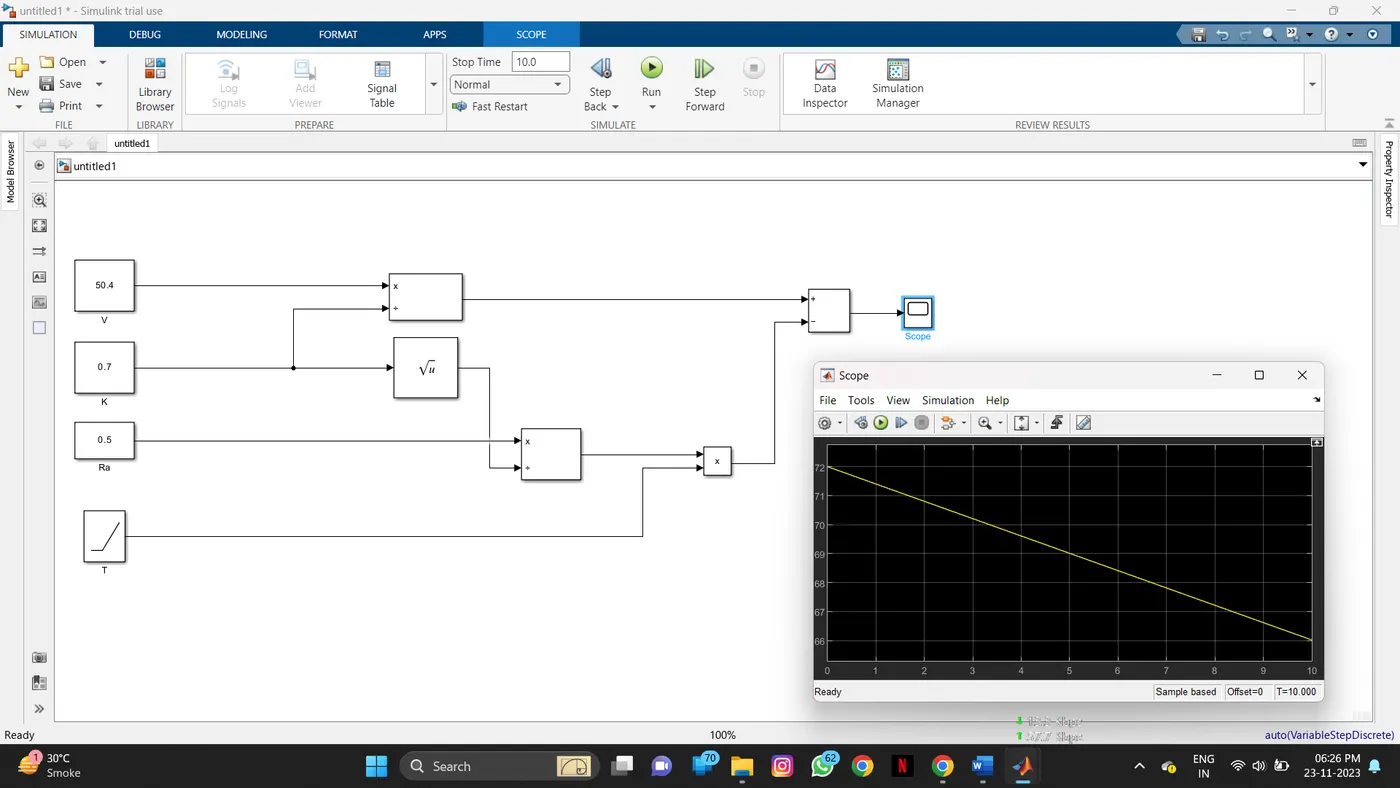
3. Develop a mathematical model of a DC Motor for the below equation using Simulink.
ω">ω�= V/Kϕ">ϕ� -Ra/Kϕ">ϕ�^2 .T
4. Refer to the blog on below topic:
Induction Versus DC brushless motors by Wally Rippel, Tesla
Explain in brief about author’s perspective.
This blog is about the walley reppel about the brushless DC and induction motor.
Walley is proponent of electric vehicle , he was engineer at Aeroenvironment .He also worked in jet propulsion laboratory on electric vehicle battery research ,among other projects proponent means someone who is in favor of something.
He said the lead acid battery is replaced by lithium and brush DC motor with brushless DC motor or induction motor,Next he talk a closer look of the brushless DC motor and induction motor there technologies .
He said that induction motor not require inverter and the motor has ability to start under the load with the fixed utility power dc brushless motor produces no starting torque it needs inverter
then heading is brushless or induction
comparision between DC brushless and induction motor
| DC Brushless | Indution Motor |
| Require an absolute position sensor | Require an absolute position sensor |
| less rotor heat is genereted ,rotor cooling is easier and peak point efficiency higher operate at unity power factor | Power factor is about 85%,peak point efficiency higher compare to DC brushless |
| average efficiency is low | Average efficiency is high |
| Permanent magnets are expensive | No magnet there is advantage in cost |
| They are easy to control | The control laws are more complex and difficult to understand , so difficulties to control |