Week-6 Challenge: EV Drivetrain
Question 1)
Which types of power converter circuits are employed in electric and hybrid electric vehicles?
Solution:
Differences between electric vehicles and hybrid electric vehicles:
| Specifications | Hybrid Cars | Electric Cars |
| Power/Fuel Source | Electricity and Fossil Fuel (Petrol and Diesel) | Electricity Through Battery Pack (DC) |
| Engine | Internal Combustion Engine (ICE) and Electric Motor(s) |
Electric Motor(s) |
| Fuel Efficiency | Combination of ICE and Battery Range | Depends on Battery Range |
| Emission Levels | Higher Compared to Electric Cars | Lower Compared to ICE and Hybrid Cars |
| Price Range | Similar to Conventional ICE Cars | High |
| Charging | Not Needed | Needed |
Power Converter:
Types of Power Converters:
There are four main types of power converter circuits that are used in electric and hybrid electric vehicles.
There are,
AC-to-DC Converter:
- AC-to-DC converters are one of the most important in power electronics because a lot of real-world applications are based on this conversions. The AC-DC current conversion process is known as rectification. The rectifier converts the AC supply into the DC supply at the load end connection. Normally, transformers are used to adjust the AC source to get a step-down transformer to reduce the voltage level and have a better operation range for DC supply.Noramlly AC-to-DC converter converts low voltage values. In most countries, electrical power generation and transmission are purely based on alternating current. Different types of electrical power stations use alternators to generate electricity.
- Most electrical appliance which use DC current for their operation, such as Television,computers, mobiles, etc. In the case of EVs and HEVs, the battery pack that operates with a DC power supply is charged at home or at a charging station, both of which supply power in AC form from the electric grid, so the charges for these vehicles are an example of an AC to DC power converter.
DC-to-AC converter:
- A power inverter is a power electronic device or circuitry that changes direct current to alternating current. The input voltage, output voltage, frequency, and overall power handling depend on the design of the specific device. The inverter does not produce any power; the power is provided by the DC source. A power inverter can be entirely electronic or may be a combination of mechanical effects and electronic circuitry.Static inverters do not use moving parts in the conversion process. An inverter is a device that converts DC power to the AC power used in an electric vehicle motor. The inverter can change the speed at which the motor rotates by adjusting the frequency of the alternating current.
DC-to-DC converter:
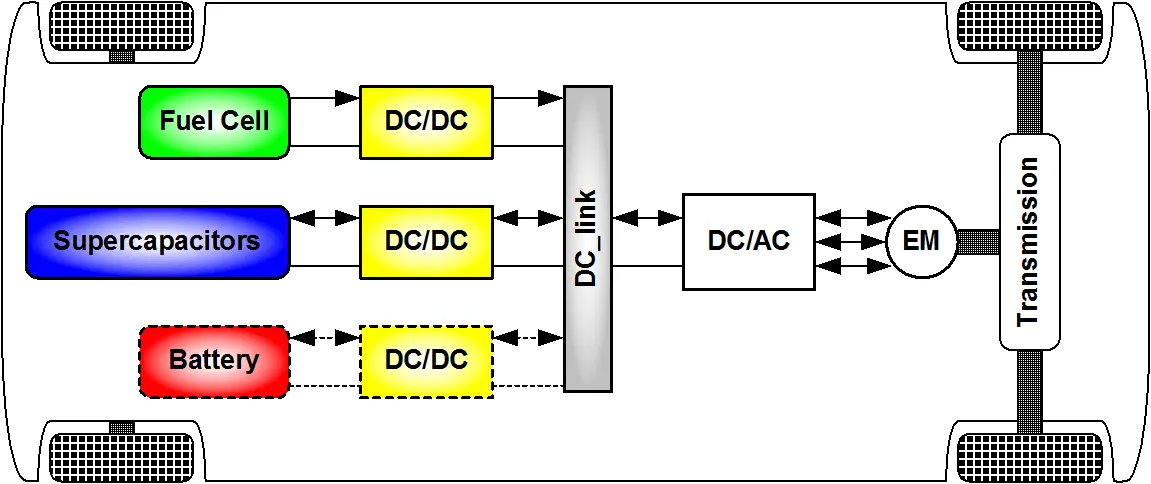
- In electric engineering, a DC to DC converter is a category of power converters, and it is an electric circuit that converts a source of direct current from one voltage level to another by storing the input energy temporarily and then releasing that energy to the output at a different voltage. DC/DC converters can be designed to transfer power in only one direction, from the input to the output. However, almost all DC/DC converter topologies can be made bi-directional. A bi-directional converter can move power in either direction, which is useful in applications requiring regenerative braking.
1. Non-isolated converters:
The non-isolated converter type is generally used where the voltage needs to be stepped up or down by a relatively small ratio (less than 4:1). And when there is no problem with the output and input having no dielectric isolation, there are five main types of converters in this non-isolated group, usually called the buck, boost, buck-boost, cuk, and charge-pump converters. The buck converter is used for voltage step-down, while the boost converter is used for voltage step-up. The buck-boost and cuk converters can be used for either step-down or step-up. The charge-pump converter is used for either voltage step-up or voltage inversion, but only in relatively low-power applications.
2. Isolated converters:
Usually, in this type of converter, a high-frequency transformer is used. In applications where the output needs to be completely isolated from the input, an isolated converter is necessary. There are many types of converters in this group, such as half-bridge, full-bridge, fly-back, forward, and push-pull DC/DC converters. All of these converters can be used as bi-directional converters, and the ratio of stepping down or stepping up the voltage is high.
AC-to-AC converter:
- Ac-to-Ac converters are used for converting AC waveforms with one particular frequency and magnitude to AC waveforms with another frequency at another magnituide. This conversion is mainly required in the case of speed-controlling machines for low-frequency and variable-voltage-majority applications as well. We know that there are different types of loads that work with different types of power supplies, like single-phase and three-phase supplies, and the supplies can be differentiated based on the voltage and frequency range as well. We require a particular voltage and frequency for operating some special devices or machines. For speed control of induction motors, AC-to-AC converters are used primarily to obtain the desired AC power supply from the actual power supply. We need some converters called AC-to-AC converters
Question2)
An electric vehicle's powertrain with a 72V battery pack is shown in the diagram below. The duty ratio for acceleration operation is 'd1' and for braking operation, the duty ratio is 'd2'.
Solution :
Given:
The other parameters of the electric vehicle are given below:
Motor and Controller Parameters:
Rated Armature voltage= 72 V
Rated armature current= 400 A
Ra= 0.5Ω, KΦ= 0.7 Volt second
Chopper Switching frequency= 400 Hz
The vehicle speed-torque characteristics are given by the below equation
What is the EV steady-state speed if the duty cycle is 70%?
As the torque formula is given, we need to find the speed in rad/sec.
T=((v*k)/R)-((k^2*w)/R)
T= torque
v=Armature voltage
R=resistance
w=speed rad/sec
24.7+0.0051*w^2 = ((v*k)/R)-((k^2*w)/R)
24.7+0.0051*w^2=(72*0.7)/0.5-(0.7^2/0.5)*w
70.56-0.98*w=24.7+0.0051*w^2
w^2+192.15*w-8992.5=0
n order to find the roots, use the following formula for a quadratic equation of the form ax^2 + bx + c = 0. the solution are
As the speed values can be negative,
w=38.95 rad\sec
or
clear all
close all
clc
%% input paramater
fprintf("Input Parameter \n")

Va = input("Enter the Va battery or Armature voltage(volt) = ") ;
Ia = input("Enter the Ia Armature current (Ampere) = ") ;
Ra = input("Enter the Ra resistance (ohm) = ") ;
Kphi = input("Enter the Kphi motor constant(volt sec) = ") ;
d = input("Enter the d duty cycle (in percentage) = ") ;

f = 400; % chopper switching frequency (Hz)

%% duty cycle (d),Vo output voltage , Va battery voltage
d1 = d/100  ;% 70 percent
Vo = Va * d1 ;

%% Tm torque for motor and O omega angular speed
syms('Tm','O')
eqn = Tm == ((Vo - (O.*Kphi)).*Kphi)./Ra ;
s1 = solve(eqn);

fprintf("\n")
fprintf("Equation of motor Tm = %s \n",s1)

%% Tv torque for vehicle
% Tv = 24.7 +(0.0051*(O.^2));
eqn1 =  24.7 +(0.0051*(O.^2));
% at steady state Tm = Tv
syms('O')
eqn2 = s1 == eqn1 ;
s2 = vpasolve(eqn2,[O]);
s2rpm =(s2(2)*60)./(2*3.14);

fprintf("\n")
fprintf(" EV steady state speed \n if duty cycle is 70 percentage = %f radian/sec %f RPM",s2(2),s2rpm)

challange_objective2.m
Displaying challange_objective2.m.
ans:
Question3)
Develop a mathematical model of a DC motor for the below equation using Simulink.
ωω= V/Kϕϕ -Ra/Kϕϕ^2 .T
Solution:
Result:
Question 4)
Refer to the blog on the below topic:
Induction Versus DC brushless motors by Wally Rippel, Tesla
Explain in brief about author’s perspective
Solution:
This blog is about the walley reppel about the brushless DC and induction motor.
What is Walley?
Walley is a proponent of electric vehicles; he was an engineer at Aeroenvironment. He also worked in a jet propulsion laboratory on electric vehicle battery research, among other projects. A proponent is someone who is in favor of something. He said the lead-acid battery is replaced by lithium, and brushless DC motors are replaced with brushless DC motors or induction motors. Next, he talks about brushless DC motors and induction motors' technologies.
He said that induction motors do not require inverters, and the motor has the ability to start under load. With the fixed-power DC brushless motor, it produces no starting torque and does not need an inverter.
then heading is brushless or induction here comparison between DC brushless and induction motor
| DC Brushless | Indution Motor |
| Require an absolute position sensor | Require an absolute position sensor |
| less rotor heat is genereted ,rotor cooling is easier and peak point efficiency higher operate at unity power factor | Power factor is about 85%,peak point efficiency higher compare to DC brushless |
| average efficiency is low | Average efficiency is high |
| Permanent magnets are expensive | No magnet there is advantage in cost |
| They are easy to control | The control laws are more complex and difficult to understand , so difficulties to control |
And finally here both are best as per the requirement