Week-6 Challenge: EV Drivetrain
Ans- 1 There are following types of convrters used in EV -
a) AC to DC converter.
b) Dc to Dc converter.
c) Dc to Ac converter .
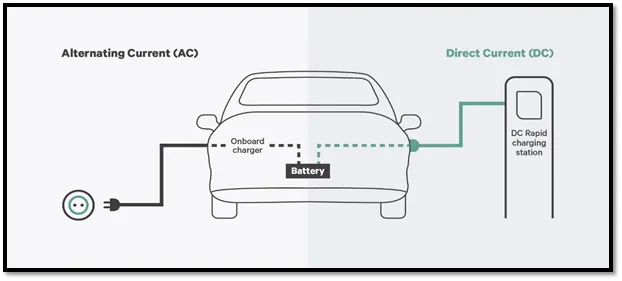
AC – DC Converter (On Board Charger): -
AC to DC converters are most commonly used in Plug-in Hybrid Electric Vehicles (PHEV) & Plug-in Electric Vehicles (PEV). These vehicles get their propulsion power from an external electricity source (charging stations) which is alternating current. The battery needs to be charged using a direct current source. For this purpose, AC to DC converter is employed in a PHEV & PEV.
DC – DC Converter: -
DC-DC converters can be used to interface the elements in the electric power train by boosting or chopping the voltage levels. By introducing DC/DC converters one can choose the voltage variation of the devices and the power of each device can be controlled. The power of the DC/DC converter depends on the characteristics of the vehicle such as top speed, acceleration time from 0 to 100 Km/h, weight, maximum torque, and power profile (peak power, continuous power).
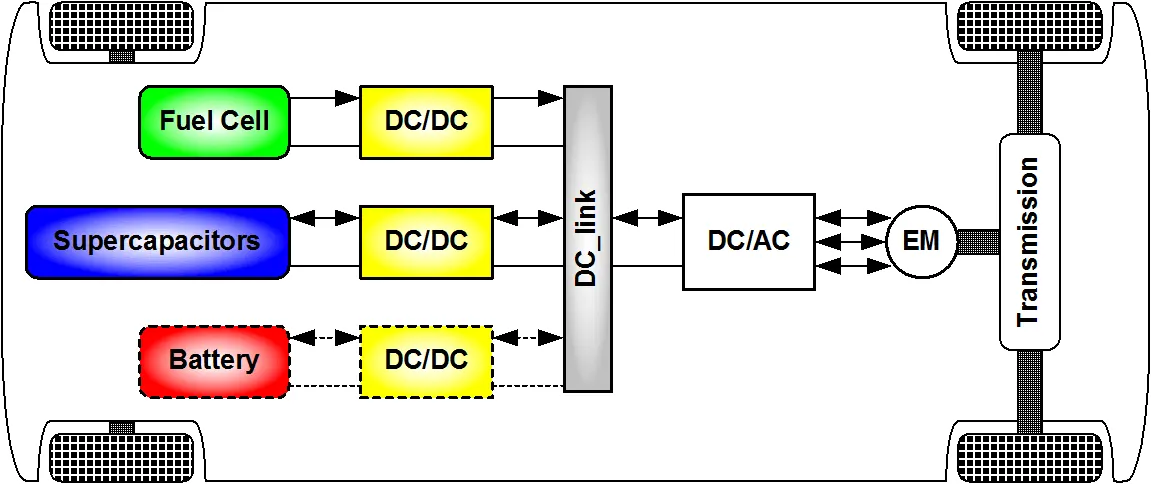
The most common DC/DC converters can be grouped as follows:
Non-isolated converters
The non-isolated converters type is generally used where the voltage needs to be stepped up or down by a relatively small ratio (less than 4:1). And when there is no problem with the output and input having no dielectric isolation. There are five main types of converter in this non-isolated group, usually called the buck, boost, buck-boost, Cuk and charge-pump converters. The buck converter is used for voltage step-down, while the boost converter is used for voltage step-up. The buck-boost and Cuk converters can be used for either step-down or step-up. The charge-pump converter is used for either voltage step-up or voltage inversion, but only in relatively low power applications.
Isolated converters
Usually, in this type of converters a high frequency transformer is used. In the applications where the output needs to be completely isolated from the input, an isolated converter is necessary. There are many types of converters in this group such as Half-Bridge, Full-Bridge, Fly-back, Forward and Push-Pull DC/DC converters. All of these converters can be used as bi-directional converters and the ratio of stepping down or stepping up the voltage is high.
Ans- 2 Steady state speed of Motor :
Motor terminal voltage (Vt) = Va* D
=>72 * 0.7
= > 50.4 volt
Torque speed relation of Motor is given by :
wm= vt/kphi - Ra/Kphi^2 TM
So the torque frim above is equation can be calculated by
Tm= Vt*kphi / Ra - wm(Kphi)^2 / Ra
After putting the respective valuesand solving the above equation we get
Tm = ((50.4*0.7)/(0.5))- ((0.7)^2*Wm)/0.5 = 70.56-0.98*wm
For steady state speed of vehicle the motor torque and the vehicle torque sholuld be equal
so equating TM=Tv
70.56-0.98Wm =24.7+(0.0051)Wm^2
0.0051wm^2+0.98wm-70.57+24.7=0
0.0051wm^2+0.98wm-45.89=0
After solving the above equation we get
Wm=38.936 rad/sec
&
wm =-231.0936 rad/sec
considering the forward motoring mode Wm = 38.9368 rad/sec
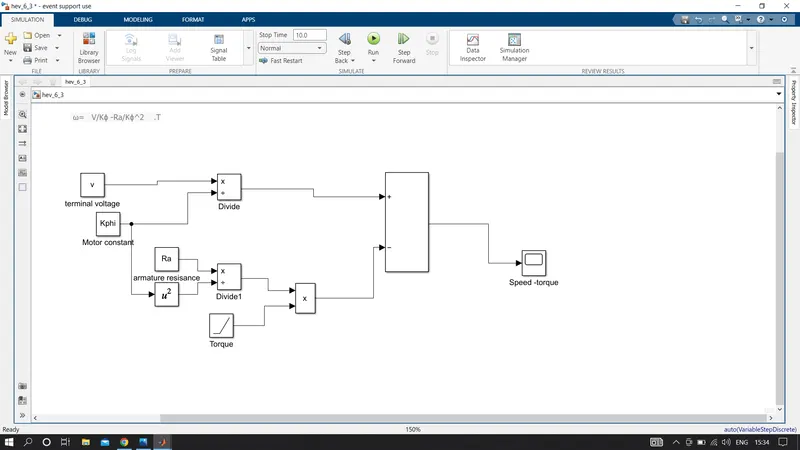
Ans-3 ω">ω= V/Kϕ">ϕ -Ra/Kϕ">ϕ^2
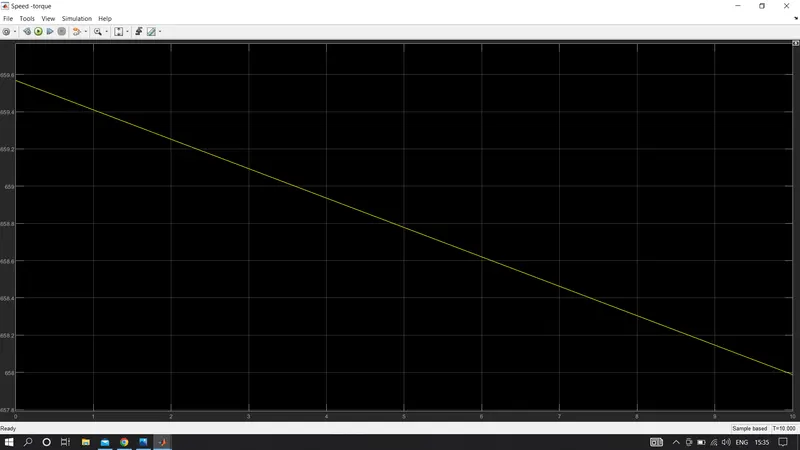
Scope Ouput :
Ans-4
`In the above blog the author has discussed about two motors and their advantages and
disadvantages at a particular and finally he concluded that both motors are best and useful
at their place and as per their requirement . In the end the author couldn't choose which drive
is better then other but makes it clear that Dc Brushless motor drives will likely continue
to dominate in the hybrid and upcoming Plug-in Hyrid markets and induction motors drives
will likely maintain dominance for the high - peformance pure electric .
note- automatically this text formate changed
i have aready submitted this and it got reviewed again i have to do the challenge
98 marks igot