Week-6 Challenge: EV Drivetrain
Q.1 - Which types of power converter circuits are employed in electric and hybrid electric vehicle?
A power converter is an electric circuit which is used to transform one form of electric energy in the another as per the desired load.

There are two types of converter:
1. Step up converter - This converter increases ther voltage of the current from the source to the load.
2. Step down converter - This converter decreases the voltage of the current from the source to the load.

Now, in an EV/HEV both these converters are used combined in a single unit.

Step up converter is used in an EV/HEV for increasing the voltage of the current from the battery to power the induction motor.
The voltage is stepped up from (180-300 volts) to around 650 volts.
This setup allows us to use even a low power battery to run a high voltage motor.

Step down converter can be used to lower the current voltage from EV/HEV battery so that it can be used to power the light load devices
such as lights, windows, media system, mirrors and seat adjustment.

Different types of power converter circuits are as follows :
1- AC to DC Converter (Controlled Rectifier)
2- DC to DC Converter (DC Chopper)
3- AC to AC Converter (AC voltage regulator)
4- DC to AC Converter (Inverter)
5- Diode Rectifier
6- Static Switches

- AC to DC Converter (Controlled Rectifier)

  It is the most common method of charging today for electric vehicles. It converts the AC power to DC and feeds it into the cars battery.
  It is also knows as onboard charger.

- DC to DC Converter (DC Chopper)

  In an EV/HEV ypu shall find two batteries, one being the high voltage battery other being the low voltage battery.
  These converters are used to reduce high voltage DC inpuit to low voltage DC output.
  Previously the low-voltage battery used to be charged using an alternator but today it gets its power from high voltage battery pacl.
  Sometimes the low voltage battery is also required to supply power to the high voltage battery during cranking of the car.
  So, the DC to DC converter should be bi-directional and very efficient.

-  DC to AC Converter (Inverter)

  The function of the inverter is to convert the DC current from the battery pack of EV/HEV to Ac current so that it can be used to
  power the motor and other devices.

-  AC to AC Converter (AC voltage regulator/Cycloconverters)

  Cycloconverters are majorly called as frequency changers that convert the AC power with one input frequency to AC power with a different
  output frequency and can be used for changing the magnitude of the AC power also.
2. An Electric Vehicle's powertrain with 72V battery pack in shown in the diagram below. The duty ratio for acceleration operation is 'd1' and for the braking operation the duty ratio is 'd2'.
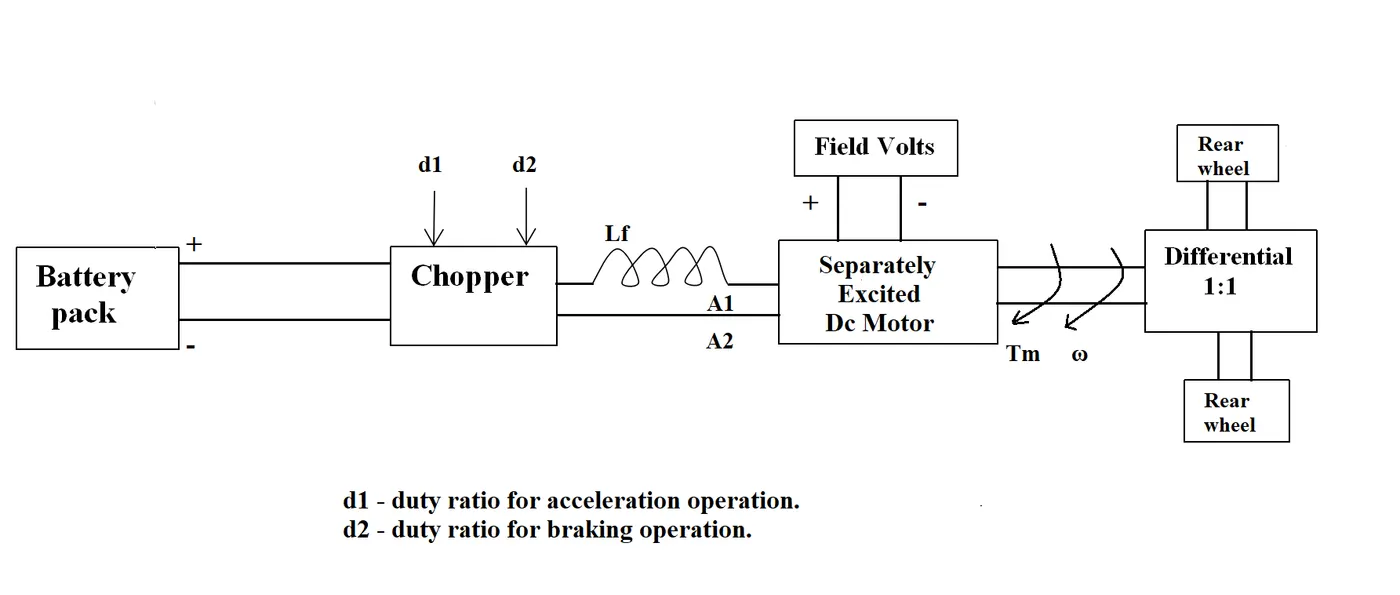
The other parameters of the electric vehicle is given below,
Motor and Controller Parameters:
Rated Armature voltage= 72 V
Rated armature current= 400 A
Ra= 0.5Ω, KΦ= 0.7 Volt second
Chopper Switching frequency= 400 Hz
The vehicle speed-torque characteristics are given by the below equation

What is EV steady state speed if duty cycle is 70%?
ANS-
clear all
close all
clc
%% input paramater
fprintf("Input Parameter \n")

Va = input("Enter the Va battery or Aremature voltage(volt) = ") ;
Ia = input("Enter the Ia Armature current (Ampere) = ") ;
Ra = input("Enter the Ra resistance (ohm) = ") ;
Kphi = input("Enter the Kphi motor constant(volt sec) = ") ;
d = input("Enter the d duty cycle (in percentage) = ") ;

f = 400; % chopper switching frequency (Hz)

%% duty cycle (d),Vo output voltage , Va battery voltage
d1 = d/100  ;% 70 percent
Vo = Va * d1 ;

%% Tm torque for motor and O omega angular speed
syms('Tm','O')
eqn = Tm == ((Vo - (O.*Kphi)).*Kphi)./Ra ;
s1 = solve(eqn);

fprintf("\n")
fprintf("Equation of motor Tm = %s \n",s1)

%% Tv torque for vehicle
% Tv = 24.7 +(0.0051*(O.^2));
eqn1 =  24.7 +(0.0051*(O.^2));
% at steady state Tm = Tv
syms('O')
eqn2 = s1 == eqn1 ;
s2 = vpasolve(eqn2,[O]);
s2rpm =(s2(2)*60)./(2*3.14);

fprintf("\n")
fprintf(" EV steady state speed \n if duty cycle is 70 percentage = %f radian/sec %f RPM",s2(2),s2rpm)
Input Parameters :-
Enter the Va battery or Aremature voltage(volt) = 72
Enter the Ia Armature current (Ampere) = 400
Enter the Ra resistance (ohm) = 0.5
Enter the Kphi motor constant(volt sec) = 0.7
Enter the d duty cycle (in percentage) = 70

Equation of motor Tm = 1764/25 - (49*O)/50

 EV steady state speed
 if duty cycle is 70 percentage = 38.914983 radian/sec 371.799198 RPM>>
Final Ans - If the duty cycle is 70% the ev steady state speed will be 371.80 rpm
Q.3- Develop a mathematical model of a DC Motor for the below equation using Simulink.
ωω= V/Kϕϕ -Ra/Kϕϕ^2 .T
Ans- 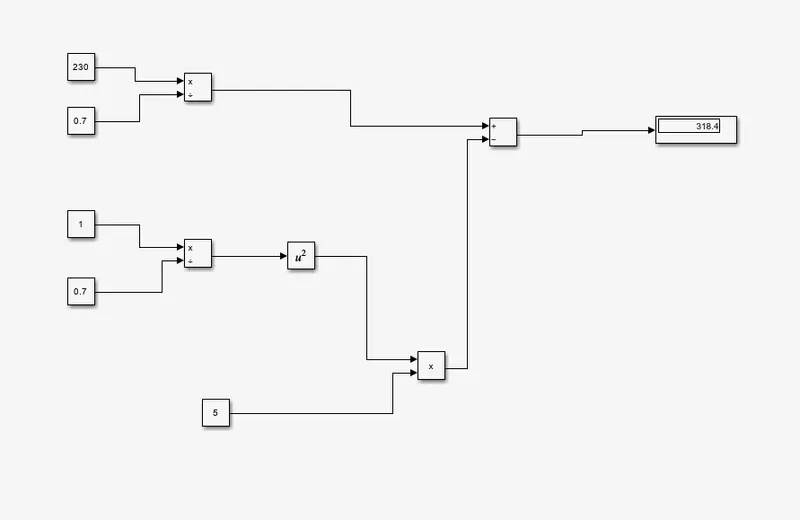
Q.4- Refer to the blog on below topic:
Induction Versus DC brushless motors by Wally Rippel, Tesla
Explain in brief about author’s perspective.
Ans-
In this blog the aurthor speaks about the change in technology over the years and the similiarity between the IC engine vehicles and EV/HEV vehicles.
The author here is Walley Rippel who is also an engineer. He played a major role in the success of the EV1 car for the general motors.

Walley claims and beleives that there is no best or perfect engine. Every engine wil have its merits and demerits. The choice of an engione fopr a particular vehicle will depend upon
many factors such as performance, ride quality, fuel efficiency, size and etc. Walley also claims that this is the same for electric vehicles(EV) as well.
According to the author it is very hard to predict the future for these machines, or assume how long any component of the car will be in use. As the time passes by and technology gets
more and more progressive, it is natural that there will be new innovations in this field.

He describes how in his time DC brush motor, Lead acid battery and contractor conmtrollers vwere common. Now, they have been replaced with DC brushless, Lithium batteries and Induction
contractors. He talks more in detail about the differences between these two technologies.
What are these two technologies? How do they work? What differentiates them? And what do they have in common?

Starting with DC brushless machines, these motoer consist of two permanent magnets attached in a way that they create a magnetic field inside the stator rotor.
Now to control the magnitude and polarity of the stator currents in the right way, inverter is used. This helps to maintain the torque as per desired values.
This motor is useless without the inverter.

Induction motor was invented by nikola tesla. It is very similar to DC brushless and the only difference is in the rotor construction.Unlike the DC brushless rotor, the induction rotor has no magnets
– just stacked steel laminations with buried peripheral conductors that form a “shorted structure.” Currents flowing in the stator windings produce a rotating magnetic field that enters the rotor.
This motor when connecyted to 3 phase supply, torque is produced at the outlet and hence no inverter is required.

Lets see the difference between both the motors in a tabular form

	DC Brushless  							Induction motor
require an absolute position sensor			require an absolute position sensor

to get max torque the magnetic field    		no magnets and B fields are “adjustable,”
should max at low speed maintained by   		since B is proportionate to V/f (voltage to frequency)
the inverter and motor current low			efficiency is maximized due to low magnetic losses

Average efficiency is low				Average efficiency is high

Permanent magnets are expensive				No magnet there is advantage in cost

they are easy to control				The control laws are more complex and difficult to understand, so difficult to control

Easy design						Complex design

Can be used for avberage performance			Can be used for high performance.

Conclusion :- To conclude author says that according to him DC brushless motor would last and dominate in the coming years, and that the induction motor would play its own role
	      in the performance sector of these EV vehicles. He also predicts that in the coming years it is also possible that we might be able to see both these motors working
	      side by side as thye future will be the golden era for these EV and HEV vehicles.