Week-6 Challenge: EV Drivetrain
Which types of power converter circuits are employed in electric and hybrid electric vehicle?
- there are four different types of power converter circuits are used.
- the power converter circuits are also known as power converter circuits.
- the power converter circuits converts one form of energy to another form.
- this converted form is will be based on the end user andhis requirements.
power electronmic circuits:
- It deals with the processing and controlling the flow of energy in order to supply voltages and current.
- the power electronic circuits consists of four blocks i.e.., power source,power circuit, control circuit, electrical load.
- the power electronics circuits consists of both power part and control part.
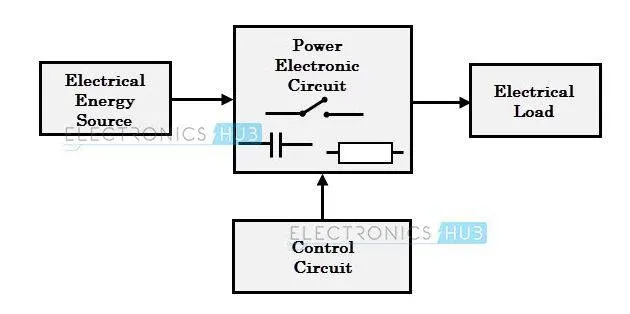
- the power part is used to transfer the energy from the source to load with the help of switches.
- the control circuit part controls the elements or parts in the power electronic circuits to give a continious flow of the power or energy.
- the power electrionic convertors perform basic electronic functions and are classified into four types:
AC to DC converter or rectifier:
- it rectifies the AC supply and send it to the DC load.
- In this type of convertor they use transformer, rectifiers, filters, control circuit.
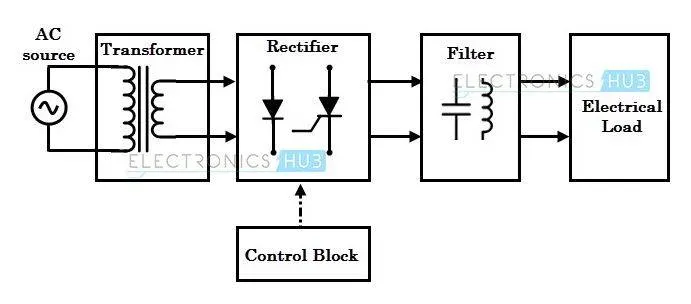
- AC supply is send to the transformer which adjust as the input for the rectifier as low voltage supply.
- the rectifer takes the low voltage AC supply to DC supply.
- the DC supply from the rectifier is passed through a filter where it is passed through a choke or a capacitor.
- the control block controls the firing angle of the thyristors in the cas eof phase controlled rectifiers.
- the diodes are of two types i.e.., controlled rectifiers and uncontrolled rectifiers.
- the converter is built inside the car. It is called the onboard charger though it really is a converter.
- It converts power from AC to DC and then feeds it into the car high voltage battery.
- This is the most common charging method for electric vehicles today and most chargers use AC power.
DC to AC converters or inverters:
- these DC converters are connected between the DC source of fixed supply to the AC load.
- these DC to AC converters are called as inverters. these inverters are mainly seen in batteries.
- the DC fixed voltage is converted into AC variable voltage.
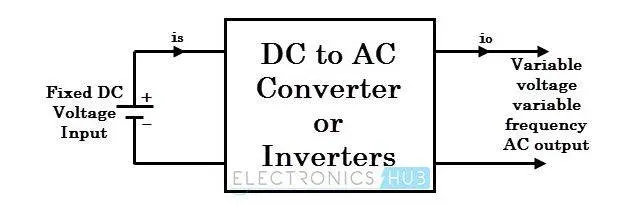
- this converstion of the DC to AC is done by operating various triggering angle of the thyristors.
- most of the thyristors are imployed in conversion of DC to AC are forced commutation technique.
- further these inverters are classified into current source inverters and voltage source inverters.
- the DC supply to AC supply will convert the current which is used to drive the vehicle.
- the increase in the speed or torque of the motor is based on the amplitude of the signal that is generated.
- at the time of regenerative braking the current generated by the vehicle braking will supply to battery in the form of DC supply.
- this is stored in the battery and is supplied to vehicle when ever it is required to the vehicle.
- this converstion of the power is used for the vehicle reliability.
DC to DC converters:
- these converters are used to get variable DC supply from DC fixed supply.
- these DC variable supply is used to get variable speed in the Dc motors, traction vehicles, DC vehicles.
- the chopper is a device which is used to convert the fixed DC voltage into different magnitude DC voltage.
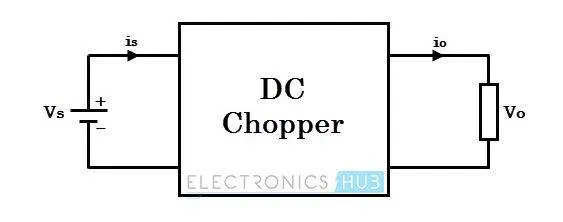
- the DC fixed voltage is send through the chopper which gives a variable DC voltage as output.
- the choppers are are connected to the power electronic devices such as thyristors.
- the output voltage is controlled by adjusting the ON time of the thyristors.
- which in turn changes the width of the DC output voltage.
- there are two type of choppers i.e.., step-down chopper or buck converter and step-up chopper or boost converter.
- the DC to DC converters are classified into unidirectional and bi-directional converters.
- the unidirectional converters are used for the on board load such as sensors, lights, utility, etc.
- the bidrectional is used in the case of re-generative braking, battery charging, power bracking.
- when the regenerative braking is applied the current produced from the braking will charge the battery of the vehicle.
- this helps the vehicle to operate safely.
AC to AC converters:
- these type of converters are used to convert the AC supply voltage to the AC voltage that is required to the load.
- they convert one level of AC voltage supply to another level by varying its magnitude and frequency of supply voltage.
- there are two types of AC to AC converters i.e.., AC to AC voltage converters and AC to AC frequency converters.
- these converters are mainly used to change the rms value of the output voltage at a constant frequency for voltage type converters.
- for the frequerncy type converters there will be used for varying the frequency of the input source to the desired load output.
2. An Electric Vehicle's powertrain with 72V battery pack in shown in the diagram below. The duty ratio for acceleration operation is 'd1' and for the braking operation the duty ratio is 'd2'.
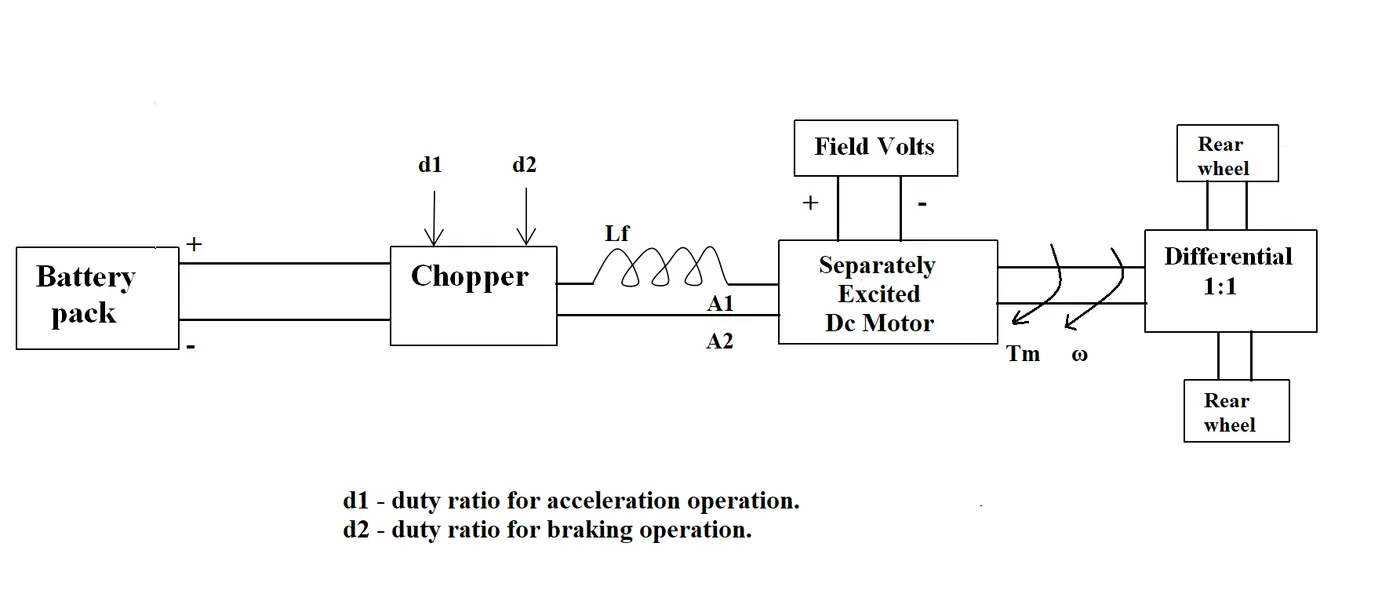
What is EV steady state speed if duty cycle is 70%?
given:
rated armature voltage(V) = 72V
rated armature current(I) = 400 A
Ra = 0.5 Ω
kΦ = 0.7 volt
chopper switching frequency(f) = 400 Hz
d = 0.7
The vehicle speed-torque characteristics are given by the below equation:
 ------- (1)
answer:
the duty cycle = 0.7
the average armature voltage with the given drive cycle:
`(Vo) = V*d = 72*0.7 = 50.4 V`
the speed torque characteristics of Dc motor is:
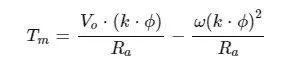 -------(2)
by substituting the values we get:
`Tm = ((50.4*0.7)/0.5)-(omega*((0.7)^2)/0.5)`
`Tm = 70.56- 0.98*omega`
by comparing the both the equations we gwt:
`24.7 + (0.0051)*(omega^2) = 70.56 - 0.98*(omega)`
`0.0051*(omega^2) + 0.98*(omega) - 45.86 = 0`
by dividing the equation with 0.0051 we get:
`omega^2 + 192.15*omega -8992.15 = 0`-----(3)
by solving the equation we get th evalue for the angular speed:
`omega = (-b pm sqrt(b^2+4ac))/(2*a)`
`omega = (-192.15 pm sqrt (192.15^2-4*1*8992.15))/2*1`
`omega = (-192.15 pm 269.98)/2`
we get two roots for omega:
`omega = 38.915 ((rad)/s) or -231.06((rad)/s)`
the angular speed is always positive soi we consider:
`omega = 38.915 ((rad)/s)`
3. induction motor vs DC brush less motor?
| Induction motor | DC brushless motor |
| It is having a 3 phase stator | Two or more permanent magnets are used in stator. |
| the rotor doesnt have the magnets and it is stacked up with small laminates. | as the rotor rotates there should be continous variation of the current in the stator which should be monitored. |
| initial starting of the motor under the load conditioin is easy with induction motor. | there should be phase difference to start the DC motor under the load condition. |
| no inverter is required. | inverter is required to maintain the phase with tghe rotor. |
| induction motor has to operate with AC supply, it will not work with DC supply. | DC motor requires the DC supply to work. |
| these are constant speed machines. | these are high speed machines. |
| speed, torque characteristics are limited. | speed, torque charactericts are high compared to that of AC machine. |
| with connecting the inverters the speed and torque can be changed in the induction motors. |
the inverters are used such that the current control is monitered. |
conclusion:
- according to the auther, both have there unique futures.
- but the DC brushless motor is used because of the high torque and the speed that can be obtained by the motor.
- in case of the induction motor, with the help of the inverters they can match the motor speed and torque characteristics.
- with thw advanatages and disadvantages, each of the motoe will have the respective application.
- and the combination of these both motors in the hybrid electric vehicle will give us a different perspective to the electric vehicles.