Week-6 Challenge: EV Drivetrain
Week-6 Challenge: EV Drivetrain
- Which types of power converter circuits are employed in electric and hybrid electric vehicle?
- An Electric Vehicle's powertrain with 72V battery pack in shown in the diagram below. The duty ratio for acceleration operation is 'd1' and for the braking operation the duty ratio is 'd2'.
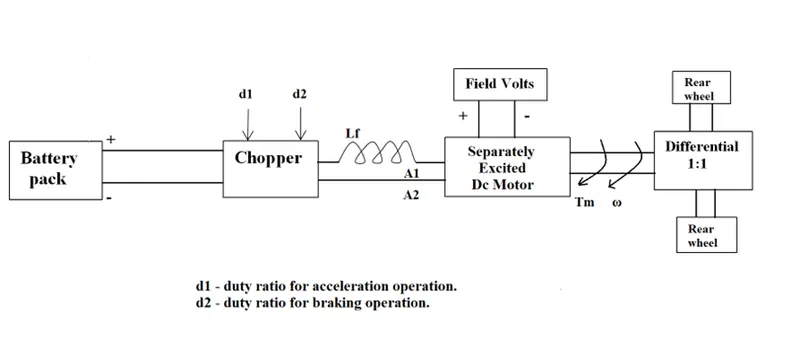
The other parameters of the electric vehicle are given below,
Motor and Controller Parameters:
Rated Armature voltage= 72 V
Rated armature current= 400 A
Ra= 0.5Ω, KΦ= 0.7 Volt second
Chopper Switching frequency= 400 Hz
The vehicle speed-torque characteristics are given by the below equation

What is EV steady state speed if duty cycle is 70%?
- Develop a mathematical model of a DC Motor for the below equation using Simulink.
ωω= V/Kϕϕ -Ra/Kϕϕ^2 . T
- Refer to the blog on below topic:
Induction Versus DC brushless motors by Wally Rippel, Tesla
Explain in brief about author’s perspective.
Answer: -
Power converter circuits are employed in electric and hybrid electric vehicle.
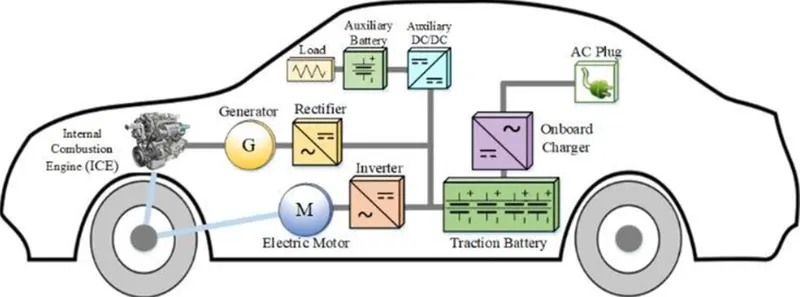
In the Electric & hybrid electric vehicle varies power converter circuit are used as per different requirements. We can see the following fig in this diagram different power converter circuits are used.
- AC – DC Convertor: -
AC voltage is converted to required DC voltage. These are used in EVs to charge the battery storage used for traction. AC power fed from external grid or charging stations is fed to battery via AC - DC converter. Also used for HEVs where generator is incorporated with the engine producing AC power which is used to charge the battery. And for EVs, when there is regenerative braking, in that case also AC - DC converter comes into picture.
- DC – AC Convertor: -
DC to AC convertor means inverter, in this power circuit are used to convert direct current (DC) into alternating current (AC) and this AC supply gives traction motor from the battery.
- DC – DC Convertor: -
Higher value DC voltage is converted to required lower value DC voltages. This happens by means of a converter called Buck converter.
Also, lower value DC voltages are converted to required higher value DC voltage by means of a converter called Boost Converter. These converters are used to supply voltage from Main Battery to all types of ancillary loads such as Head lights, Tail lights, Cabin lights, wipers, music system, infotainment system, mirror controls etc. In HEVs auxiliary battery is also used as a extra back-up source, which is charged by both main battery and regenerative braking via DC -DC converters. It supplies power to horn, power steering and controls etc.
- AC – AC Convertor: -
We require a particular voltage and particular frequency for operating some special devices or machines. For speed control of induction motor, AC to AC converters (Cycloconverters) is used majorly. For obtaining a desired AC power supply from the actual power supply, we need some converters called AC to AC converters.
Now, we can see the given data,
Rated armature voltage = 72V
Rated armature current = 400 A
Ra = 0.5Ω,
Kø = 0.7 V/s
Chopper Switching frequency= 400 Hz
The vehicle speed-torque characteristics are given by the below equation
Vehicle output power = Battery Voltage (V) * Duty cycle
= 72 * 0.70
Vehicle Voltage = 50.04
Now Equation for vehicle torque is given by

Tv = (50.04 – 0.7 w) 0.7/0.5
Tv = 70.56 – 0.98 w
Tv = 24.7 + 0.0051 w^2
We can solve these two equations
70.56 – 0.98.w =24.7 -0.0051.w^2
We can get the quadratic equation
0.0051 w^2 + 0.98.w – 46.94 = 0
Solving this quadratic equation
W = 38.85 rad/sec.
Study state – speed 0f vehicle W = 38.85 rad/sec.
Develop a mathematical model of a DC Motor for the below equation using Simulink.
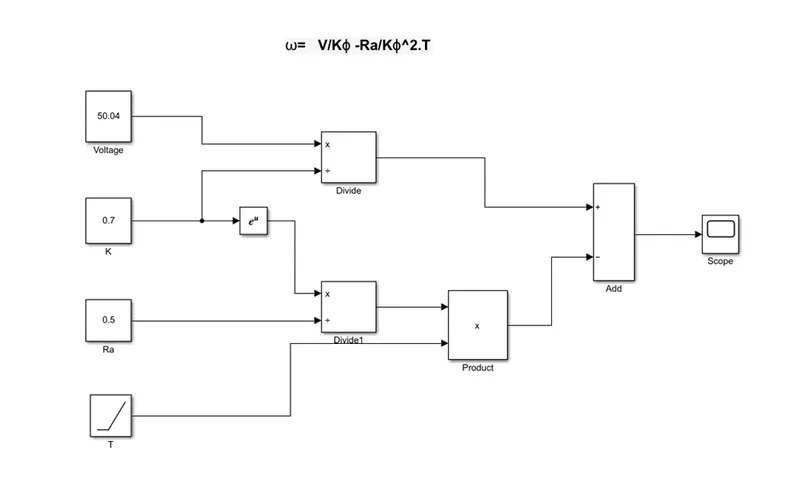
ωω= V/Kϕϕ -Ra/Kϕϕ^2 . T
let,
Kø = 0.7
V = 50.04 Volt
Ra = 0.5 Ω
we can consider torque as linearly increasing signal if we can use ramp function.
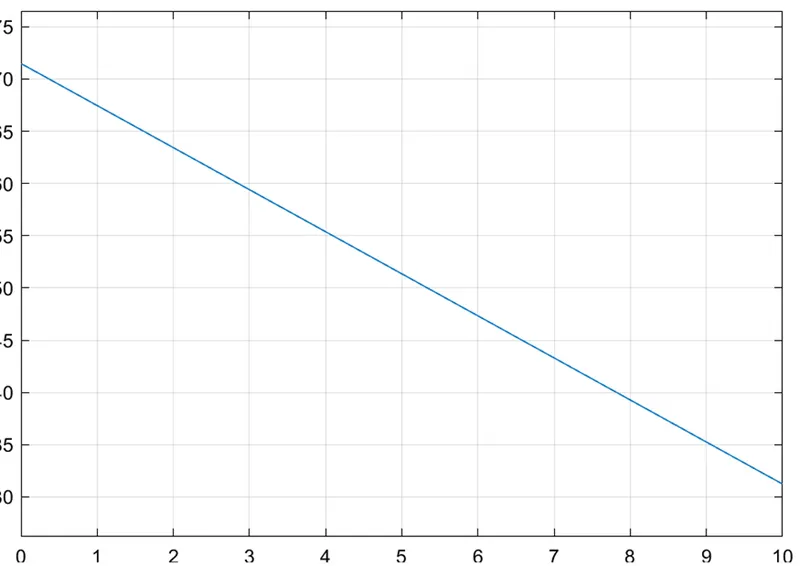
We can run the given model and see the result speed of the motor is inversely proportional to load.
. Refer to the blog on below topic:
Induction Versus DC brushless motors by Wally Rippel, Tesla
Explain in brief about author’s perspective.
In the first place, the creator portrays the predominance of Internal Combustion Engines (ICE) in the realm of the auto business and furthermore examine various sorts of motors. He clarifies that all motors were comparative and it was dependent upon the client to choose as indicated by their necessity. He additionally talks about enlistment engines and brushless DC engines and presents his view that these two innovations will be broadly utilized in the coming years.
- Then he clarifies the working of both a 3-stage enlistment engine and a brushless DC engine. Presently the creator has done a correlation between these two innovations and expressed a few benefits and burdens of each.
- Induction engine enjoys a few benefits like it has no magnets The engine can turn over under load. No inverter is required. A few disservices of Induction engines are: They can't work from DC: AC is an absolute necessity. Shaft speed is proportionate to line recurrence. Consequently, when utilized with utility force, they are steady speed machines. When worked from utility force, they have restricted beginning force and fairly restricted running pinnacle force abilities, when contrasted with DC type machines
- Brushless DC engine enjoys a few benefits like considerably less rotor heat is produced with the DC brushless drive. The pinnacle point energy productivity for a DC brushless drive will normally be a couple of rate focuses higher than for an acceptance drive. A few drawbacks of a Brushless DC engine are: as machine size develops. the attractive misfortunes increment proportionately and part load proficiency drops. Perpetual magnets are costly and hard to deal with because of extremely enormous powers that become an integral factor when anything ferromagnetic draws near to them.
- Finally, the creator couldn't pick which drive is superior to the next however clarifies that DC brushless drives will probably keep on overwhelming in the crossbreed and coming module half breed markets, and that enlistment drives will probably keep up with strength for the elite unadulterated electrics