Week-6 Challenge: EV Drivetrain
OBJECTIVE:
- To explain the types of Power converters in electric and hybrid vehicles.
- Based on the conditions given, calculate the steady-state of an electric vehicle.
- Referring to the article needs to explain the Author's perspective.
PROCEDURE:
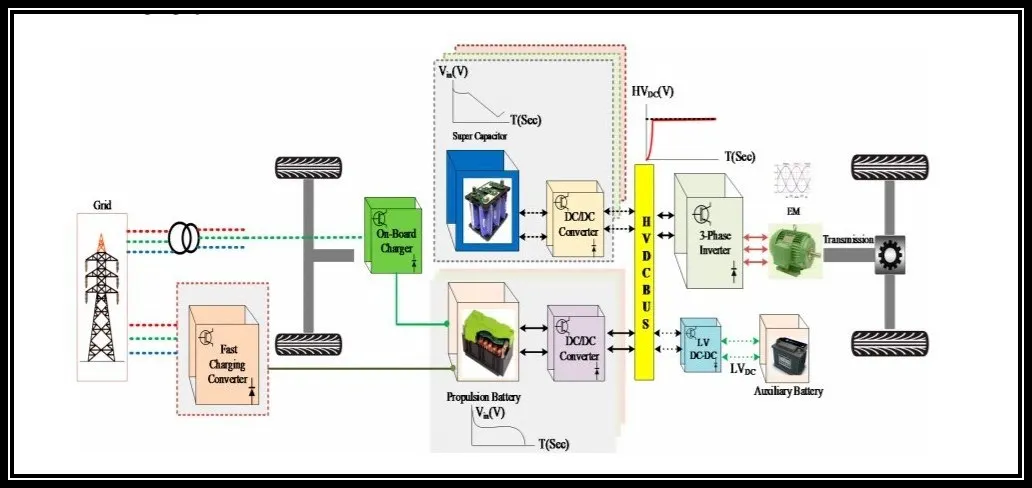
The Types of power converter circuits in the hybrid and electric vehicle includes:
- Rectifier
- Inverter
- Chopper.
RECTIFIER:
- A Rectifier is a device that converts an oscillating two-directional (A.C) current into a single directional (D.C) current.
- This process of conversion is called the Rectification.
- A rectifier converts the whole input waveform of alternate current to one of constant polarity or only positive polarity at its output which forms continuous current or direct current.
- This D.C obtained from a generator that helps to charge the battery.
- It's also used in board chargers to convert output A.C voltage to D.C voltage and then it feeds into the battery.
INVERTER:
- The Inverter is used to convert D.C voltage into A.C voltage.
- It converts the D.C. voltage from the battery to A.C voltage and then, the A.C voltage is used to drive the induction motor.
CHOPPER:
- Chopper is used for altering the voltage either increasing or decreasing.
- There are two types of chopper step up(increase the given voltage) or step down(decrease the given voltage).
- Generally, the choppers are used to convert the high voltage from the battery to low voltage(step down) in order to power up the infotainment systems, lights, etc in the vehicle.
2)EV STEADY STATE SPEED:
GIVEN:
Battery pack voltage=72V
Rated armature current=400A
Armature Resistance=0.5`ohm`
Motor constant(K`phi`)=0.7
Chopper Switching Frequency=400Hz.
Vehicle-Speed Torque characteristics Equation`Tv=24.7+(0.0051)omega^2`
Duty cycle=70%
To find:
Steady-state speed.
Solution:
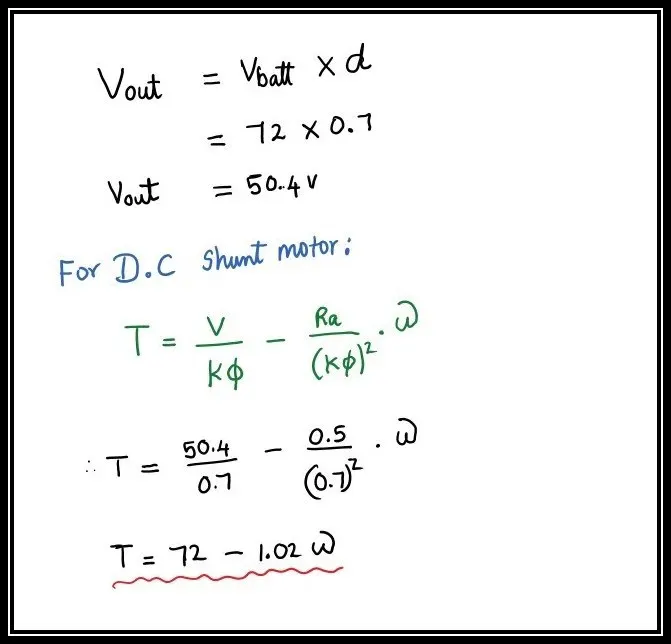
- Then, we need to find the steady-state point matching the torque equation vehicle with the motor.
- To find out the steady-state point, Matlab code is used.
Matlab Code:
clear all
close all
clc
 omega=linspace(0,100,100);
 %T=Speed Torque Relation For D.C Motor.
 %t=Speed Torque Relation For Vehicle Characteristics.
 for n=0:100
    T=(72-(1.02.*omega));
    t=(24.7+((0.0051)*(omega.*omega)));
end

plot(omega,T,'linewidth',2,'color','r');
hold on
plot(omega,t,'linewidth',2,'color','b');
grid on
title('Steady-State Speed Calculation')
xlabel('Speed(rad/s)')
ylabel('Torque(Nm)')
legend('Motor','Vehicle-Speed')
Step-Wise code explanation:
- Clear all, close and clc command used to clear the workspace window, close all the plots, and clear the command window.
- Angular speed(`omega`) value is generated using the linspace command(100 values generated).
- Then, in the next step for all value of speed torque is calculated using the torque-speed relation equation.
- The torque is calculated for both vehicle-Speed characteristics and D.C. motor characteristics.
- Then the speed vs Motor torque and speed vs Vehicle speed-torque is plotted using the plot command.
- The title is given to the plot using the title command.
- X label and Y label is given using the x label and y label command.
- Using the legend command the Motor curve and vehicle Speed torque curve are differentiated.
RESULT:
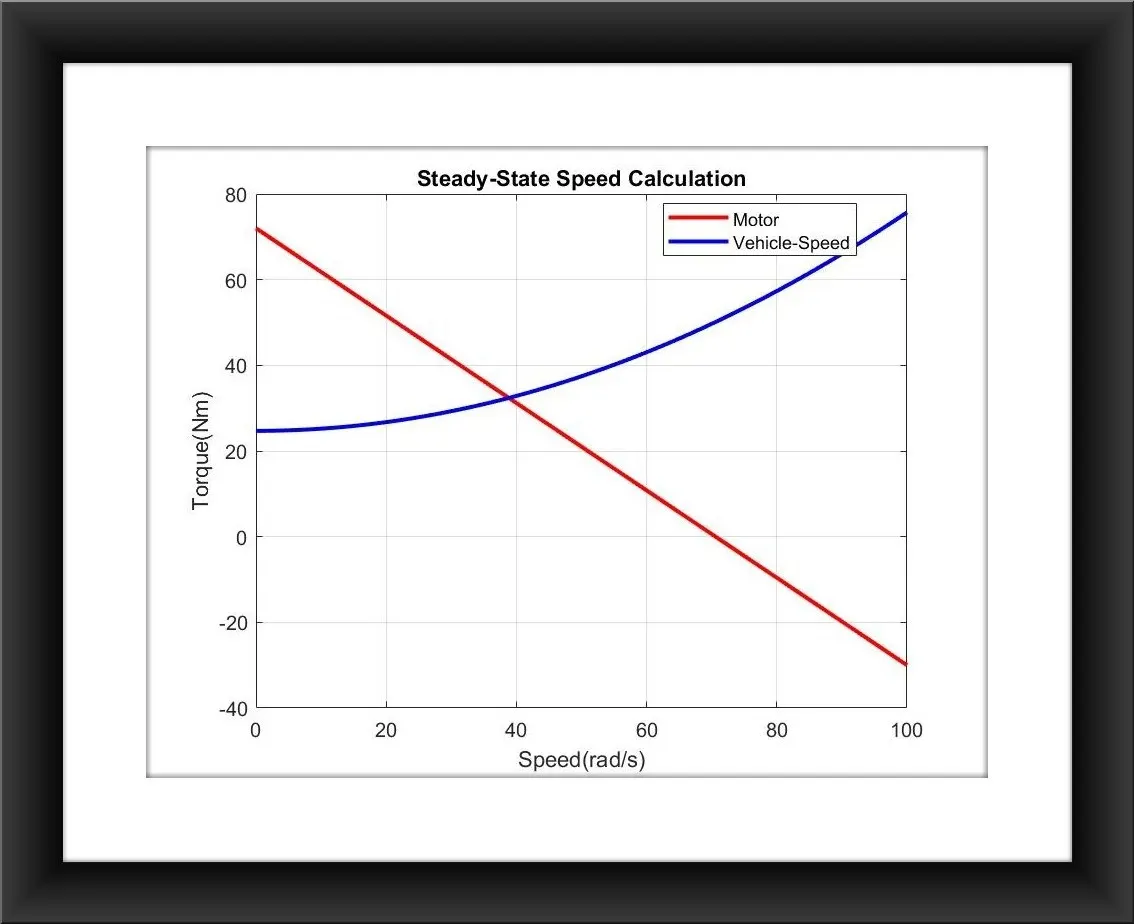
- From the graph, it is observed that the steady-state speed point is around 39 rad/s.
3)https://www.tesla.com/blog/induction-versus-dc-brushless-motors
In the above article, the author sprinkles the pros and cons of induction motor and D.C Brushless motor.
The points are tabulated as follows:
| Induction Motor | D.C Brushless Motor |
|
Torque is produced at the rotor ; The motor has the ability to start under load, No inverter is needed. |
D.C.Brushless motor produces no starting torque when directly connected to the fixed frequency utility power, they need an inverter in order to maintain phase in step with the angular position of the rotor. |
| More Rotor heat is generated. | Less Rotor heat is generated and rotor cooling is easier. |
| Induction motors have no permanent magnets and B fields are adjustable. | No easy way of changing B with permanent magnets. |
| As machine size grows, losses do not necessarily grow. | As motor size increases, the magnetic losses increase proportionately. |
| Most desired for high-performance applications where even though peak efficiency is less but the average efficiency will be better. | Even though peak efficiency is high it is not desired for high-performance applications since average efficiency is less. |
| Induction motors have no permanent magnets and so it is cost-effective. | Permanent magnets are expensive and PM rotors are so difficult to handle due to very large forces come into play. |
| Induction motors are difficult to control and control laws are more complex and difficult to understand. | Control laws are simple and easy to understand. |
Conclusion:
- The author didn't predict the winner of these two motors he mentioned that there is no one best engine type rather there are different types of engines to suit personal requirements.
- After explaining the pros and cons of the two motors he then added that D.C brushless drives will likely in the hybrid and in plug-in hybrid whereas the induction drives will dominate the high-performance complete EV trains.
- He then also adds up that since both the drives have so much hardware is common we will see that both work side by side in the coming golden era of hybrid and electric vehicles.