Week-6 Challenge: EV Drivetrain
1. Which types of power converter circuits are employed in electric and hybrid electric vehicle
CIRCUIT TYPE:
1. Rectifier
2. Inverter
3. Chopper
OPERATION:
Rectifier:
OPERATION: converts AC line voltage in DC battery voltage.
APPLICATION: EV chargers.
Inverter:
OPERATION: Converts DC battery power to AC voltage.
APPLICATION: AC motor drive and control.
Chopper:
OPERATION: Step down high voltage DC to low voltage DC.
APPLICATION: Power auxillary loads like headlights,infotainment.etc.
2. An Electric Vehicle's powertrain with 72V battery pack in shown in the diagram below. The duty ratio for acceleration operation is 'd1' and for the braking operation the duty ratio is 'd2'.
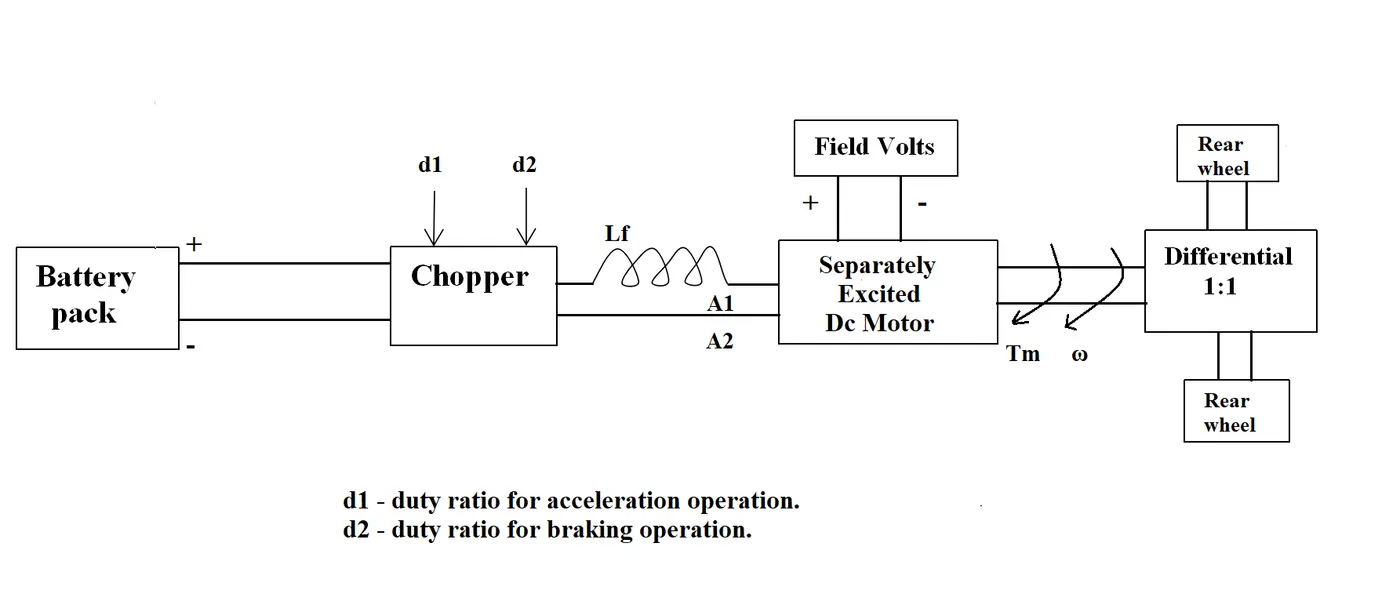
The other parameters of the electric vehicle is given below,
Motor and Controller Parameters:
Rated Armature voltage= 72 V
Rated armature current= 400 A
Ra= 0.5Ω, KΦ= 0.7 Volt second
Chopper Switching frequency= 400 Hz
The vehicle speed-torque characteristics are given by the below equation

Motor and controller paramwters:
Rated armature voltage
Va =72v
Voltage after 70% duty ratio=72*0.7=50.4
Rated armature current
Ir = 400A
Ra = 0.5`Omega`
k`phi` = 0.7V-s
chopper switching frequency
`f`=400Hz
The vehicle characteristics are given by the equation
TTR = 24.7+0.0051.`omega^2`- (1)
The derived formula for motor speed characteristics- T=V. `(kphi)/(Ra)-(kphi)^2/(Ra).omega`
So after comparing both the motor characteristics equation
0.0051.`omega^2`+0.98.`omega` - 45.89=0
Using quadratic equ formula we get 2 values of `omega`
`omega` = -231.07rad/s and 38.92rad/s.
Here EV steady state speed, if duty cycle is 70% then -ve value of speed shows that the torque is transferred to the motor externally where the +ve value states that the motor generally torque reaches to the wheels.
3. Induction Versus DC brushless motors by Wally Rippel, Tesla
The author tries to draw out a comparison between induction motor and DC brushless motor used in driving electric vehicles. The author's intention is to underline the principles of the operation between both motors and lists out the pro's and con's in terms of performance ,control strategies,cooling system,generated torque and manufacturing costs.
this difference encaptures the author's comparision between both motors.
DC brushless magnets:
Rotor construction - permanent magnets
Stator construction - Distributed windings inside stator core.
supply voltage type - DC.
Control strategy - Inverter needed to vary stator currents to generate rotatingmagnetic field and easier to control.
Torque characteristic - Cannot generate starting torque from the onset when connected to fixed frequency supply.
Speed - Can be varied or controlled by inverter.
Rotor Heating - Lower and can be cooled easily.
Efficiency - High can operate at unity power factor.
Magnetic Field - Cannot be varied.
Magnetic losses - Increases with size of machine.
Cost - Permanent magnets are expensive.
Induction Motor:
Rotor construction - stacked steel Laminations.
Stator construction - Distributed windings inside stator core.
supply voltage type - AC 3 phase.
Control strategy - No inverter necessary, can run directly on 3 phase power.
Torque characteristic - Can generate starting torque from the onset when connected to fixed frequency supply.
Speed - Can run only on constant speed.
Rotor Heating - More rotor heat is generated by eddy currents.
Efficiency - Lower can operate at 0.85 power factor.
Magnetic Field - Can be varied.
Magnetic losses - Does not increases with size.
Cost - Cheaper because of no magnets.
CONCLUSION:
The author concludes that is no cleary winner to prefer one over the other. he states that DC brushless drives are better fit for hybrid elecrtic vehicle and AC Induction drives are better for high performed pure electric vehicle.He hopes in the future that these two motors can work side by side.