Week-6 Challenge: EV Drivetrain
1.) Which type of power converter circuits are employed in the electric and hybrid electric vehicle?
Power Electronic converters:-
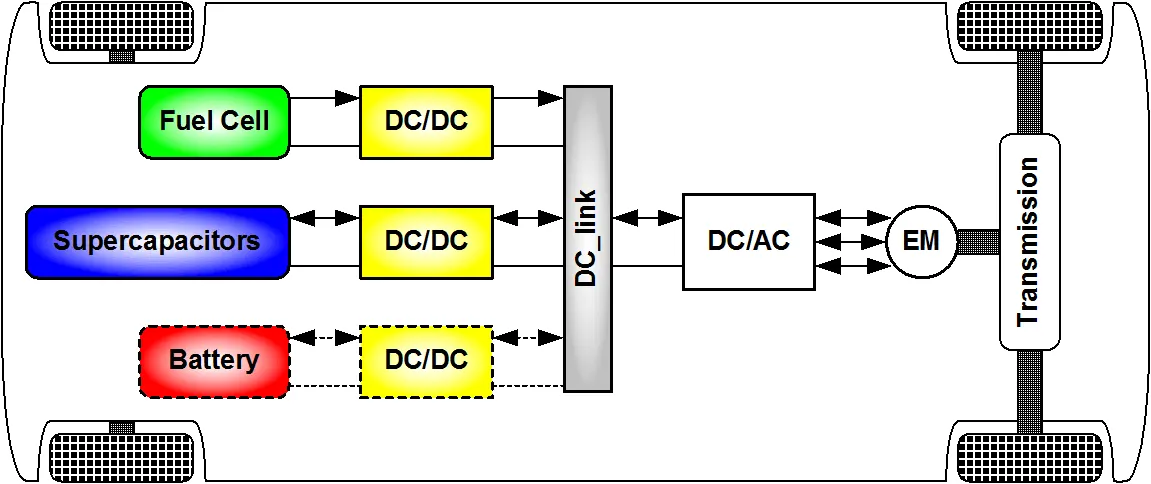
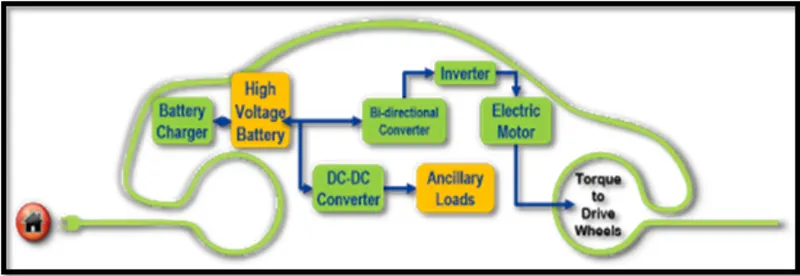
In Electric and Hyrid Electric Vehicle (EV/HEV), the power electronic converters are considered as the key elements that interface their power source to the drivetrain of the EV's. In order to design highly efficient converters for the Ev's power system, advanced DC/DC and DC/AC converters are required to adapt the output voltage and current levels with high power quality.
The 3 types of converters which are widely used in an electric vehicle are:
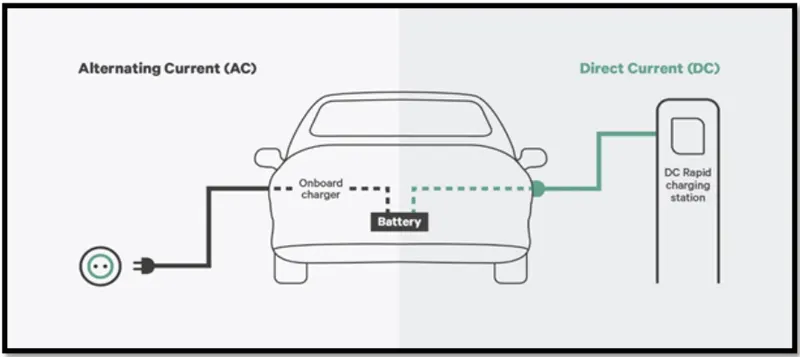
AC-DC converter(On Board Charger):-
AC-DC converter are most commonly used in plug-in Hybrid Electric Vehicle (PHEV) & plug-in Electric Vehicle (PEV). These Vehicle get their propultion power from an external electricity source (charging stations) which is alternating current. the battery needs to be charged using a directcurrent source. For this purpose, AC to DC converter is employed in a PHEV & PEV.
DC-DC converter:-
DC-DC converters can be used to interface the elements in the electric power train by boosting or chopping the voltage levels. By introducing DC/DC converters one can choose the voltage variation of the devices and the power of each device can be controlled. the power of the DC/DC converter depends on the charecteristics of the vehicle such as top speed, acceleration time from 0 to 100 km/h, weight, maximum torque and power profile (peak power, continuous power).
DC-AC Converter(Inverter):-
The DC/AC converter is required to convert the dc power to a suitable AC power for the electrical machine. The power output from battery pack (DC current) is converted using inverter to be used in electric motor(AC current).
References:- https://www.intechopen.com/chapters/19583#B14
2.) An Electric Vehicle's powertrai with 72V battery pack in shown in the diagram below. The duty ratio for acceleration operation is 'd1' and for the braking operation the duty ratio is 'd2'.
The other parameters of the electric vehicle is given below,
Motor and controller parameters:
Rated Armature voltage = 72 V
Rated Armature current = 400 A
Ra = 0.5Ω, kΦ = 0.7 volt second
chopper switch frequency = 400 Hz
The vehicle speed-torque charecteristics are given by the below equation

What is EV steady state speed if duty cycle is 70%?
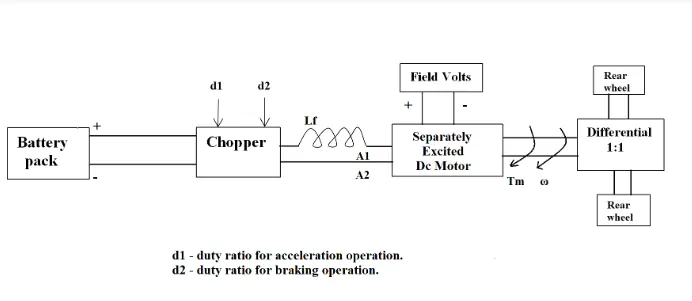
Given:-
The following input parameters are given:
Battery pack voltage (v) = 72 V
Ratted armature current = 400 A
Armature Resistance (Ra) = 0.5Ω
Motor constant (kΦ) = 0.7
Chopper Switching Frequency = 400 Hz
Duty Cycle = 70%
Solution:-
Vehicle Output Voltage is given by:
Vv = battery voltage (v)*Duty cycle
Vv = 72*0.70
Thus, Vehicle voltage = 50.4V
Now, Equation for vehicle torque is given by:-
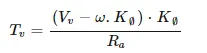
Where;
Tv = Vehicle Torque (N-m)
Vv = Vehicle voltage (Volts)
ω = steady state speed of vehicle (rps)
kΦ = Motor constant
Ra = Armature resistance
Substituting all these values in equation, we get:
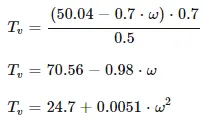
Solving these two equations,

We get a quadretic equation:

Since quadratic equation, we get two value of;

We take the positive value;
Steady state speed of vehicle = 38.85 rad/s
3.) Develop a mathematical model of a DC Motor for the below equation using Simulink.
ω">ωω= V/Kϕ">ϕϕ -Ra/Kϕ">ϕϕ^2 .T
Let us draw a model for the above equation.
Let V = 50.4 volts
kΦ = 0.7
Ra = 0.5Ω
and also let consider torque as alinearly increasing signal.
Model:-
Result:-
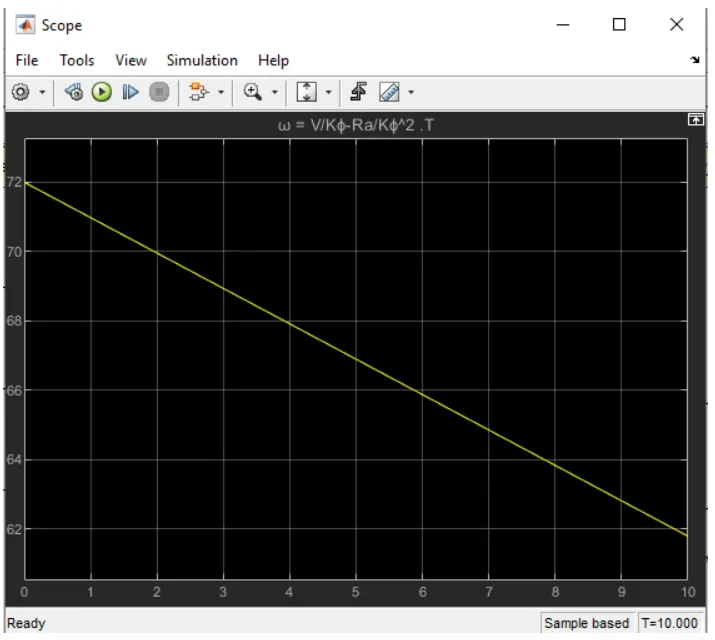
4.)Refer to the blog on below topic:
Induction Versus DC brushless motors by Wally Rippel, Tesla
Explain in brief about author’s perspective.
Wally Rippel is a long-time proponent of electric vehicles. Prior to joining Tesla Motors, he was an engineer at AeroVironment, where he helped develop the EV1 for General Motors and was featured in the documentary movie, Who Killed the Electric Car? Wally has also worked for the Jet Propulsion Laboratory on electric vehicle battery research, among other projects. In 1968, as a Caltech undergraduate student, he built an electric car (a converted 1958 Volkswagen microbus) and won the Great Transcontinental Electric Car Race against MIT.
In the biginning, the author describes the dominance of internal Combustion Engines(ICE) in the world of automobile Industry. He explain that all engines were similar and it was up to the user to select according to their requirement. Next, the author highlights topics related to EV technology especially related to DC Brushless Motor and induction motor.
According to him, DC Brush Motors is replaced by either DC Brushless Motor or Induction Motor. Also, the Lead Acid Battery is replaced by lithium-ion batteries for EVs. He also quoted that there will be the future of both the technology (DC Brushless Motor and Induction Motor) depends upon their demands and uses.
DC Brushless Motor:
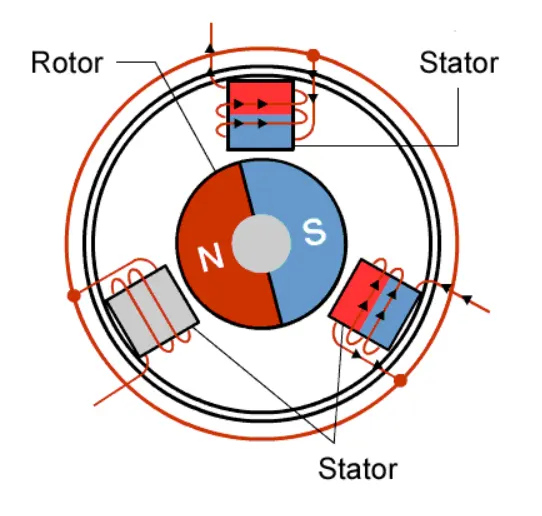
As their name implies, brushless DC motors do not use brushes. With brushed motors, the brushes deliver current through the commutator into the coils on the rotor. So how does a brushless motor pass current to the rotor coils? It doesn’t—because the coils are not located on the rotor. Instead, the rotor is a permanent magnet; the coils do not rotate, but are instead fixed in place on the stator. Because the coils do not move, there is no need for brushes and a commutator.
With the brushed motor, rotation is achieved by controlling the magnetic fields generated by the coils on the rotor, while the magnetic field generated by the stationary magnets remains fixed. To change the rotation speed, you change the voltage for the coils. With a BLDC motor, it is the permanent magnet that rotates; rotation is achieved by changing the direction of the magnetic fields generated by the surrounding stationary coils. To control the rotation, you adjust the magnitude and direction of the current into these coils.
Advantages:-
Brushless DC motors have many advantages our the traditional brushed DC motors. Few of the advantages are discussed below in detail:
- Brushless DC motor does not have any carbon brushes, which reduces frequent replacement requirements of brushes and maintenance costs.
- Brushless DC motors have better performance and efficiency as compared to the brushed DC motors due to the involvement of electronic control enabling high-level control over the speed and position of the motor. Brushless DC motor lifespan is approximately 6 times higher than the counter brushed DC motor.
- Brushes can cause high sparks which may result in short life or complete burnout of brushed DC motor. However, in the case of brushless DC motor, due to no spark issue, there are fewer chances of burnout due to sparking issues.
- Brushless DC motors are available in small compact sizes and also provide high torque to weight ratio making it suitable for many robotics and medical application involving robotic arms and robotic legs.
- Brushless DC motor produces comparatively low operating noise as compared to other motors of the same ratings. As in other motors, there is continuous contact of brushes resulting in noise and sparking during contact. Therefore, brushless DC motors are given preference where electrical noise needs to be avoided.
- As traditional commutation based on mechanical setup is replaced by the modern electronic commutation system resulting in more control and fewer chances of failure due to previously discussed reasons of wear and tear.
- Unlike other motors, brushless DC motor has low no-load current making it suitable to run it at low or no load.
- Brushless DC motors can provide maximum torque continuously during rotation, while brushed DC motor can provide maximum torque at an only specific point of the rotation. For the same torque rating, the brushed motor will require a much bigger magnet as compared to the brushless DC motor. This results in a very compact and small-sized brushless DC motor proving very high torque rating.
- Brushless DC motors can have a feedback control to monitor and control the speed and torque, resulting in accurate torque and speed control providing higher efficiency, low power consumption, and long battery life in the case where the motor is operating using some batteries.
- Brushed DC motors have the heating issue and do not cool quickly due to the presence of electromagnet in the center of the motor. On the other hand, the brushless DC motor does not have an electromagnet in the center reducing the heating issue
Disadvantages:-
Just like in all the other devices, brushless DC motors also have few shortcomings as compared to other motors. As brushless DC motor outperforms brushed DC motor in many cases, however, brushless DC motor also has few shortcomings which are discussed below:
- The cost of a brushless DC motor is comparatively higher as compared to brushed DC motor and the electronic controller also increases the cost of overall setup, as in a traditional motor, low-cost mechanical commutation setup involving brushes is used.
- When brushless DC motor is operated at low speed, slight vibrations occur during low-speed rotation. However, vibrations reduce at high speed.
- Due to the inherent natural vibration frequency of brushless DC motor, sometimes this natural frequency can match or can come closer to the vibration frequency of the body or plastic parts resulting in the occurrence of resonance phenomenon. However, this resonance can be minimized by adjustment, and it is common to observe resonance phenomenon in many brushless DC motor based devices.
- Brushed DC motors are easy to operate having simple wiring as the positive terminal is connected to positive and negative terminal is connected to negative wire and motor starts to rotate. However, in the case of brushless DC motor, wiring and operation of the motor are not that simple due to the involvement of electronic control and its link to all the electromagnets.
Induction Motor:-
A motor with only amortisseur windings is called an induction motor. An induction motor is the most modest electrical machine from the construction point of view, in the majority of the cases. The induction motor works on the principle of induction where an electromagnetic field is induced into the rotor when the rotating magnetic field of the stator cuts the stationary rotor. Induction machines are by far the most common type of motor used in industrial, commercial, or residential settings. It is a three phase AC motor.
Advantages:-
Low Cost: Induction machines are very cheap when compared to synchronous and DC motors. This is due to the modest design of the induction motor. Therefore, these motors are overwhelmingly preferred for fixed speed applications in industrial applications and for commercial and domestic applications where AC line power can be easily attached.
Low Maintenance Cost: Induction motors are maintenance-free motors unlike dc motors and synchronous motors. The construction of an induction motor is very simple and hence maintenance is also easy, resulting in low maintenance cost.
Ease of Operation: The operation of the induction motor is very simple because there is no electrical connector to the rotor that supply power and current are induced by the movement of the transformer performs on the rotor due to the low resistance of the rotating coils. Induction motors are self-start motors. This can result in reducing the effort needed for maintenance.
Speed Variation: The speed variation of the induction motor is nearly constant. The speed typically varies only by a few percent going from no load to rated load.
High Starting Torque: The starting torque of the induction motor is very high which makes the motor useful for operations where the load is applied before the starting of the motor. 3 phase induction motor will have self-starting torque, unlike synchronous motors. However, single-phase induction motors do not have self-starting torque and are made to rotate using some auxiliaries.
Durability: Another major advantage of an induction motor is that it is durable. This makes it the ideal machine for many uses. This results in the motor running for many years with no cost and maintenance.
All these advantages make induction motor to use in many applications such as industrial, domestic, and in many applications.
Disadvantages:-
- Throughout the light load situation, the power factor is extremely less and it draws a huge current. So, the copper loss can be high which decreases the efficiency throughout the light load situation.
- The squirrel cage induction motor’s initial torque is not low.
- This is an invariable speed motor and this motor is not applicable where uneven speed needs
- This motor speed control is not easy
- This motor includes a high starting inrush current which will cause a reduction within voltage at the beginning of time.
Inference:-
In the end, the author couldn,t choose which drive is better than the other but makes it clear that Dc Brushless motor drives will likely continue to dominate in the Hybrid and upcoming plug-in hybrid markets and induction motor drives will likely maintain dominance for the high-performance pure electric.
Conclusion:-
- electric and hybried electric vehicles.
- Ev steady state speed of an EV Drivetrain was determined with the given input conditions.
- The mathematical model for DC motor is developed.
- Lastly, we have studied a blog on the topic:- Induction Versus DC brushless motor by "Wally Rippel","Nikolas Tesla" and explained in brief about the author's perspective.