Week-6 Challenge: EV Drivetrain
EV BATCH - 16
Week-6 Challenge: EV Drivetrain
Task 1:
Which types of power converter circuits are employed in electric and hybrid electric vehicles?
Power converters: A power converter is an electro-mechanical device used in the conversion of electrical energy like AC to DC and vice versa. It can also change the voltage or frequency of the current. Generally, three types of power converters are used in EVs or HEVs.
- AC to DC converters or Rectifiers
- DC to AC converters or Inverters
- DC to DC converters
AC to DC converters or Rectifier: A rectifier is an electrical device that converts an alternating current into a direct one by allowing a current to flow through it in one direction only. A rectifier periodically reverses the current direction and converts to DC. This process of straightening the direction of the current is called Rectification.
Rectifiers are categorized into a variety of designs depending on factors namely, type of supply, bridge configuration, components used, control nature, etc. Rectifiers are classified into three types namely uncontrolled, half controlled, and full controlled rectifiers. The three basic types of rectifiers are half-wave rectifiers, full-wave center-tapped rectifiers, and full-wave bridge rectifiers.
- Uncontrolled Rectifiers: The output voltage of a rectifier that cannot be controlled is known as an uncontrolled rectifier. A two-terminal component like a diode is used in it. This device cannot be controlled because it will perform only if it is connected in forward biased.
- Controlled Rectifiers: When the output voltage of a rectifier changes or varies then it is known as a controlled rectifier. The need for a controlled rectifier is clear once we look into the faults of an uncontrolled bridge rectifier. The current controlled devices like SCRs, IGBTs, and MOSFETs are used to change a rectifier from uncontrolled to controlled type.
- Half-wave Rectifier: When AC supply is applied at the input, only the positive half cycle becomes visible across the load while the negative half cycle is covered up, it becomes a halfway rectifier.
- Bridge Rectifier: A bridge rectifier circuit can be built with four diodes which are used to change both input AC half-cycle to DC output. So, in this kind of rectifier, the four diodes are mainly connected in an exact form. In the positive half cycle of the bridge rectifier, the two diodes like D1 & D2 will become forward bias whereas diodes D3 & D4 will become reverse bias. From a closed loop, the diodes D1 & D2 will provide a +Ve output voltage across the RL (load resistor).
- Full Wave Rectifier: During both the half cycles when AC supply is applied to the i/p, the flow of current through the load flows in the same direction, it becomes a full-way rectifier. This circuit yields a higher standard output voltage by altering both polarities of the i/p waveform to pulsating DC.
- Full Wave Bridge Rectifier: A Bridge rectifier is one of the capable forms of a full-wave rectifier that uses four diodes in a bridge topology. In place of the center tap transformer, a normal transformer is used. The AC supply to be rectified is applied to the diagonally differing ends of the bridge and the load resistor is connected across the residual two diagonally differing ends of the bridge.
- Center Tap Full-wave Rectifier: This type of rectifier circuit uses a transformer with secondary winding tapped at the center point. Two diodes are connected in the circuit so that each one of them uses the one-half cycle of the input AC voltage. For rectification, one diode uses the AC voltage showing the upper half of the secondary winding while the other diode uses the lower half of the secondary winding.
DC to AC converters or Inverters:
An inverter refers to a power electronic device that converts power in DC form to AC form at the required frequency and voltage output. Inverters are classified into two main categories. They are Voltage Source Inverters and Current Source Inverter.
An inverter is used to supply power to the motor at a desirable voltage in an electric vehicle. An inverter is able to change the motor speed or torque of the motor in turn the vehicle speed or power by adjusting the frequency of the alternating current. Inverters are also used in conjunction with regenerative braking technology.
DC-DC converters:
A DC-to-DC converter is an electronic circuit or electromechanical device that converts a source of direct current from one voltage level to another. In an EV or HEV DC to DC, converters are used to supply the required power to different elements like the infotainment systems, power windows, DRLs, etc. There are 2 types of DC to DC converters, Unidirectional and Bidirectional Converters.
Unidirectional DC-DC converters are used in galvanic isolation for fuel cells in electric vehicles and other applications like sensors and other safety controls.
Bidirectional DC-DC converters allow the transfer of power between two dc sources, in either direction. In most charger systems for electric vehicles, bidirectional converters for charging and discharging the batteries are required.
Task 2:
An Electric Vehicle's powertrain with a 72V battery pack is shown in the diagram below. The duty ratio for acceleration operation is 'd1' and for the braking operation the duty ratio is 'd2'. What is EV steady-state speed if the duty cycle is 70%?
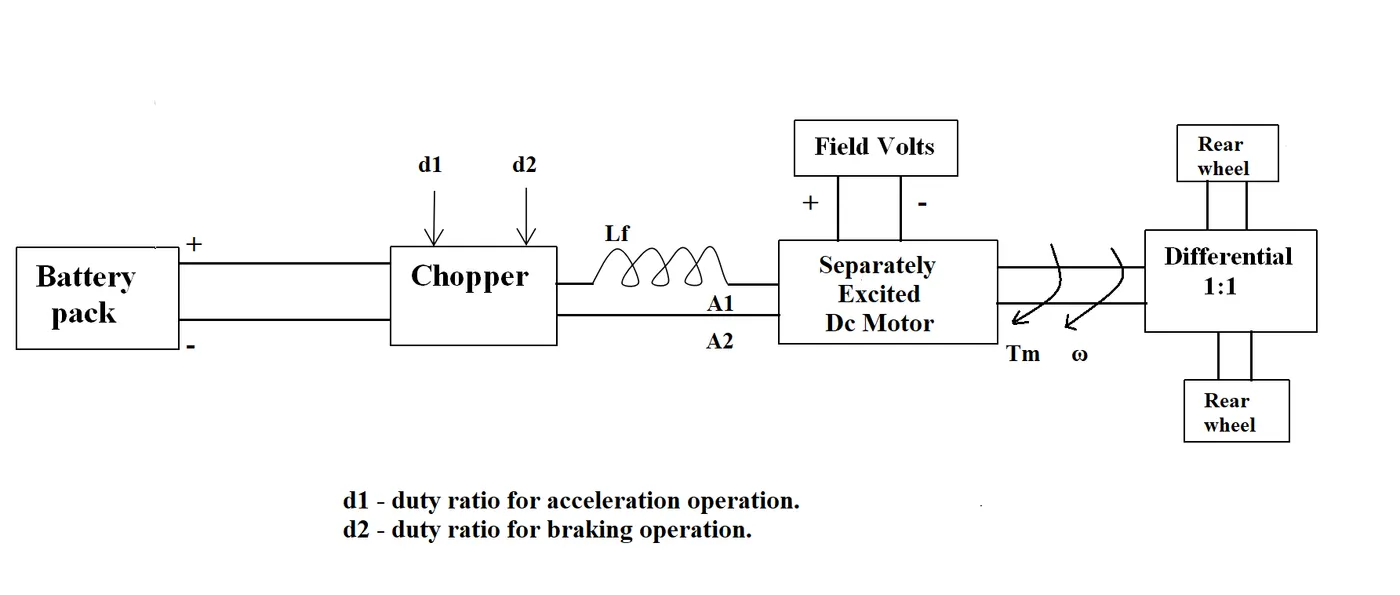
The other parameters of the electric vehicle are given below,
Motor and Controller Parameters: Rated Armature voltage= 72, Rated armature current= 400 A, Ra= 0.5Ω, KΦ= 0.7 Volt second, Chopper Switching frequency= 400 Hz
Vehicle speed-torque characteristics equation:

Solution:
Battery pack voltage (V) = 72
Rated armature current (Ia) = 400 A
Armature resistance (Ra) = 0.5
Motor constant (K) = 0.7
Chopper switching frequency = 400 Hz
Duty cycle = 70%
Total output (V) = Battery voltage * duty cycle
= 72 * 0.7 =50.4 V
Vehicle torque, Tv = Vv * (K/Ra) - (K/Ra)*w
Tv = 50.4 * (0.7/0.5) - (0.7^2/0.5)*w
Tv = 70.56 - 0.98w
Vehicle speed torque characteristics is given by
Tv = 2.47 + 0.0051w^2
Therefore
= 24.47+ 0.0051w^2 = 70.56 - 0.98w
=> 0.0051w^2 + 0.98w - 45.85 = 0
By solving this quadratic equation we get 2 roots w=-231.071 rps and w= 38.914 rps.
Since speed cannot be negative, we consider
w= 38.914 rps => 371.601 RPM
Task 3:
Develop a mathematical model of a DC Motor for the below equation using Simulink.
ω= V/Kϕ -Ra/Kϕ^2 .T
Simulink model:
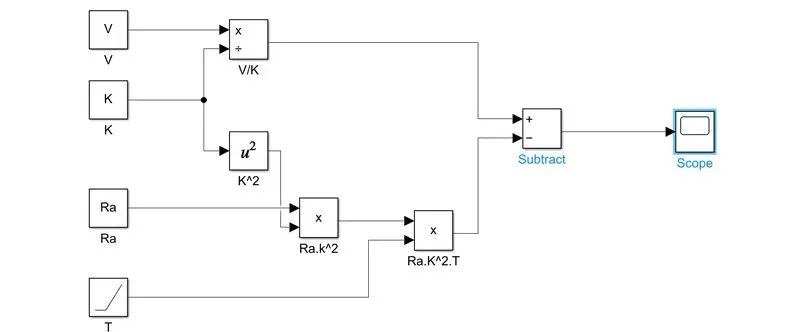
Blocks used:
- Constant Block
- Ramp
- Divide block
- Math function
- Product
- Subtract
- Scope
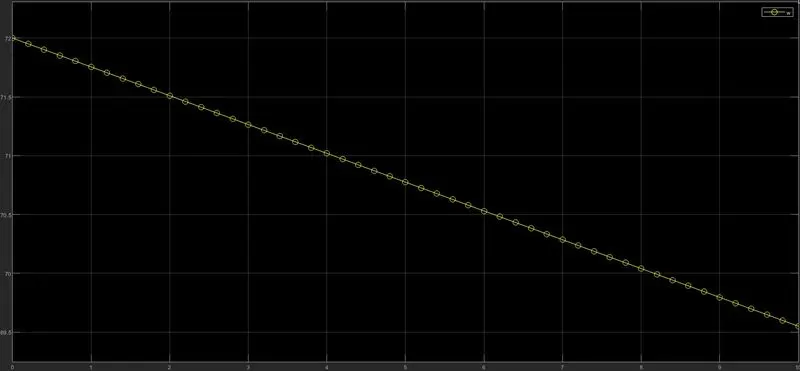
Output plot:
Task 4:
Refer to the blog on Induction Versus DC brushless motors by Wally Rippel, Tesla, and explain in brief about author’s perspective.
Wally Ripple is an engineer at Tesla Motors who had helped in the development of General Motors EV1, the first production electric car. The dominance of the combustion engine over any other automobile technology is put into the picture along with a customer's requirements in a vehicle and engines.
He explains Electric Vehicle technology prominently DC brushless motors and Induction Motors, He also explains battery technology considering Lead-acid and Li-ion batteries.
DC brushless motor: Permanent magnets are used in the rotor to create a rotating magnetic field. This magnetic field induces a current and generates a force in the rotor which rotates the rotor shafts.
Induction motor: Current is supplied to the stator with field windings which creates an electromotive force. This emf acts on the rotor and induces a current in the rotor. The rotor containing conductor plates gets interfered by this current and rotates in turn rotating the shaft.
Towards the end, he anticipates the normal DC motors will be replaced with DC brushless or Induction motors in the advent of Electric Vehicles.