Week-6 Challenge: EV Drivetrain
Week-6 Challenge: EV Drivetrain:
- Which types of power converter circuits are employed in electric and hybrid electric vehicles?
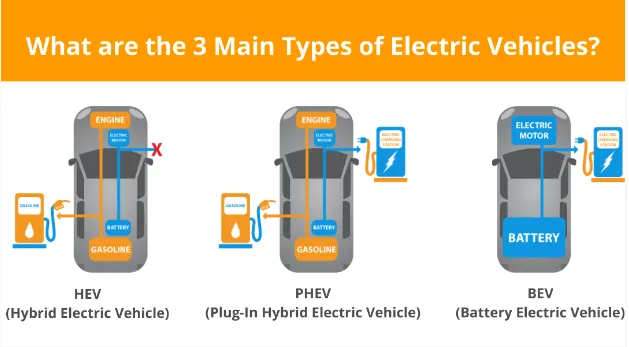
As per the below image , there are 3 types of EV. As all these involve motor and battery in it, obviously there is need of power conversion like AC to DC or DC to AC according to the requirement.
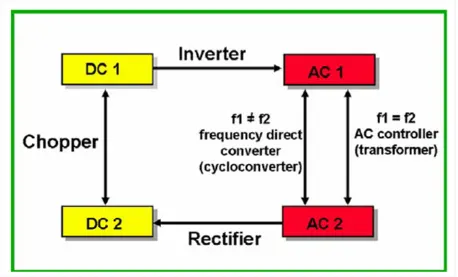
As per the below pictures , and depending on the type of function performed, power electronic converters are categorized into the following types.
- AC to DC = Rectifier: It converts AC to unipolar (DC) current
- DC to AC = Inverter: It converts DC to AC of desired frequency and voltage
- DC to DC = Chopper: It converts constant to variable DC or variable DC to constant DC
- AC to AC = Cycloconverter, Matrix converter: It converts AC of desired frequency and/or desired voltage magnitude from a line AC supply.
Only the first 3 converters are used in EV.
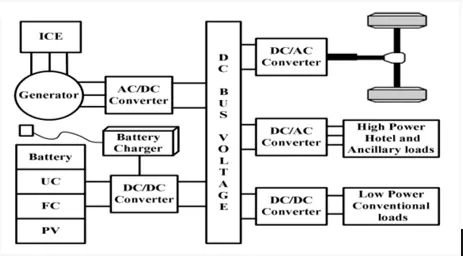
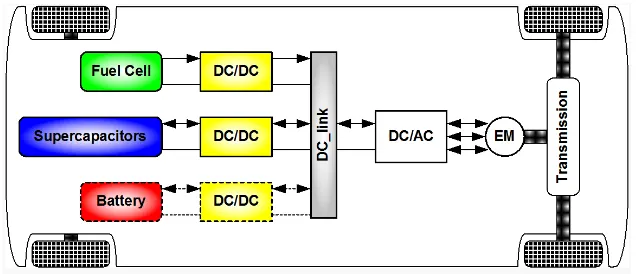
The following picture depicts the clear information about the rectifier, inverter, chopper and controller.
AC to DC Converters or Rectifiers
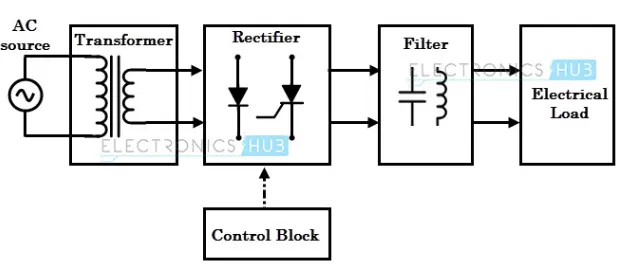
An AC to DC converter is also called a rectifier, which converts AC supply from main lines to DC supply for the load. The block diagram of an AC to DC converter is shown in the figure below.The essential components in this rectifier include transformer, switching unit, filter and a control block.
DC to AC Converters or Inverters
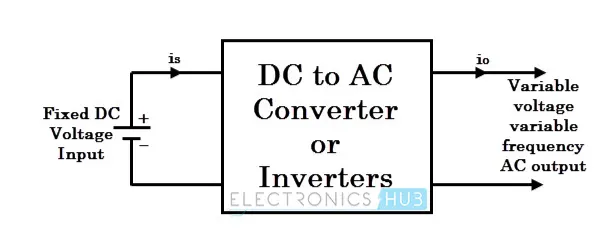
These converters are connected between DC source of fixed input, and variable AC load. Most commonly, these DC to AC converters are called inverters. An inverter is a static device that converts fixed DC supply voltage to variable AC voltage.
DC to DC Converters
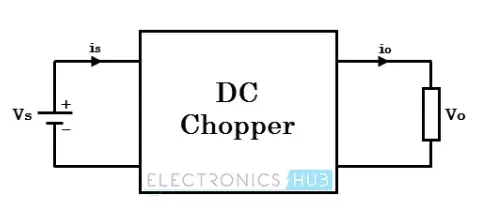
Many DC operated applications need different levels of DC voltage from a fixed DC source. A DC chopper is a static device that converts a fixed input DC voltage to variable DC output or a fixed DC output of different magnitude (which can be lower or higher) than input value. The block diagram of a DC chopper is shown in the figure below.
2. An Electric Vehicle's powertrain with 72V battery pack in shown in the diagram below. The duty ratio for acceleration operation is 'd1' and for the braking operation the duty ratio is 'd2'
The other parameters of the electric vehicle are given below,
Motor and Controller Parameters:
Rated Armature voltage Va = 72 V
Rated armature current= 400 A
Ra= 0.5Ω, KΦ= 0.7 Volt second
Chopper Switching frequency= 400 Hz
The vehicle speed-torque characteristics are given by the below equation.

ANS:
By the given torque formula, we need to find the speed in rad/sec. As per the given information for duty cycle
`phi`= 70`
Voltage = Va * `phi`
= 72 * 0.7
= 50.4 V
We know,
Torque T = k`Phi`/ Ra* [ Va - K`Phi`* `omega`]
By substituting the given values,
Torque T = (0.7/0.5)*(50.4 - 0.7`omega`)
= 1.4 * (50.4 - 0.7`omega`)
= 70.56 - 0.98`omega`
T = 70.56 - 0.98`omega`
Tv = 24.7 + (0.0051)`omega`2
At T = Tv,
70.56 - 0.98`omega` = 24.7 + (0.0051)`omega`2
(0.0051)`omega`2 +0.98`omega`+ 24.7 -70.56 = 0
(0.0051)`omega`2 +0.98`omega` - 45.86 = 0
`omega` = 38.915 rad/sec.
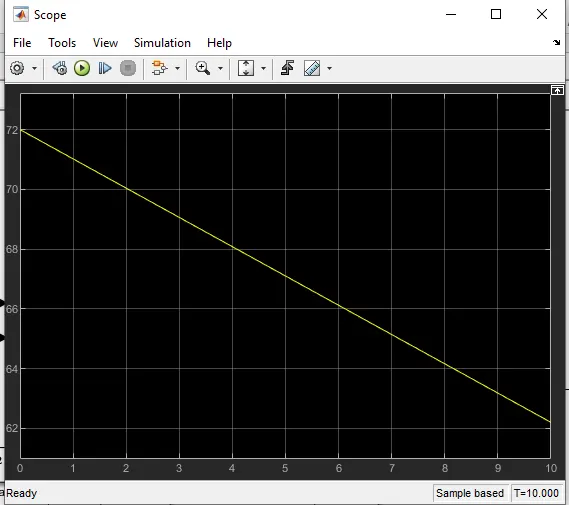
3. Develop a mathematical model of a DC Motor for the below equation using Simulink.
ω= V/Kϕ - Ra/Kϕ^2 .T
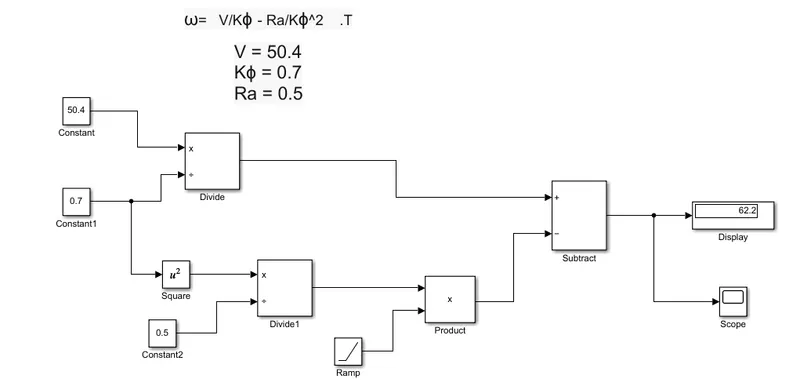
OUTPUT:
4. Refer to the blog on below topic:
Induction Versus DC brushless motors by Wally Rippel, Tesla
Explain in brief about author’s perspective.
In this author speaks more about induction vs brushless DC motor in EV / HEV
- There is no such best engine that is suitable for the vehicle.There is no one best engine type, rather there are different types of engines to suit personal requirements, such as price and performance. This is also true for electric vehicle drives
- There were lead acid batteries, DC brush motors, and contactor controllers in the EV before, now all are replaced.
- Lead has been replaced by lithium and DC by either DC brushless or induction. Contactors are replaced by modulating inverters.
- He discussed more about two technologies of brushless DC motor and induction motor.
- He talks about the inverter needed in DC brushless motors because a brushless DC motor produces no starting torque when directly connected to fixed frequency utility power.
- When a 3-phase induction motor is connected to utility type 3-phase power, torque is produced at the outset; the motor has the ability to start under load so No inverter is needed.
- Both DC brushless and induction drives use motors having similar stators. Both drives use 3-phase modulating inverters. The only differences are the rotors and the inverter controls. And with digital controllers, the only control differences are with control code. (DC brushless drives require an absolute position sensor, while induction drives require only a speed sensor; these differences are relatively small.)
His conclusion is DC brushless drives will likely continue to dominate in the hybrid and coming plug-in hybrid markets, and that induction drives will likely maintain dominance for the high-performance pure electrics.