Week-6 Challenge: EV Drivetrain
AIM:
1.TO identify the types of power converter circuit employed in electric and hybrid electric vehicle.
2.to calculate the steady state speed of an EVwith given inputs if duty cycle is 70%
3.refer to the blog and explain in brief about authors perspective.
objective:
1. which types of power converter circuits are employed in electric and hybrid electric vehicle?
power electronic converters:-
in electric and hybrid electric vehicles (HV/HEV), the power electronic converter are considered as the key elements that interface their power sources to the drivetrain of the EVs. in order to design highly efficient converter for the EVs power system ,advanced DC/DC and DC/AC converter are required to adapt the output voltage and current levels with high power quality .
the 3 types of converters which are widely used in an electric vehicle are:
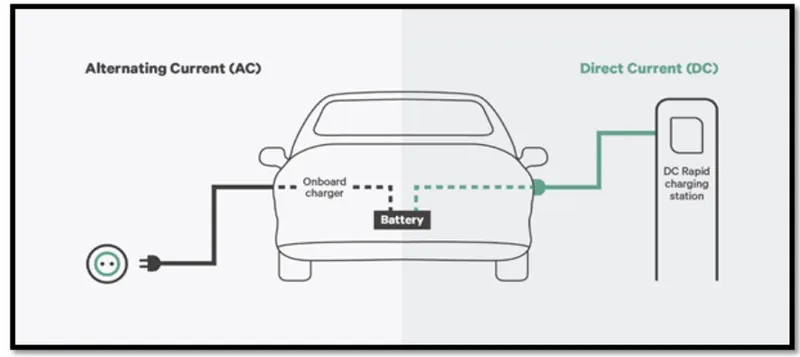
AC-DC CONVERTER (on board charger):-
AC to DC converters are most commonly used in plug -in hybrid electric vehicles (PHEV) plug in electric vehicle get their propulsion power from an external electricity source (charging current ) which is alternating current . the battery needs to be charged using a direct current source . for this a direct current source .for this purpose ,AC to DC converter is employed in a PHEV&PEV.
DC-DC Converter:-(HYBRID ELECTRIC VEHICLES)
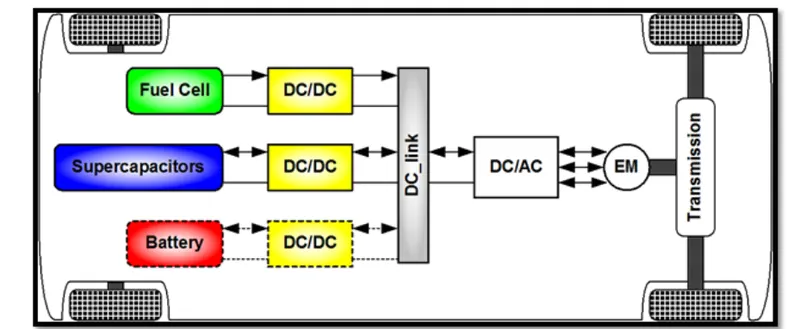
DC-DC converter can be used to interface the elements in the electric power train by boosting or chopping the voltage level . by introducing DC/DC converter one can choose the voltage variation of the devices and the power of each device can be controlled . the power of the DC/DC converter depends on the charactristics of the vehicle such as top speed ,acceleration time from 0to 100 km/h weight , maximum torque ,and power profile (peak power ,continuous power ).
ligh weight ,
high efficiency,
small volume,
low electromagnetic interfernce
low current ripple draen from the fuel cell or the batery
the step up function of the converter
control of the DC/DC converter power flow subject to the wide voltage variation on the converter input.
DC-AC converter (inverter):-
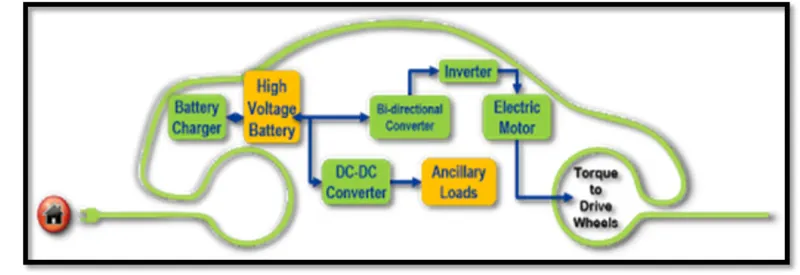
the DC/AC converter is required to convert the dc power to a suitable ac power for the electrical machine the power output from battery pack (DC current ) is converted using inverter to be used in electric motor AC current.
DC to DC isolated DC-DC converters are often used in low and medium -power vehicular application the full bridge isolated DC -DC converter is the most popular topology for BEV and PHEV powertrain .
Isolated converters:
in this type of converters a high frequency transformer is used . in the appliction where the output need to completely isolated from the input an isolated converter is necessary . there are many types of converter in this group such as half bridge ,fly back forward and push pull DC/DC converter .all of these converter can be uesd as bi -directional converter and the ratio of stepping down or setpping up the voltage is high .
Non -isolated converters :
Buck-A buck converter is a DC to DC power converter which steps down voltage from its input (supply) to its output (load) it is a class of switched mode power supply (SMPS)typically containing at leatt two semiconductors a diode and a transistor ,although moderen buck converter frequently replace the diode with a second transistor used for synchronous rectification and at capacitor ,inductor ,or reduce voltage ripple ,filter made of capacitor (sometimes in combination with inductors) are normally added to such a converters ouput (loade-side filter ) and input (supply -side filter).
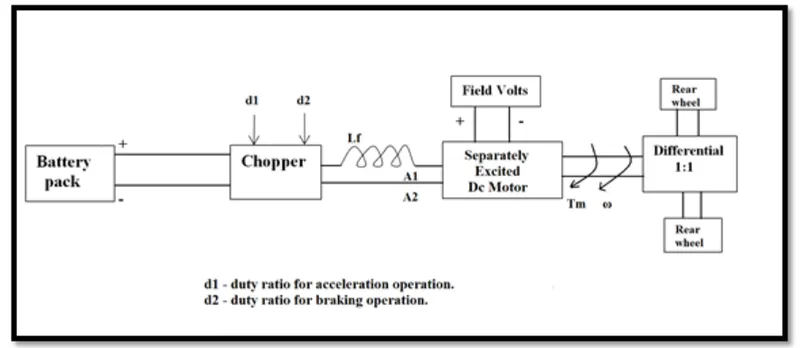
2).An electri vehicles power train with 72v battery pack in shown in the daigram below .the duty ratio for acceleration operation is d1 and for the braking operation the duty ratio is d2:
the other parameter of the electric vehicle is given below ,
motor and controller parameter :
vehicle output voltatge (Vv)is given
Vv=battery voltage (Vv)*duty cycle
Vv=72*0.70
vehicle voltage =50.4v
equation for vehicle torque is
Tv=(Vv-w.k ϕ)kϕ/Ra
Tv=vehicle torque (N-M)
Vv=vehicle voltage
w=steady state speed of vehicle (rps)
kϕ=armature resistance sub all these values in eqn
Tv=(50.04-0.7.w).0.7/0.5
Tv=70.56-0.98.w
Tv=24.7+0.0051.w^2
tv=tv
70.56-0.98.w=24.7+0.0051.w^2
0.0051.w^2+0.98.w-46.94=0
quadratic eqn
w=38.58 rds/s
=-230.95rad/s
38.85rad/sand -230.95 rad/s
we take the positive value
3.refer to the blog on below topic:
induction versus DC brushless motor by wally ripple teslexplain in brief about authors perspective.
the following points can be concluded from the above topics :
*in the beginning ,author describes the dominance of internal combustion engines (ICE) in the world of automobile industry and also discuss different types of engines. he explains that all engines were similar and it was up to the user to select according to their requirement he also speak about induction motor and present his view that these two technologies will be widely used for the coming years .
*then he explains the working of both 3-phase induction motor and a brushless DC motor.
*now the author has done comparison between these some advantages and disadvantages of each.
*induction motor have some advantages like it has no magnets .the motor has the ability to start under load .no inverter is needs .
some disadvantages of induction motors are .they cannot operate from DC.
AAC is a must shaft speed is proportionate to line frequency .
hence when used with utility power, they are constant speed machines.
when operated from utility power, they have limited starting torque and some what limited running peak torque capability ,
when compared to DC type machine .
*brushless DC motor have some advantages like .much less rotor heat is generated with the DC brushless drive . will typically be a few percentages points higher than for an induction drive .
some disadvantages of brushless DC motor are.
as machine size grows ,the magnetic losses increase proportionately and part load efficient drops . permanent magnets are expensive and difficult to handle due to very large force that come into play when anything ferromagnetic gets close to them.
finally the author couldnt choose which drive is better than the other but makes it clear that DC brushless drives will likely continue to dominate in the hybrid and coming plug-in hybrid and markets and that induction drive will likely maintain dominance for the high-performance pure electric.
conclusion:
1. types of power converter circuit and their application in EV and HEV are explained .
2.the ev steady EV steady state speed for duty cycle 70% according to the given parameter can be 38.915rad/s
3.the author perspection regarding induction vs IC brushless motor is thsy are almost same when compared overall .
the usage of them and requirment are explained .