Week-6 Challenge: EV Drivetrain
1. Which types of power converter circuits are employed in electric and hybrid electric vehicle?
AC to DC converters(Rectifiers)
It takes Alternating current as input and converts DC output
Application : EV chargers
Inverters (DC to AC)
An inverter is a circuit, it converts power from one DC level to another AC voltage and frequency.
Application: EV drives.
DC to DC power converters
One level of DC converts into another level of DC this type of converter is called Chopper.
If we increase the supply from 12v to 100v is called as step up chopper
If we decrease the supply from 100v to 12v is called as step down chopper
AC to AC converters:
Changing of one voltage and one frequency of AC supply to another voltage and frequency of AC supply called AC-AC converters.
2. An Electric Vehicle's powertrain with 72V battery pack in shown in the diagram below. The duty ratio for acceleration operation is 'd1' and for the braking operation the duty ratio is 'd2'.
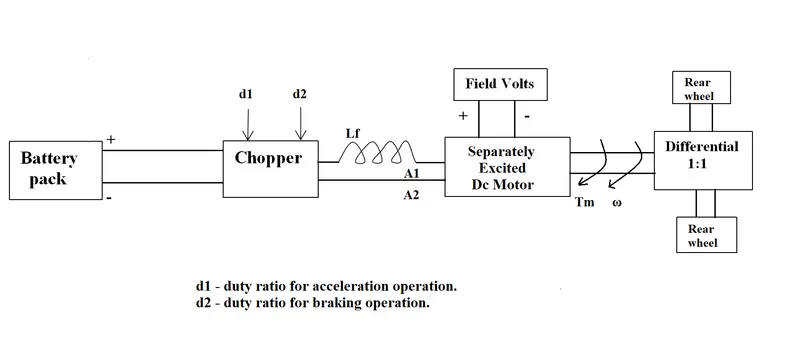
The other parameters of the electric vehicle is given below,
Motor and Controller Parameters:
Rated Armature voltage= 72 V
Rated armature current= 400 A
Ra= 0.5Ω, KΦ= 0.7 Volt second
Chopper Switching frequency= 400 Hz
The vehicle speed-torque characteristics are given by the below equation

What is EV steady state speed if duty cycle is 70%?
Motor voltage `Vm=Vb*d`
`Vm=72V*0.7`
`Vm=50.4V`
Torque-speed charecteristics of motor
`T=(V*Kphi)/R-((Kphi)^2*omega)/R`
`T=(50.4*0.7)/0.5-(0.7^2*omega)/0.5`
`T=70.56-0.98omega`
From given data
Torque-speed charecteristics of motor
`T=(V*Kphi)/R-((Kphi)^2*omega)/R`
`T=(72*0.7)/0.5-(0.7^2*omega)/0.5`
`T=100.8-0.98omega`---------- 1
From given data
--------- 2
solving equation 1 and 2
`100.8-0.98omega=24.7+0.0051omega^2`
`0.0051omega^2+0.98omega-76.1=0` ----- 3
equation 3 represents quadratic equation `ax^2+bx+c=0`
`-b+-sqrt(b^2-4*a*c)/(2*a)`
Finally we get the value of angular speed is 59.3 rad/s and -251.4 rad/s
3. Develop a mathematical model of a DC Motor for the below equation using Simulink.
ω= V/Kϕ -Ra/Kϕ^2 .T
V=24v;
Ra=0.5ohms;
`kphi=0.7`
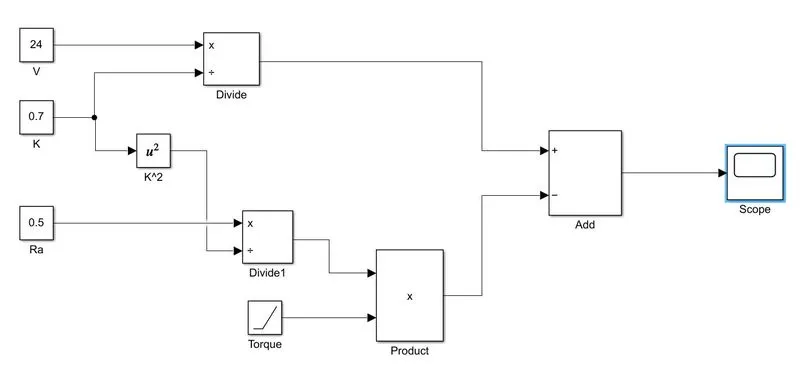
Blocks used in simulink model;
Constant block for voltage, resistor and constant
Square block
Ramp block for Torque
Divide, add/subtract
Scope for output
Output
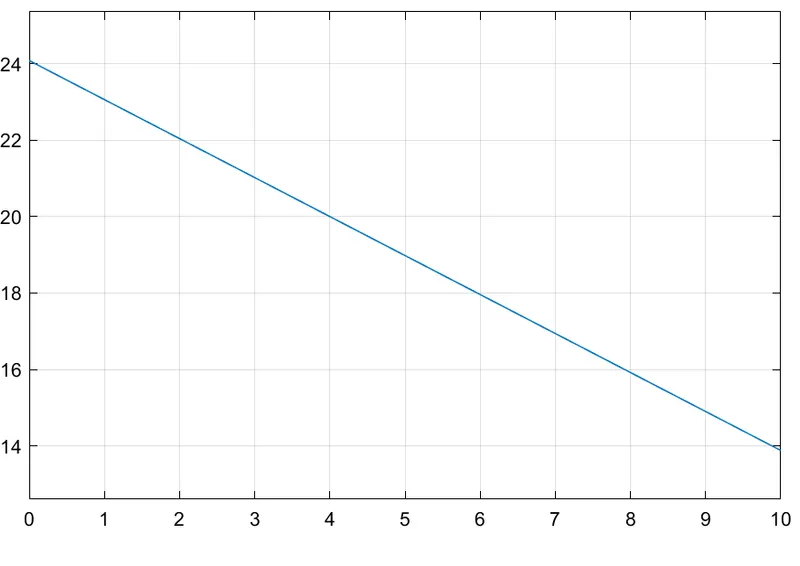
4. Refer to the blog on below topic:
Induction Versus DC brushless motors by Wally Rippel, Tesla
Explain in brief about author’s perspective.
Author compares the motors that could be used in EV and HEV.
Three Phase induction motor
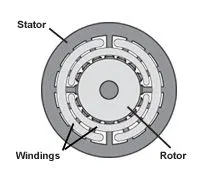
- When you connect a 3-phase AC induction motor to a 3-phase power supply, it produces torque. The motor does not require an inverter to start under load.
- The 3-phase induction motors cannot operate from DC. Instead, they need an AC supply.
- As the shaft speed is proportional to line frequency, these motors are constant speed machines.
- Compared to DC-type machines, these motors have limited running peak torque capabilities. Further, they have limited torque power when operated from utility power.
- The speed characteristics are non-linear, and it enables lower torque at lower speeds.
- For fixed speeds, there is no need for a controller. A controller is necessary only if you want variable speed.
- As both the rotor and stator have windings, the output power is lower than the BLDC motor.
- The induction motor enables poor dynamic characteristics because of high rotor inertia.
Brushless DC motor
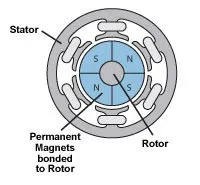
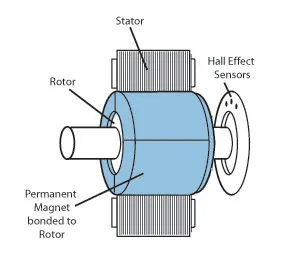
- The BLDC motors do not have any starting torque when connected to the utility power source. Therefore, it needs an inverter with the phase maintained in step with the rotor’s angular position.
- The DC brushless drive generates less heat than the 3-phase AC induction motors.
- It enables operations at varying speeds with the rated load. The speed characteristics are flat.
- It requires a controller to keep the motor running. You can also use the controller for variable speed control.
- It has permanent magnets on the rotor, so it is possible to achieve a smaller size for given power output.
- As the rotor inertia is low, it enables better dynamic characteristics.
He concluded that DC brushless drives will likely continue to dominate in the hybrid and coming plug-in hybrid markets, and that induction drives will likely maintain dominance for the high-performance pure electrics.