Week-6 Challenge: EV Drivetrain
1.Which types of power converter circuits are employed in electric and hybrid electric vehicle?
EV Drivetrain :-
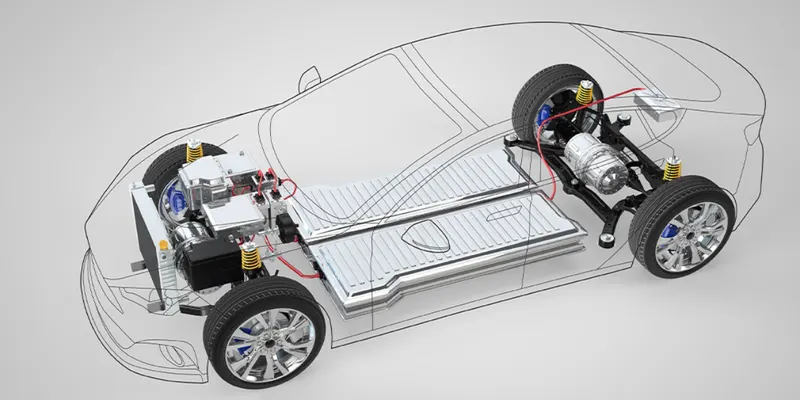
Components of Electric vehicle and Hybrid Electric vehicle :-
Regardless of the type of hybrid electric vehicle (HEV), the propulsion system is composed of at least the following components: a prime mover; an electric motor with a DC‐DC converter, a DC‐AC inverter, and the controller; an energy storage system (ESS); a transmission system.
Power Converters for Electric vehicle :-
In electric engineering, a DC to DC converter is a category of power converters and it is an electric circuit which converts a source of direct current (DC) from one voltage level to another, by storing the input energy temporarily and then releasing that energy to the output at a different voltage.
Power Converters for Hybrid Electric vehicle :-
AC to DC converters are most commonly used in Plug-in Hybrid Electric Vehicles (PHEV) & Plug-in Electric Vehicles (PEV).
Most common DC-DC convertor used in EV and HEV are :-
unidirectional converter :-
DC - AC Convertor :-
AC-DC converters take the AC power from wall outlets and convert it to unregulated DC. These power supplies include transformers that change the voltage of the AC that comes through wall outlets, rectifiers to save it from AC to DC and a filter that removes noise from the peaks and troths of the AC power waves
2. What is EV steady state speed if duty cycle is 70%?
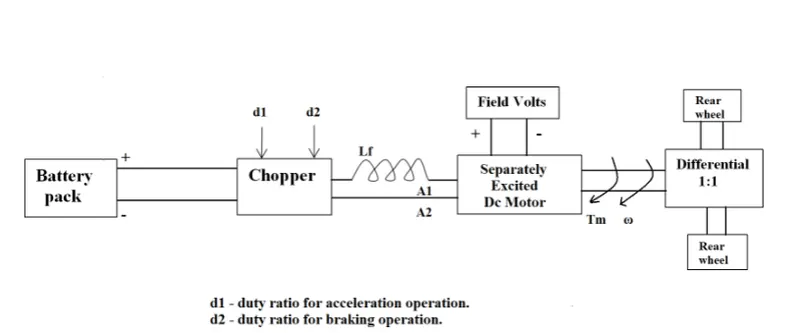
Given parameters :-
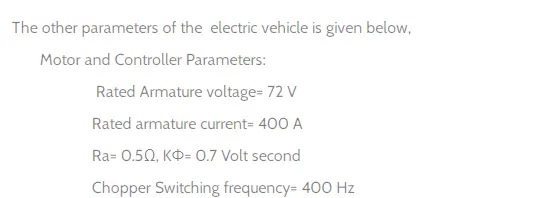
The vehicel speed tourque characteristic equation
`Tv = 24.7 + (0.0051)w^2`
a torque formula is given we need to find speed (rad/s)
T = v.k/R - K^2.w/R
Duty cycle is 70% = 0.7
therefore actual voltage is 0.7*72 = 50.4V
calculation :-
24.7+0.0051*w^2 = ((v*k)/R)-((k^2)*w/R)
24.7+0.0051*w^2 = (72*0.7*0.7)/0.5 - (0.7^2/0.5)*w = 24.7+0.0051*w^2
70.56-0.98*w = 24.7 + 0.0051*w^2
w^2 + 192.15*w - 8992.15 = 0
Find the roots using quardrating formula
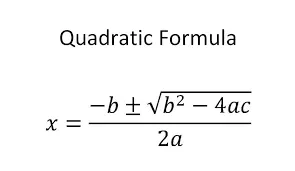
w = 38.95 rad/sec
3.Develop a mathematical model of a DC Motor for the below equation using Simulink.
Code :-
clear all
close all
clc

% Torque Speed Characteristics of DC Machine.
Speed  = linspace(0,500,50);

% Input of Speed constant of a motor  (rpm/v)
N_s   =  input('Enter the value Speed Constant of Motor = ');

% Input the Battery voltage supply value.(volts)
V   =  input('Enter the value Voltage Supply = ');

%Input the Armature Resistance. (ohms)
R_a  =  input('Enter the value Armature Resistance = ');

% Back E.M.F developed
EMF  =  1 ;

%Calculating the constant of proportionality in emf and speed relation
k_p  =  (EMF*60)/(N_s*2*3.14);

% the DC motor Speed torque charateristics
% T = ((V*k_p/R_a) - ((k_p)^2/R_a)*omega)
% Calculation of Torque
 T  =  ((V*k_p/R_a) - (((k_p)^2/R_a).*Speed));


 % To calculate Total Current in Ampere
 TC  =  (V - EMF)/R_a;

 % To Calculate the maximum Torque
 T_max  = k_p*TC ;


  %Convert Speed value in rpm from rad/sec
 Speed  =  Speed*60/(2*3.14);

 % Plotting the D.C.Machine charateristics w.r.t Speed Vs Torque
 plot(Speed,T,'color','r','linewidth',3);
 xlabel('Speed (RPM)');
 ylabel('Torque (Nm)');
 title('D.C.Machine Charateristics wrt Speed Vs Torque');
Simulink Model :-
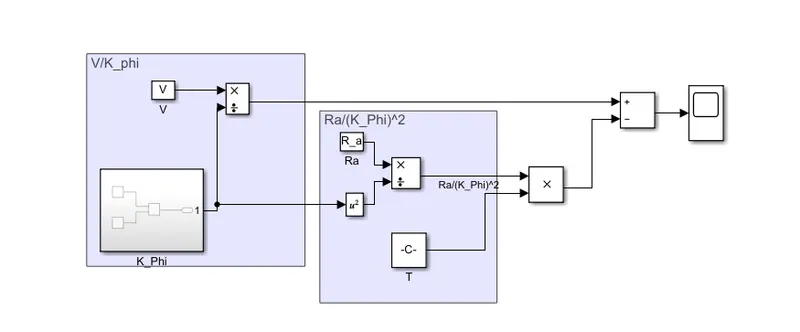
output Plot :-
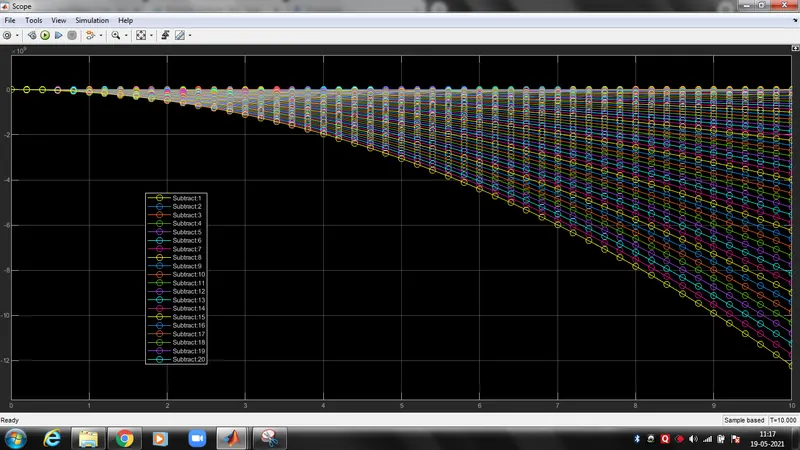
4. Induction Versus DC brushless motors by Wally Rippel, Tesla
Explain in brief about author’s perspective.
- As the rotor rotates, it is necessary that the magnitude and polarity of the stator currents be continuously varied – and in just the right way - such that the torque remains constant and the conversion of electrical to mechanical energy is optimally efficient. The device that provides this current control is called an inverter. Without it, brushless motors are useless motors.
- Currents flowing in the stator windings produce a rotating magnetic field that enters the rotor. In turn, the frequency of this magnetic field as “seen” by the rotor is equal to the difference between the applied electrical frequency and the rotational “frequency” of the rotor itself. Accordingly, an induced voltage exists across the shorted structure that is proportionate to this speed difference between the rotor and electrical frequency. In response to this voltage, currents are produced within the rotor conductors that are approximately proportionate to the voltage, hence the speed difference.
-they also have some severe limitations. They cannot operate from DC; AC is a must. Shaft speed is proportionate to line frequency. Hence, when used with utility power, they are constant speed machines. Finally, when operated from utility power, they have limited starting torque and somewhat limited running peak torque capabilities, when compared to DC type machines.
-The DC brushless drive can also operate at unity power factor, whereas the best power factor for the induction drive is about 85 percent. This means that the peak point energy efficiency for a DC brushless drive will typically be a few percentage points higher than for an induction drive.
-This advantage becomes increasingly important as performance is increased. With DC brushless, as machine size grows, the magnetic losses increase proportionately and part load efficiency drops. With induction, as machine size grows, losses do not necessarily grow. Thus, induction drives may be the favored approach where high-performance is desired; peak efficiency will be a little less than with DC brushless, but average efficiency may actually be better.