Week-6 Challenge: EV Drivetrain
1. Which types of power converter circuits are employed in electric and hybrid electric vehicle?
Ans.
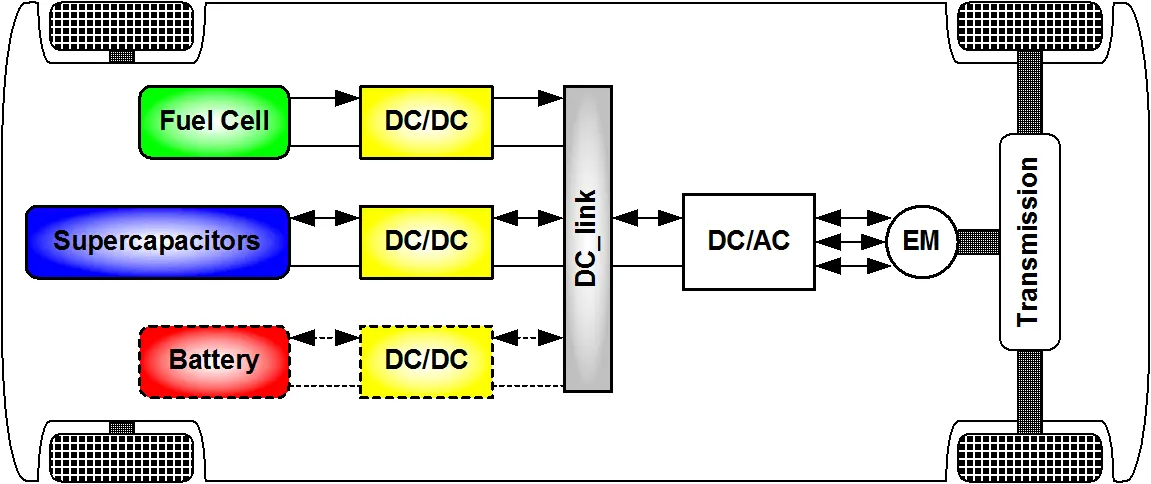
The different configurations of EV power supply show that at least one DC/DC converter is necessary to interface the FC, the Battery or the Supercapacitors module to the DC-link.
A DC to DC converter is a category of power converters and it is an electric circuit which converts a source of direct current (DC) from one voltage level to another, by storing the input energy temporarily and then releasing that energy to the output at a different voltage.
The storage may be in either magnetic field storage components (inductors, transformers) or electric field storage components (capacitors).
DC/DC converters can be designed to transfer power in only one direction, from the input to the output.
However, almost all DC/DC converter topologies can be made bi-directional.
A bi-directional converter can move power in either direction, which is useful in applications requiring regenerative braking.
The most common DC/DC converters can be grouped as follows:
Non-isolated converters:
The non-isolated converters type is generally used where the voltage needs to be stepped up or down by a relatively small ratio (less than 4:1).
And when there is no problem with the output and input having no dielectric isolation.
There are five main types of converter in this non-isolated group, usually called the buck, boost, buck-boost, Cuk and charge-pump converters.
The buck converter is used for voltage step-down, while the boost converter is used for voltage step-up.
The buck-boost and Cuk converters can be used for either step-down or step-up.
The charge-pump converter is used for either voltage step-up or voltage inversion, but only in relatively low power applications.
Isolated converters:
In this type of converters a high frequency transformer is used.
In the applications where the output needs to be completely isolated from the input, an isolated converter is necessary.
There are many types of converters in this group such as Half-Bridge, Full-Bridge, Fly-back, Forward and Push-Pull DC/DC converters.
All of these converters can be used as bi-directional converters and the ratio of stepping down or stepping up the voltage is high.
2. An Electric Vehicle's Drivetrain with 72V battery pack in shown in the diagram below. The duty ratio for acceleration operation is 'd1' and for the braking operation the duty ratio is2'. The other parameters of the electric vehicle is given below,
Motor and Controller Parameters:
Rated Armature voltage= 72 V
Rated armature current= 400 A
Ra= 0.5Ω, KΦ= 0.7 V-s
Chopper Switching frequency= 400 Hz
The vehicle characteristics are given by the equation
TTR=24.7+0.0051w2
What is EV steady state speed if duty cycle is 70%?
Ans.
We know: T= V*Km/Ra - Km*phi^2/Ra*w
where,
T- torque
Km- constant
Ra- armature resistance
Now,
duty cycle*battery voltage = voltage of motor
Motor voltage = 50.4 V
Now putting the values in the above stated equation,
T = 24.7 + 0.0051`w^2`
The complete equation is, 24.7 + 0.0051`w^2`= 50.4*0.7/0.5 - `0.7^2`/0.5w
solving this equation we get,
w = 38.82
w = -230 rad/s
Hence, the EV steady speed state is -230 rad/s
3. Refer to the blog on below topic:
Induction Versus DC brushless motors by Wally Rippel, Tesla
Explain in brief about author’s perspective.
Ans.
Author's perspective:
Induction machines are difficult to control.
Achieving stability in the entire range of torque-speed range and over temperature is more difficult in induction than in DC brushless.
Both DC brushless and induction machines have similar stators.
The rotors and the inverter controls are the only difference.
And with digital controllers, the only difference is with the control code.
Energy efficiency for a DC brushless drive will typically be a few percentage points higher than for an induction drive.
Permanent magnets are costlier.
Permanent magnets are difficult to handle due to very large forces that come into play when anything ferromagnetic in nature comes near it.
The author futher suggests that, DC brushless drives will likely continue to dominate in the hybrid, plug-in hybrids, and the induction drives will likely maintain dominance for the high performance pure electronics.
We will observe induction and DC brushless live function together in future electric and hybrid vehicles.