Week 6.2 - Setting up a model
CHALLENGE: To create high quality mesh for given electronic cabinet model and to carryout natural convection simulation in steady state and transient state condition to validate the thermal perfromance of the electronics cabinet.
MODEL:
1. The model given is initially verified for simplification and all unnecessary components have been removed in spaceclaim and all components which are not very small and contributing are removed as those components may increase mesh count decrease quality.
2. All important components have been simplified into Icepak primitives. and exported to Icepak for further analysis. the below image shows simplified model for analysis.
MESH:
1. Initial mesh have been created to visualize mesg bleeding. poor quality cells and cells distribution.
2. Based on the initial mesh Non-conformal assemblies have been created to avoid mesh bleeding. and to increase mesh quality.
3. Inorder to further reduce mesh count N/C assemblies have created to cylindrical components and densely packed family of components.
4. cut cell meshing have been used as gaps near cylinder is very less and reported negative volume in small gaps.
5. with all parameters defined. mesh have been created which satifies minimum quality requirement of Ansys Solver.
CASE SETUP-
NATURAL CONVECTION_STEADY STATE:
1. Initially the problem have been solved for steady state condition to ensure that the problem is getting solved and properly converges.
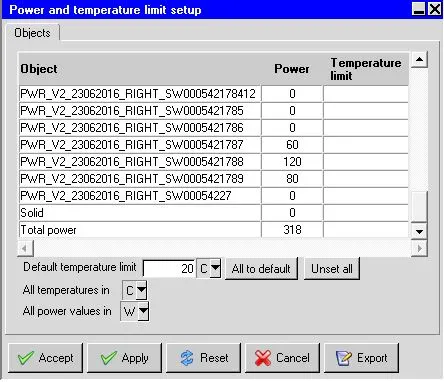
2. The below image shows the power set up for steady state case.
3. The problem is solved with coupled solver along with pseudo transient settings to ensure proper convergence.
4. The convergence plot shows that solution is getting properly converging without any fluctutations.
5. The above image shows the temperature contour plots for the electronics component with maximum temperature of 61.95 deg.
6. And the image shows temperature in fins is comparatively lesser.
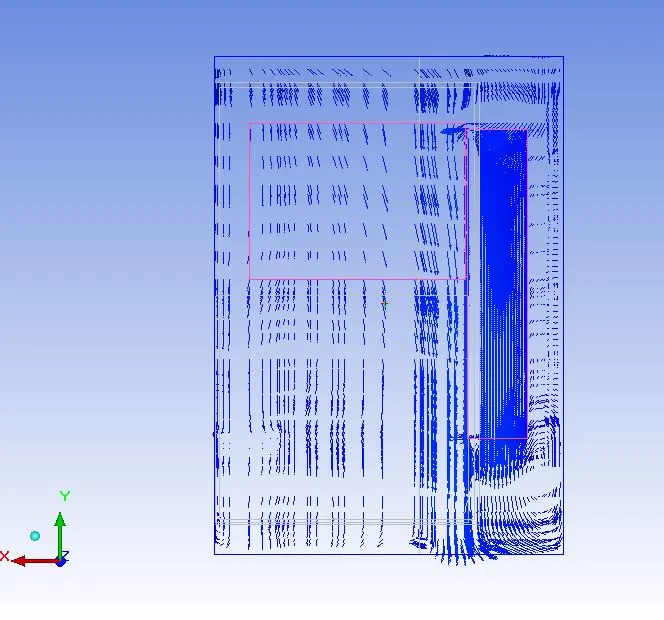
5. The above images shows the velocity vectors inside the cabinet. the velocity is minimum since there is no external sources like fan to promote airflow.
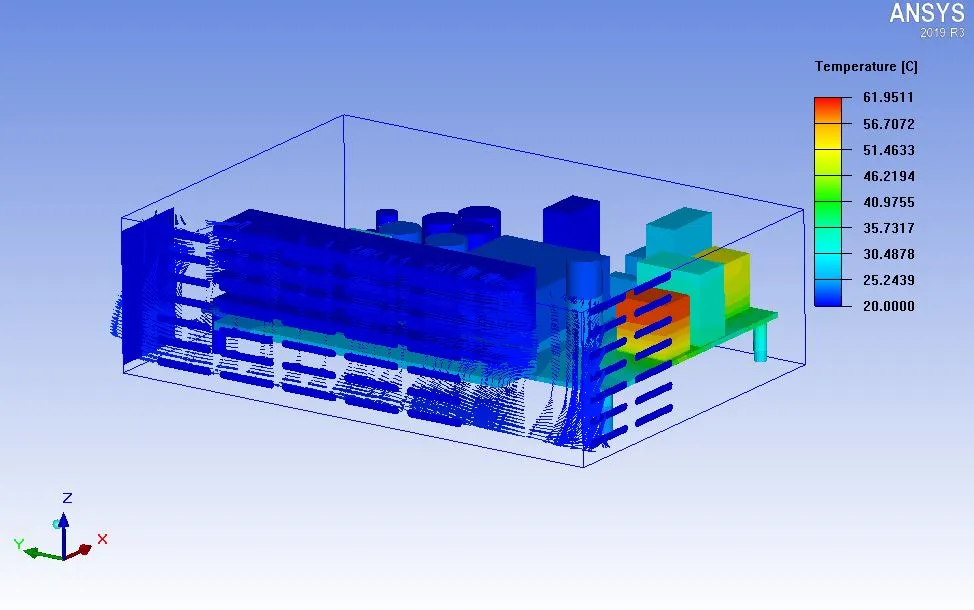
6. Velocity vectors in the cut plane which shows flow profile in openings and grilles along fins.
NATURAL CONVECTION_TRANSIENT STATE:
1. The problem have been solved for transient case for 20s. the power dissiptaion in capacitor have been defined as the function of time with following specification.
2. The transient square wave for heat dissipation is calculated under transient option in basic parameters in problem setup(shown below).
3. Convergence criteria have been lowered to 1 * e-7 to achieve good quality results. the problem is solved for timestep of 0.1seconds. and solver setup includes model based initialization to predict inital values precisely to achieve better convergence.
4. Solution displayed robust convergence since based on initial trials solver settings have fine tuned.
POST PROCESSING:
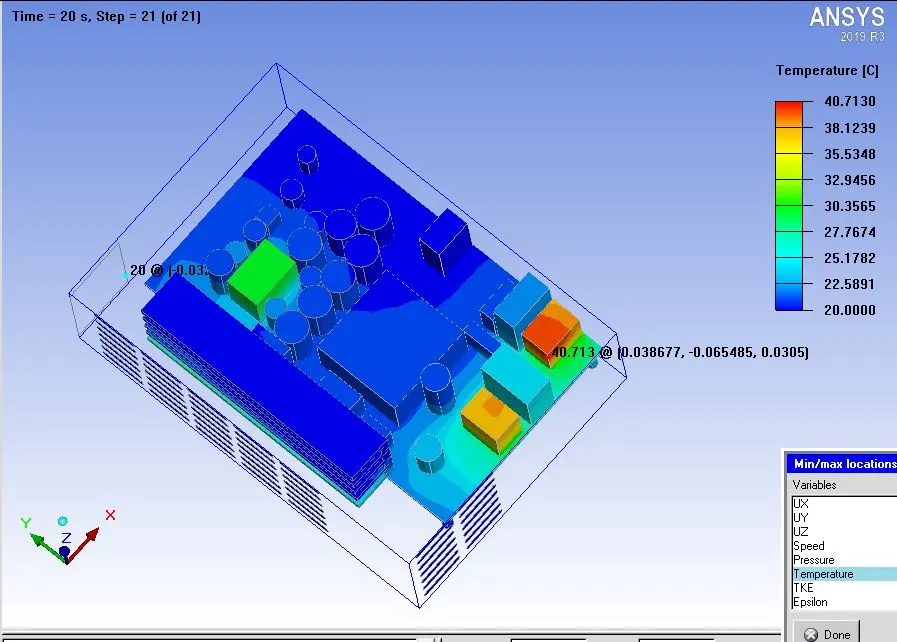
1. The results reviews shows that the max temperature in cabinet is 40.173 Degree. The temperature is in range in cabinet so the electronics components are safe.
2. The below image shows the temperature contours in cut plane across heat generation component at T=20s.
3. The below image shows the temperature variation with respect to square wave form heat dissipation as defined in transient settings.
4. The below image shows the temperature contours and max & min location of temperature in domain.
IMPORTANT RESULT REVIEW
------------------------------
Mass flow rates:
Specified Calculated
--------- ----------
Heat flows for openings, walls, grilles, and fans:
Opening -4.75361 W
Opening.1 -4.15057 W
Opening.2 -1.47614 W
Opening.3 -0.826025 W
Opening.4 -0.937989 W
Opening.5 -1.2621 W
Opening.6 -7.49354 W
Opening.7 -3.8048 W
Opening.8 -3.22306 W
Opening.9 -1.00875 W
Opening.10 -0.704536 W
Opening.11 -0.902127 W
Opening.12 -6.01434 W
Opening.13 -8.68506 W
Opening.14 -0.576694 W
Opening.15 -0.0792854 W
Opening.16 -0.206036 W
Opening.17 -0.0795488 W
Opening.18 -1.45149 W
Opening.19 -5.6484 W
Opening.20 -12.1714 W
Opening.21 -0.225128 W
Opening.22 -0.00483029 W
Opening.23 -0.00587072 W
Opening.24 -0.114768 W
Opening.25 -0.47541 W
Opening.26 -1.06069 W
Opening.27 -7.85883 W
Opening.28 -0.849224 W
Opening.29 -0.174509 W
Opening.30 -0.00405285 W
Opening.31 -0.0039988 W
Opening.32 -0.0186958 W
Opening.33 -0.368539 W
Opening.34 -2.93588 W
Opening.35 -2.68333 W
Opening.36 -2.04545 W
Opening.37 -2.58789 W
Opening.38 -2.47077 W
Opening.39 -2.33316 W
Opening.40 -1.65198 W
Opening.41 -3.37058 W
Opening.42 -62.4044 W
Opening.43 -18.5738 W
Opening.44 -7.99574 W
Opening.45 -7.09558 W
Opening.46 -3.25381 W
Opening.47 -4.05054 W
Opening.48 -8.44212 W
grille.1 -55.2982 W
Maximum temperatures:
PWR_V2_23062016_RIGHT_SW000542178 31.7587 C
PWR_V2_23062016_RIGHT_SW00054217810 22.9541 C
PWR_V2_23062016_RIGHT_SW00054217824 27.134 C
PWR_V2_23062016_RIGHT_SW00054217829 24.219 C
PWR_V2_23062016_RIGHT_SW00054217831 20.8113 C
PWR_V2_23062016_RIGHT_SW00054217833 22.9517 C
PWR_V2_23062016_RIGHT_SW000542178341 22.742 C
PWR_V2_23062016_RIGHT_SW00054217837 22.1916 C
PWR_V2_23062016_RIGHT_SW00054217841 22.0783 C
PWR_V2_23062016_RIGHT_SW000542178411.1 23.3998 C
PWR_V2_23062016_RIGHT_SW000542178431 25.1688 C
PWR_V2_23062016_RIGHT_SW0005421786 27.6327 C
PWR_V2_23062016_RIGHT_SW0005421788 38.6122 C
PWR_V2_23062016_RIGHT_SW0005421789 40.713 C
PWR_V2_23062016_RIGHT_SW000542 20.6572 C
PWR_V2_23062016_RIGHT_SW000542176 22.2907 C
PWR_V2_23062016_RIGHT_SW000542177 29.7392 C
PWR_V2_23062016_RIGHT_SW00054227 23.4619 C
PWR_V2_23062016_RIGHT_SW00054217812 22.0102 C
PWR_V2_23062016_RIGHT_SW00054217813 22.7227 C
PWR_V2_23062016_RIGHT_SW00054217815 23.9994 C
PWR_V2_23062016_RIGHT_SW00054217818 20.6886 C
PWR_V2_23062016_RIGHT_SW00054217826 23.1839 C
PWR_V2_23062016_RIGHT_SW00054217828 21.2916 C
PWR_V2_23062016_RIGHT_SW000542178281 20.7711 C
PWR_V2_23062016_RIGHT_SW00054217830 22.235 C
PWR_V2_23062016_RIGHT_SW00054217832 22.1159 C
PWR_V2_23062016_RIGHT_SW00054217835 23.2912 C
PWR_V2_23062016_RIGHT_SW000542178351 22.7912 C
PWR_V2_23062016_RIGHT_SW00054217839 21.0829 C
PWR_V2_23062016_RIGHT_SW000542178411 21.7216 C
PWR_V2_23062016_RIGHT_SW000542178412 21.1573 C
PWR_V2_23062016_RIGHT_SW0005421785 24.0216 C
PWR_V2_23062016_RIGHT_SW0005421787 30.5503 C
Solid 21.6455 C
PWR_V2_23062016_RIGHT_SW00054217834 24.0209 C
PWR_V2_23062016_RIGHT_SW00054217834.1 21.1347 C
PWR_V2_23062016_RIGHT_SW00054217834.2 22.3127 C
PWR_V2_23062016_RIGHT_SW00054217834.3 21.5353 C
PWR_V2_23062016_RIGHT_SW00054217834.4 21.804 C
PWR_V2_23062016_RIGHT_SW00054217834.5 21.2684 C
PWR_V2_23062016_RIGHT_SW00054217834.6 22.8052 C
PWR_V2_23062016_RIGHT_SW00054217834.7 21.0185 C
PWR_V2_23062016_RIGHT_SW00054217834.8 27.6871 C
Overall totals:
power 255.021 W
mass flow through boundaries 0.0000114343 kg/s
volume flow through boundaries 9.84255e-005 m3/s
IMPRESSIONS:
1. From steady state simulation it is evident that the maximum temperature is 60deg. and in transient simulation till t=20s temperature is 40deg so we have to solve transient case for another 40sec to see rise in temperature.
2. Heat dissipation is not satisfying so implementing fan will reduce temperature in key electronic components.