Week 5 - Turbulence modelling challenge
1)
Various turbulence models in modern engineering applications.
Spalart–Allmaras (S–A)
The Spalart–Allmaras model is a one-equation model that solves a modelled transport equation for the kinematic eddy turbulent viscosity. The Spalart–Allmaras model was designed specifically for aerospace applications involving wall-bounded flows and has been shown to give good results for boundary layers subjected to adverse pressure gradients. It is also gaining popularity in turbomachinery applications.[citation needed]
k–ε (k–epsilon)
K-epsilon (k-ε) turbulence model is the most common model used in computational fluid dynamics (CFD) to simulate mean flow characteristics for turbulent flow conditions. It is a two-equation model which gives a general description of turbulence by means of two transport equations (PDEs). The original impetus for the K-epsilon model was to improve the mixing-length model, as well as to find an alternative to algebraically prescribing turbulent length scales in moderate to high complexity flows.
k–ω (k–omega)
In computational fluid dynamics, the k–omega (k–ω) turbulence modelis a common two-equation turbulence model that is used as a closure for the Reynolds-averaged Navier–Stokes equations (RANS equations). The model attempts to predict turbulence by two partial differential equations for two variables, k and ω, with the first variable being the turbulence kinetic energy (k) while the second (ω) is the specific rate of dissipation (of the turbulence kinetic energy k into internal thermal energy).
SST (Menter’s Shear Stress Transport)
SST (Menter's shear stress transport) turbulence model is a widely used and robust two-equation eddy-viscosity turbulence model used in computational fluid dynamics. The model combines the k-omega turbulence model and K-epsilon turbulence model such that the k-omega is used in the inner region of the boundary layer and switches to the k-epsilon in the free shear flow.
Reynolds stress equation model
The Reynolds stress equation model (RSM), also referred to as second moment closure model, is the most complete classical turbulence modelling approach. Popular eddy-viscosity based models like the k–ε (k–epsilon) model and the k–ω (k–omega) models have significant shortcomings in complex engineering flows. This arises due to the use of the eddy-viscosity hypothesis in their formulation. For instance, in flows with high degrees of anisotropy, significant streamline curvature, flow separation, zones of recirculating flow or flows influenced by rotational effects, the performance of such models is unsatisfactory. In such flows, Reynolds stress equation models offer much better accuracy.
Eddy viscosity based closures cannot account for the return to isotropy of turbulence, observed in decaying turbulent flows. Eddy-viscosity based models cannot replicate the behaviour of turbulent flows in the Rapid Distortion limit,where the turbulent flow essentially behaves like an elastic medium.
We cannot use DNS is because it generates a mesh which is very fine and tries to capture all anomalies, so as the mesh cells increase the time taken to solve will increase. Due to this industries dont prefer this method.
2
Aim
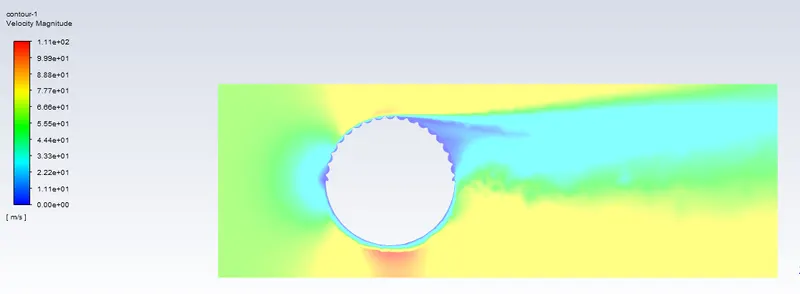
To do a 3D simulation of a golf ball and explain the recirculation region when the ball is traveling at 60m/s.
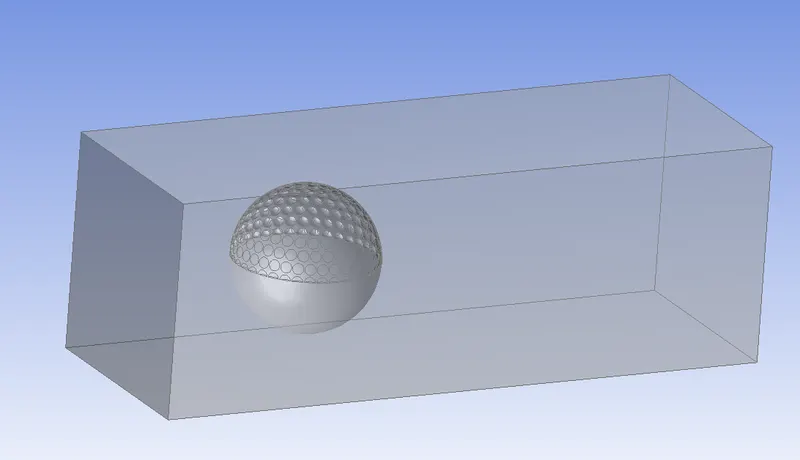
3D CAD model
Mesh
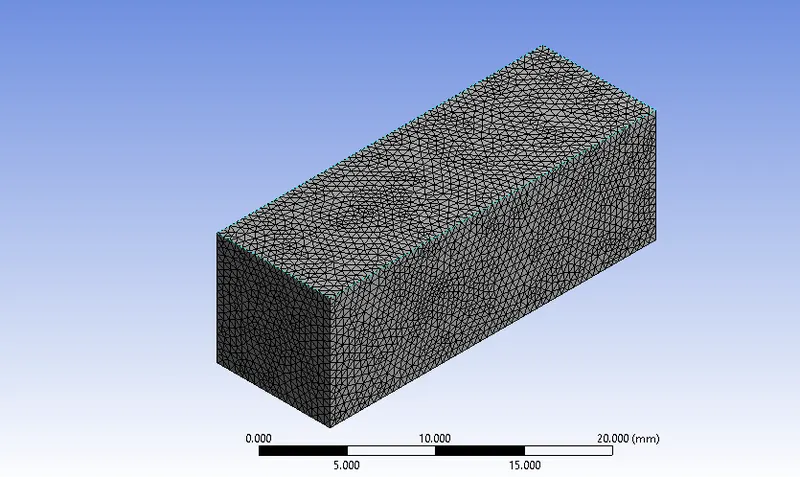
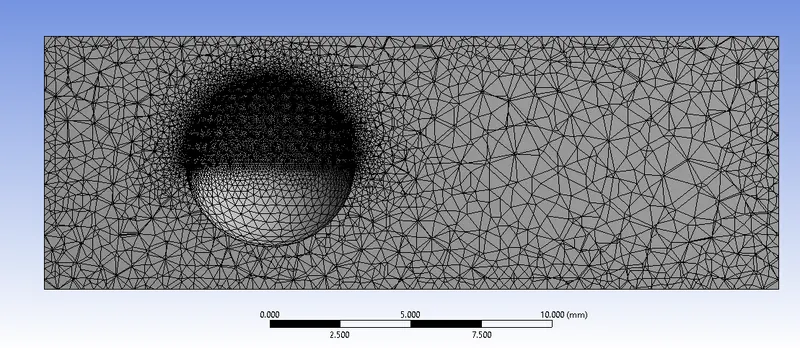
Mesh size 0.5 mm
Mesh cross section
Velocity Contour
Pressure contour
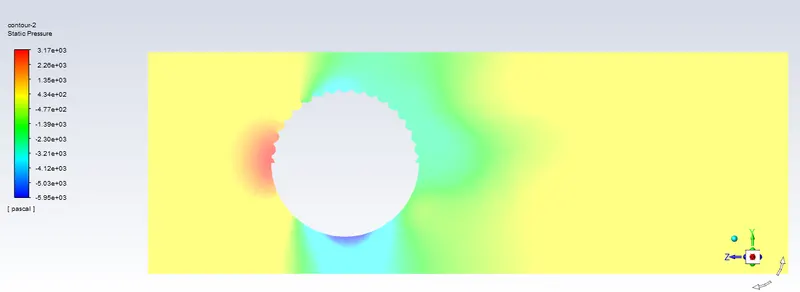
Velocity Vector plot
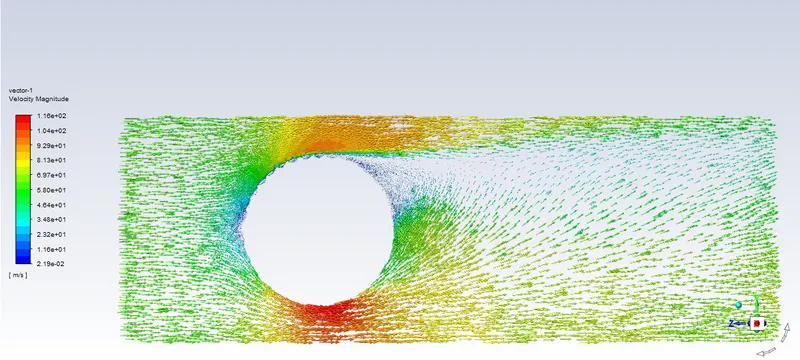
After observing the velocity vectors the direction of the ball is it's going down and the dimples on the golf ball helps to reduce the drag by reducing the wake region. It also helps the flow to be attached and tries to seperate the flow away from the golf ball