Sphere pressing on a plate
- Objectives: To capture plastic deformation of a plate when pressed by a sphere.
- Geometrical Design:
We have a 3D Assembly of a sphere and plate.
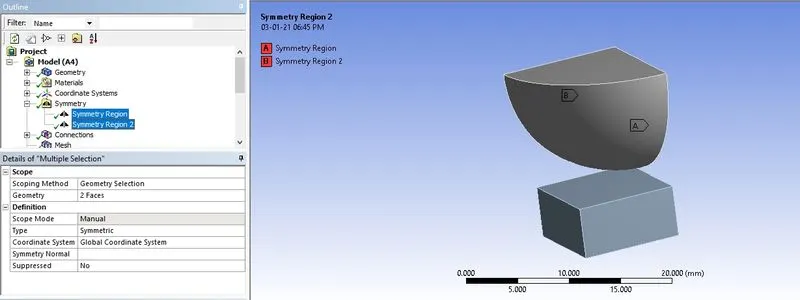
The profile of sphere is Round and Plate is square so we will apply symmetry here in geometry, we will consider only quarter portion of geometry.
Benefits of using Symmetry in FEA:
- Appling Symmetry will reduce the overall size of Geometry.
- Small geometry will lead to less number of nodes and elements.
- Less number of nodes and elements will lead to less computing time and less chances of convergence issue if a problem is Non Linear.
- Quarter or Half portion of geometry can be analysed easily then we can get results for whole geometry using symmetry.
These are some benefits of using symmetry in FEA, so we will use this method in this project as well.
After cutting the geometry in quarter (4th) part this is how it looks like.
Symmetry:
- Material Properties:
For Sphere Structural Steel is used and for plate Structural Steel Non-Linear is used, below tables shows the mechanical properties of materials.
Bi-Linear Isotropic Hardening for Structural Steel Non-Linear:
- Problem Statement:
One Steel Plate is pressed by sphere to capture plastic deformation. Sphere is pressed and then retracted back to obtain results.
- Mesh Criterion:
Type of Elements:
Size of Elements:
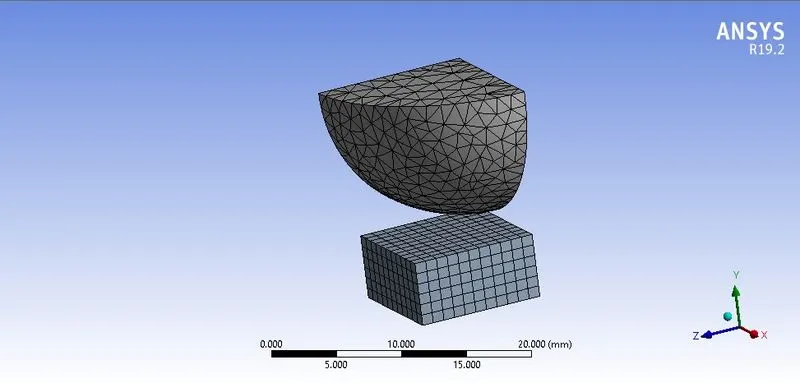
This how geometry looks like when meshing done;
Mesh:
- Boundary Condition:
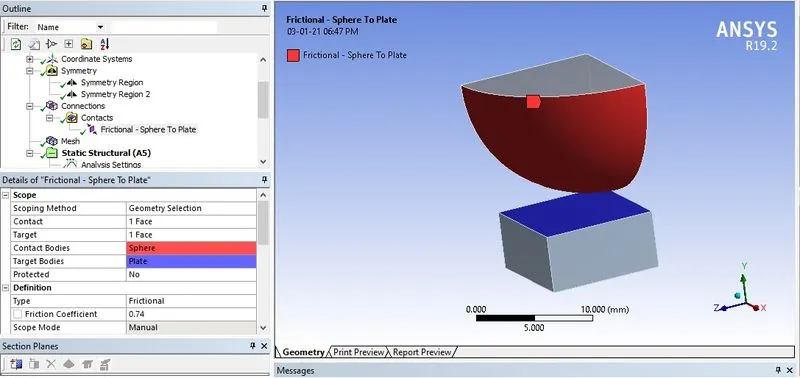
Plate is fixed with bottom side, other sides kept free. Frictional contact is applied connection with Frictional Co-Efficient as 0.74
- Loading and Analysis Setting:
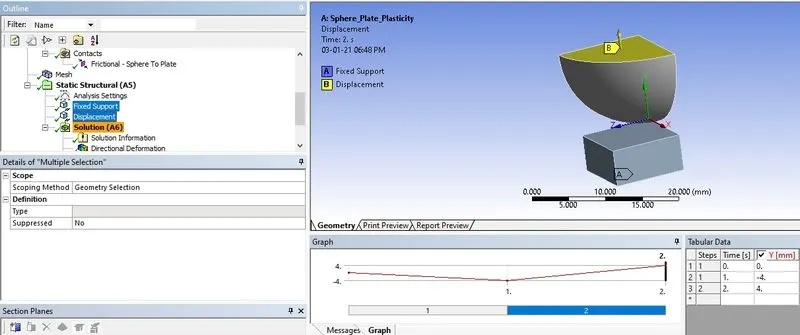
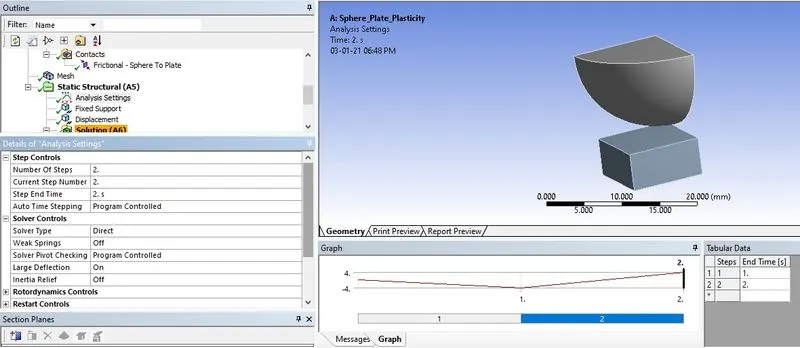
Sphere is given displacement in Y Direction; analysis is carried out in 4 steps, in first two steps negative displacement is given and in last two steps sphere is retracted back to original position.
Step 1: -2 mm
Step 2: -4 mm
Step 3: 0 mm
Step 4: 0 mm
View of Assembly after it is constrained;
Analysis Settings:
- Post Processing:
After analysis done we have looked at various results which are given below;
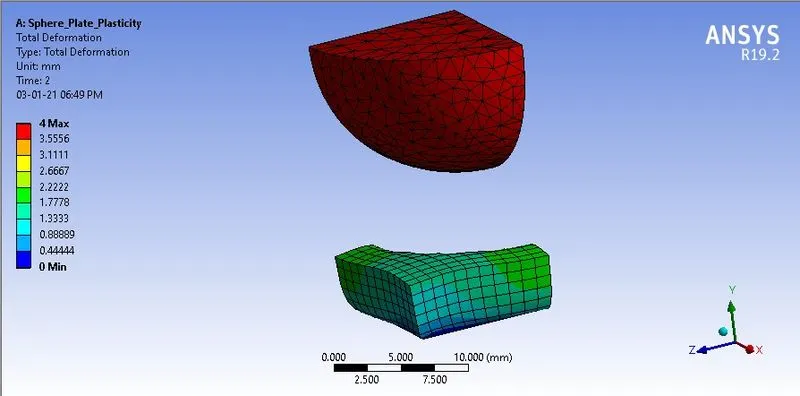
- Total Deformation:
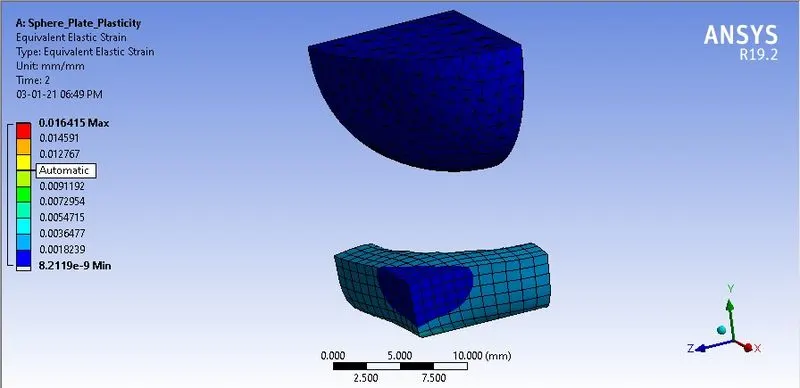
- Equivalent Elastic Strain:
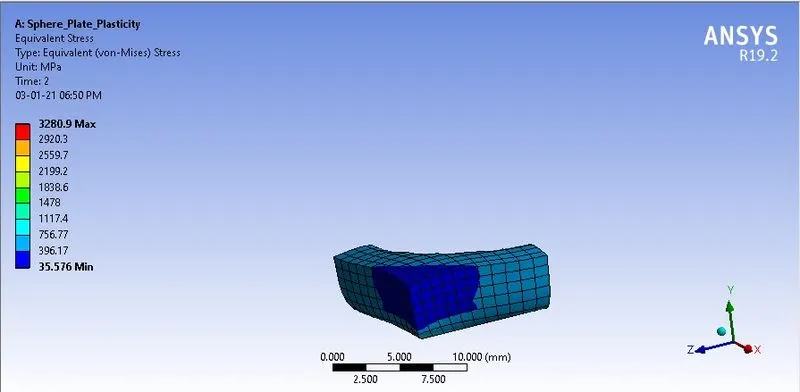
- Equivalent Stress:
- Directional Deformation (Y Axis):
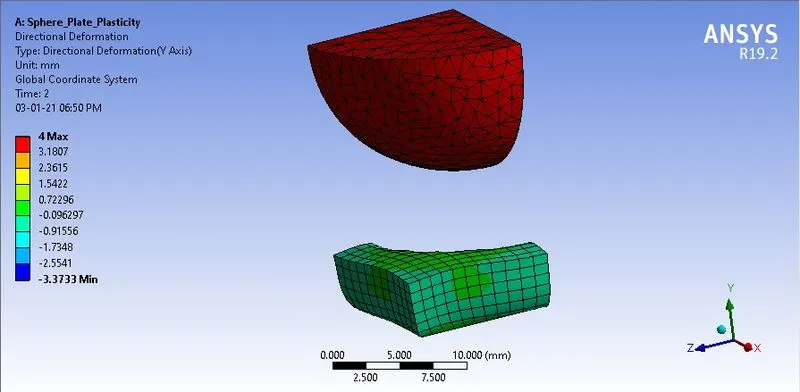
here is a Link for Animation of this Project;
Post Process Results Summary;

- Results and Conclusion:
1) Maximum Total Deformation in this project is 4 mm.
2) Maximum Equivalent Elastic Strain is 0.0164
3) Maximum Equivalent Stress is 3280.9 Mpa
Steel Plate is pressed with Sphere (Symmetry used) and we captured Plastic Deformation of Steel Plate.