Week- 5 - Solid meshing
AIM
The Rearview mirror component should mesh by using tetra volume mesh and clear the kinks and dips.
OBJECTIVE
The component should check for geometry errors and clean up the failing surfaces for minimum elements length and should be mesh by tria or ortho tria.
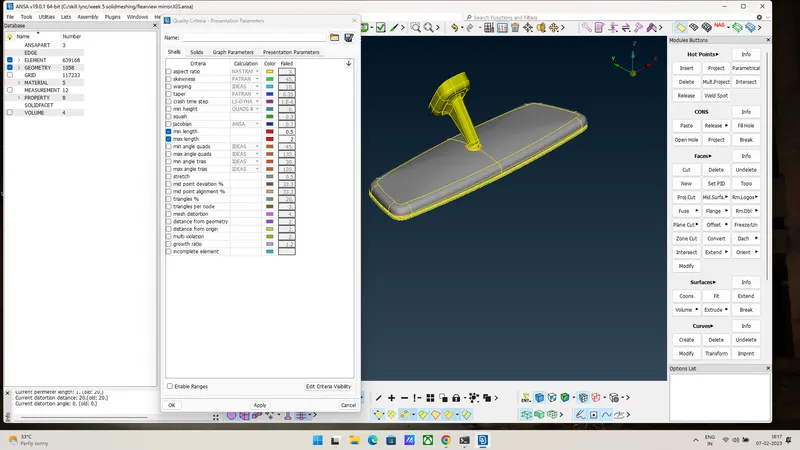
Element quality criteria for meshing the rearview component
| S.No | Quality Criteria | Value |
| 1 | Target/Average Length | 1 |
| 2 | Minimum Length | 0.5 |
| 3 | Maximum Length | 2 |
| 4 | Tet Collapse | 0.2 |
Following the quality parameters using tetra mesh volume and clearing the kinks and dips.
PROCEDURE
- Importing the model: imported the model from the storage in .IGS format to ANSA software.
- Setup: We performed ‘TOPO’ for the whole model to connect any unattached surface. The given model has been given with 4 PID for different features.
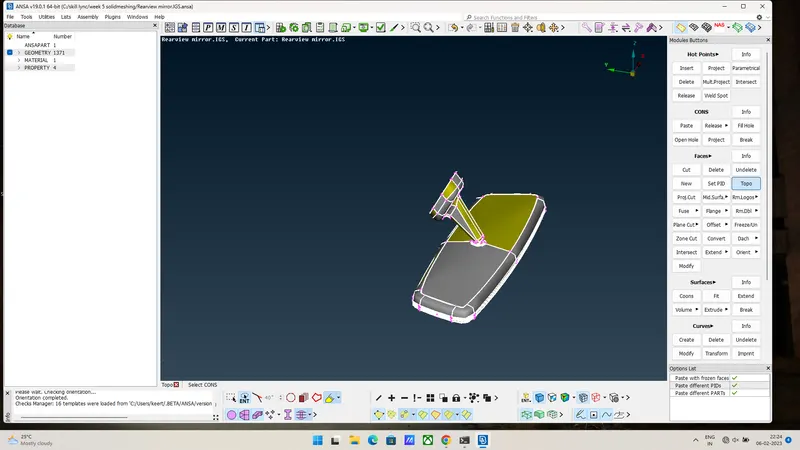
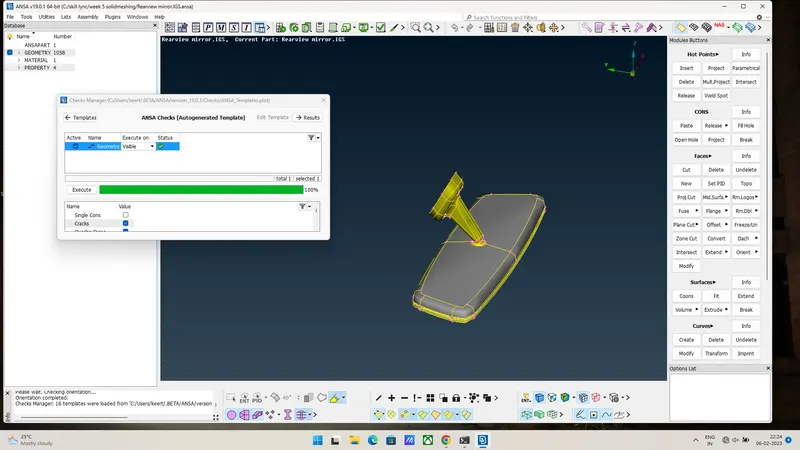
- Geometry Check: From ‘Checks Manager’ using ‘Geometry’ we checked for any geometrical errors. And fixed using Auto Fix options. The below image shows the result after removing all errors.
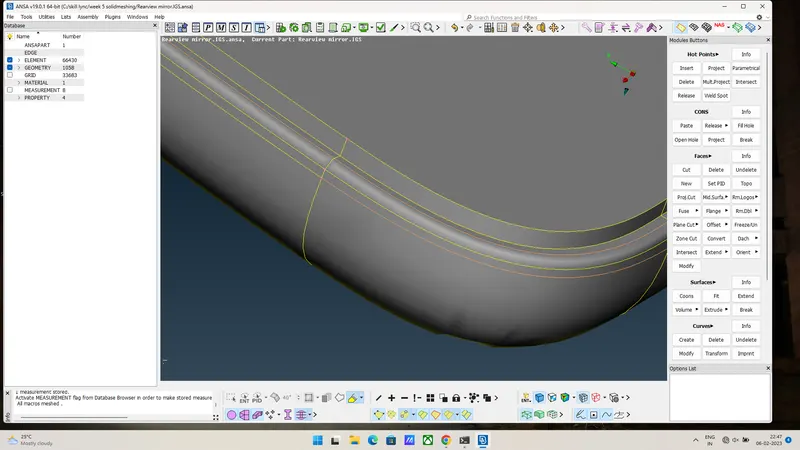
- De-Featuring: In order to prepare the model for the meshing we removed unnecessary cuts and hotpoints from the surface. To maintain the minimum length criteria i.e. 0.5 throughout the model we removed some cuts from the model. Below image shows the de-featured element, where the cuts are removed to maintain the minimum length criteria.
- Quality Criteria- Now to create mesh within the given Quality Criteria we feed the same to ANSA through Utilities>QUALITY CRITERIA> SHELL and QUALITY CRITERIA>SOLID. And to for parameters UTILITIES>MESH PARAMETERS. For getting Tetra Mesh we selected Element Type as Ortho Tria.
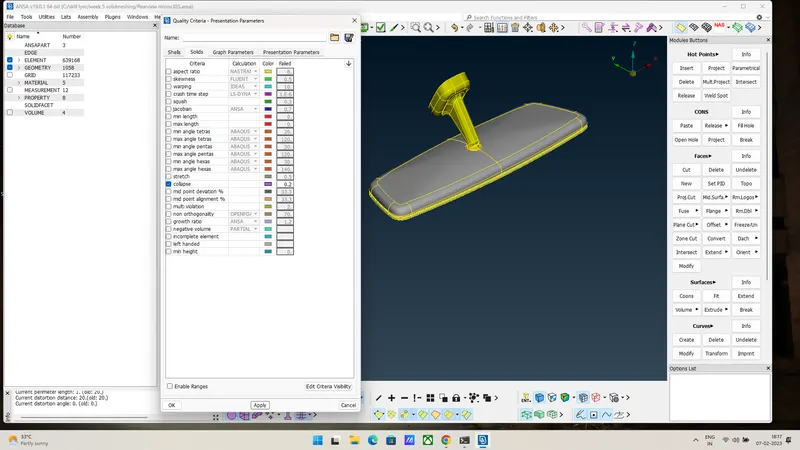
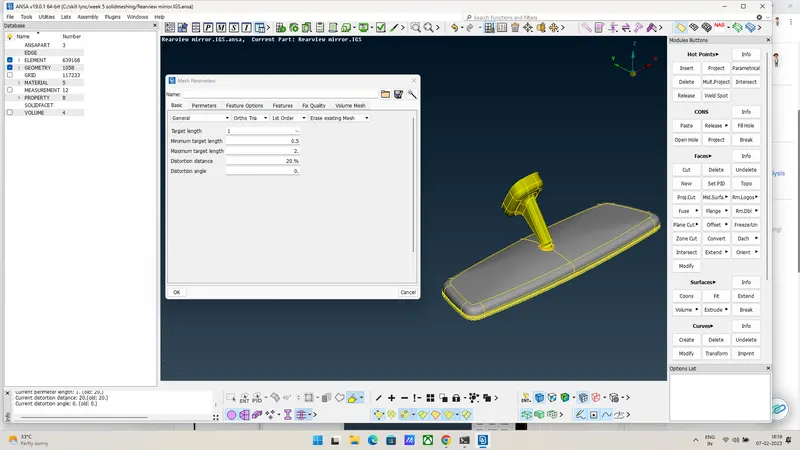
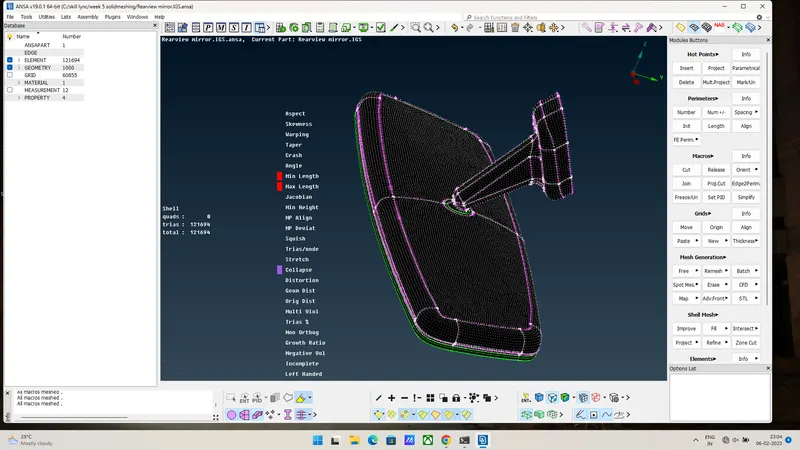
- Meshing: In order to create the mesh, we assign mesh to surface by using MESH GENERATION>SPOT. The type of element for the mesh selected was Ortho Tria, which is preferably better for the curved features, however the element type can be changed. In case the result is not proper we can use SHELL MESH> RECONSTRUCTION to get better result. The below images shows the result using the above method.
- Defining Volume: After completing meshing of all the features we need to define the volume for each feature as ANSA it is required for achieving volumetric mesh. In order to do so we use the tool VOLUME>VOLUME MESH>DEFINE>MANUAL. After volume is defined for each feature we can go to Property to create new PID as Solid. After creating 4 different Solid PIDs we applied it. Below image shows the Solid PIDs and type of elements created.
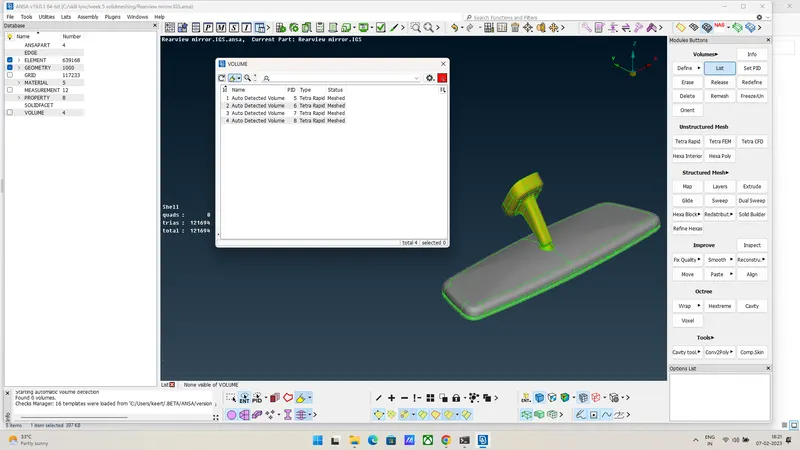
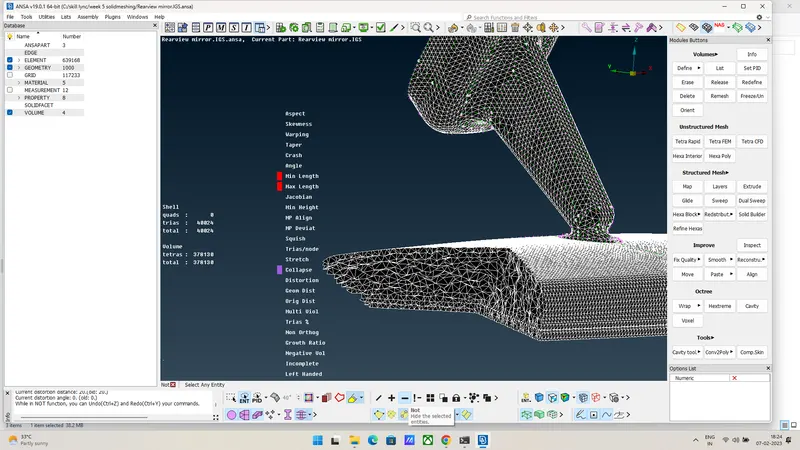
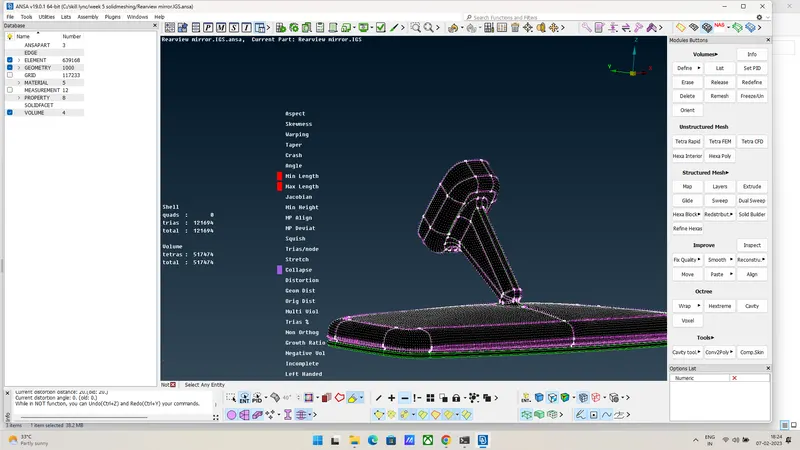
- TETRA Meshing: Once the PIDs are created we can go to VOLUME MESH> LIST and check whether the Volumes are meshed or not. For unmeshed volumes, we can either use the Re-mesh the option or we use the tools in VOLUMES>UNSTRUCTURED MESH. We can use between TETRA FEM and TETRA RAPID to create the Volumetric mesh, which are generally used methods. With the given quality criteria we can start meshing. Once the meshing was done we checked for any off elements, in TETRA MESHING TET Collapse is of most importance in this model there was no TET Collapse, the Max. And Min. Length failure were reduced to lowest possible number without creating dents and kinks in the model. The below image shows that no off elements for TET-Collapse are produced in the model.
CONCLUSION
The challenge is to understand the 3D solid meshing use different options and getting the proper mesh flow with no tet collapse and kinks.