Week 5:- Rest Unit & Clamp Unit Design Challenge
AIM
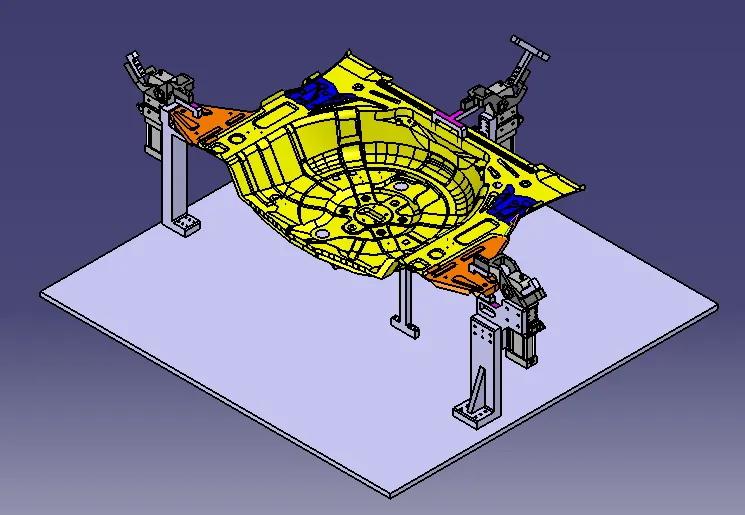
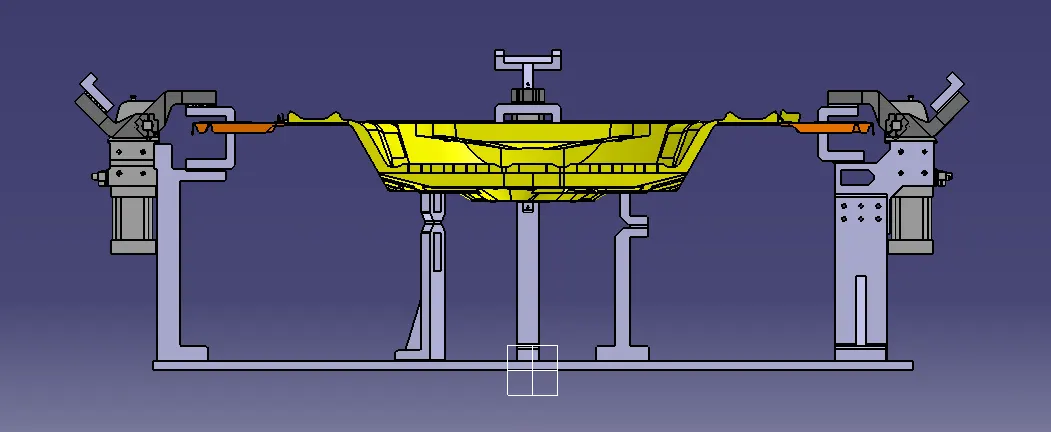
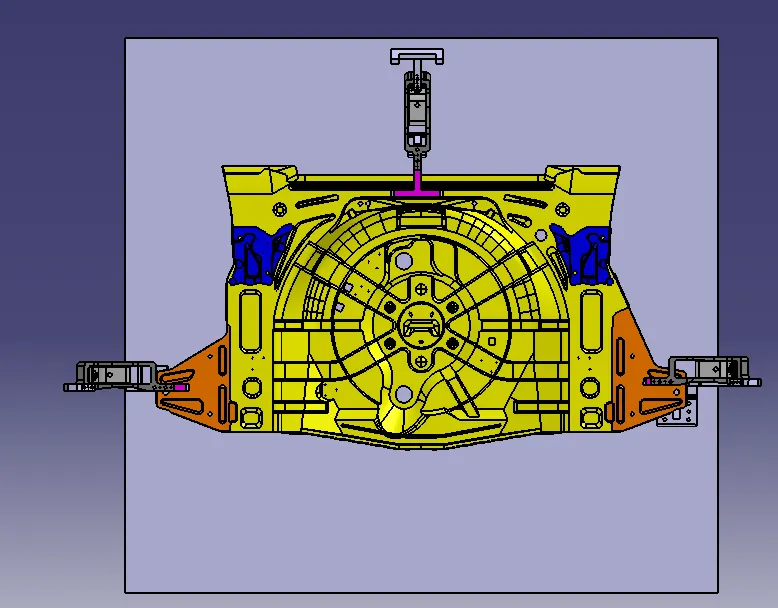
To design 3 Different types of Power Clamp Units with Different Risers, Blades, and Clamp Arms and design 2 Different types of Rest Units for the given Car Panel.
INTRODUCTION
A Clamp is a device that is used to hold the part tightly, yet, firmly in the assembly, The clamp prevents any sought of movement of the assembly in the fixture and ensures proper operation on the part without any distortion.
The clamp must be placed in such a way that it does not interpret the operation.
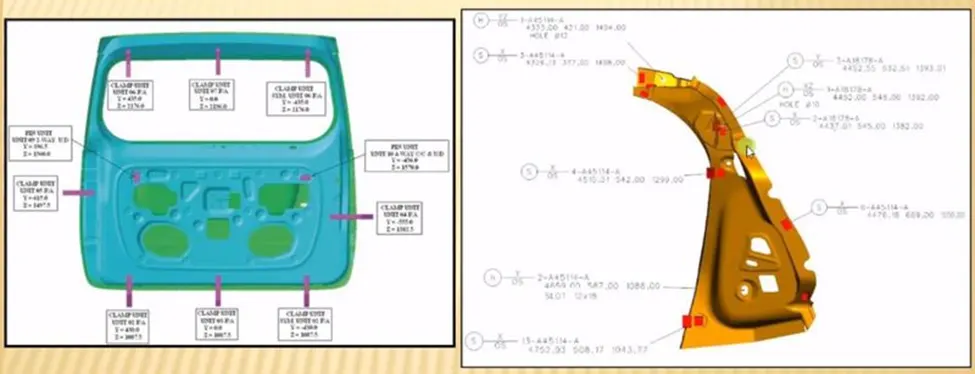
The clamp plan is the data provided by the customer. The clamp plan provides information on the location of pins, rest units, Clamp units, Dumps, etc.
It gives the details of the exact position of the clamping locations in the form of coordinates
The clamp position in some cases will be in such a way that it might damage the tool, or be very near to the pin position. In such cases, We should not decide to change the clamp plan without discussing it with the customer.
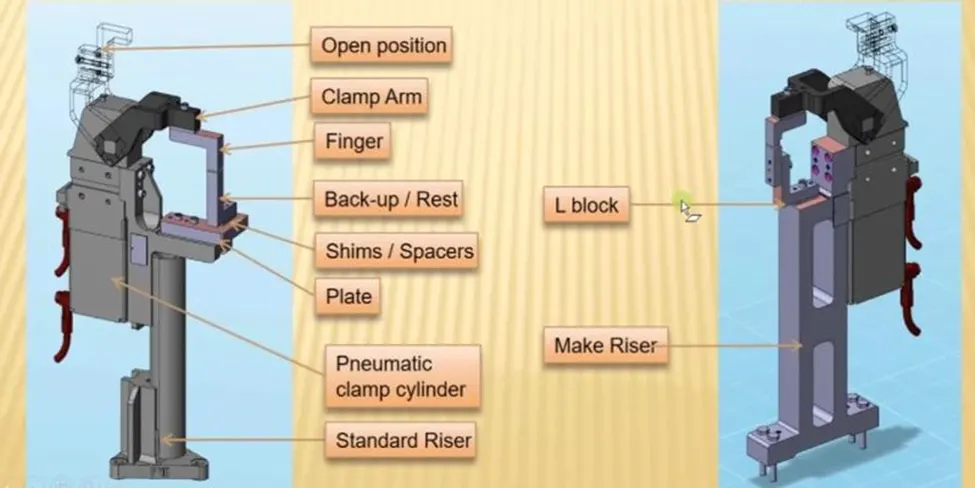
Typical parts of a clamp unit are as follows
Finger
A Finger is an NC Block, Which is mounted on the Clamp arm of the cylinder, and will press the car panels towards the rest, so it holds the car panel.
Rest
Rest is an NC block, which is fixed to the unit to support the car panel, also it resists the clamping force of the finger and thus clamps the car panel.
Clamp Arm
A Clamp arm is a bought-out part, to which all the movable parts are fixed. In general, a clamp arm is a part of a clamp cylinder.
Clamp Cylinder
A Clamp Cylinder is a pneumatic device that works with pressurized air. The Clamp cylinder is used to open and close the parts fixed to the clamp arm fixed to the clamp body. Clamp arms are generally bought-out parts.
3-2-1 Principle
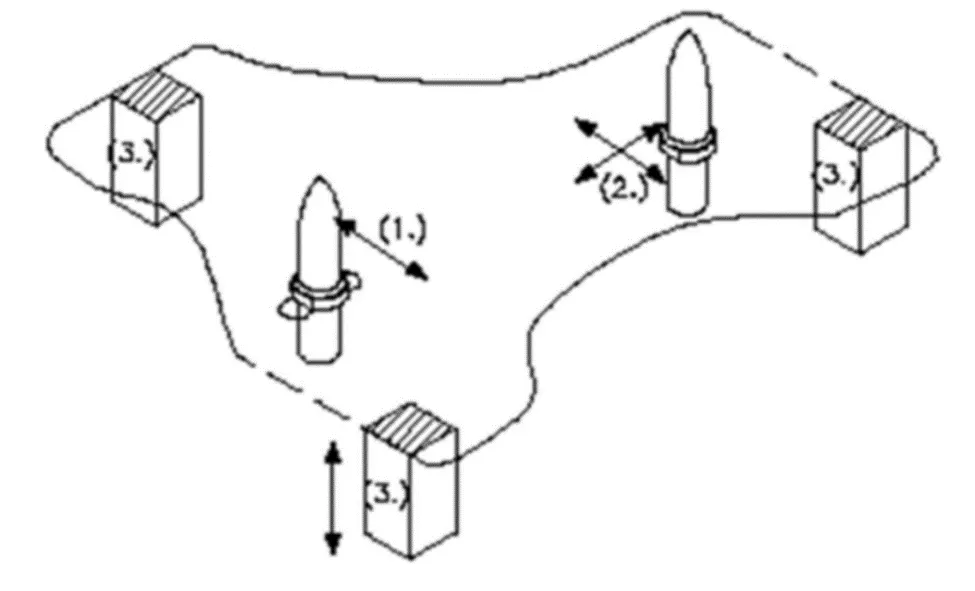
The 3-2-1 method is a work-holding principle where three pins are located on the 1st principle plane, i.e. either XY, YZ, ZX. And two pins are located on the 2nd plane which is perpendicular to the 1st plane, and at last one pin on the plane which is mutually perpendicular to the 1st and 2nd planes. The ultimate goal is to constrain the movement of the workpiece along all three axes.
3. Minimum
From the above figure, We can see three locator blocks positioned at the primary locating surface. These three locators restrict the axial upward and downward movement along with it the two radial movements both clockwise and Anti clockwise are also restricted. So, a total of four radial movements is restricted to the two mutually perpendicular axes.
The three locators, on the whole, have restricted six Degrees of freedom.
2. Round Locating Pin
The pin added in the location of the hole restricts the axial movements of two perpendicular axes (both positive and negative). Thus, restricting Four Degrees of Freedom.
1. Round Locating Pin
The round locating pin is added to the slot to restrict the remaining radial movement in both clockwise and anti-clockwise. This, therefore, restricts the remaining two degrees of freedom.
Thus, the 3-2-1 principle is used to restrict the 12 degrees of freedom of a part.
CLAMP UNIT:
Clamps are versatile tools that serve to temporarily hold work securely in place.
A Clamp unit is a unit designed to clamp/ hold the car panel at a certain location.
Its purpose is to hold the panel at that place with the application of force.
TYPES OF CLAMP UNIT:
Power Clamp unit.
Swivel cylinder clamp unit.
CLAMP PLAN:
The customer provides the clamp plan which consists of the position of the clamp, pins, rests dump, etc.
It has the exact coordination of these components and in addition, it also has the hole’s dimensions and tolerances.
As this is critical input data, it must not be modified.
In case the spot for weld and the clamp position is nearby and it may create a problem later and there is a need to change the position of the clamp, the same must be done so with the permission of the customer as it will be easy for the customer to make changes from his side also.
REST UNIT:
A rest unit is a unit that is designed to support or rest the car panel on it.
Its sole purpose is to rest the panel onto it and thus no force or clamping is done.
However as it is a simple design, it can be combined with other units to reduce the cost of the overall project.
For example, it can be used along with a locating unit to locate and rest the panel or with a clamp unit to clamp and rest the panel.
The rest unit, locating unit, and clamp unit can be used together in one single project.
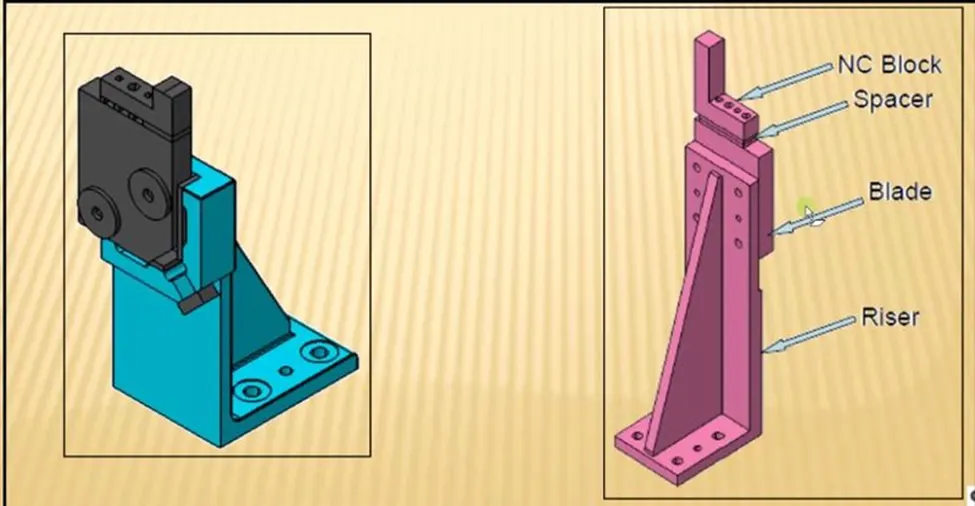
Components of Rest unit:
NC block
Spacer/ Shim pack
Blade
Riser
IMPORTANT NOTES:
Clamping: The car panel will rest on the rest unit, also it resists the clamping unit for the clamping force of the finger and thus clamp the car panel.
Resting: The car panel will rest on the rest unit, also it resists the clamping force of the finger and this clamps the car panel.
Forces act in clamp & Rest Unit:
To design a clamp unit, we have considered some forces that act in a clamp unit for clamping purposes. The force acts in the clamp unit are.
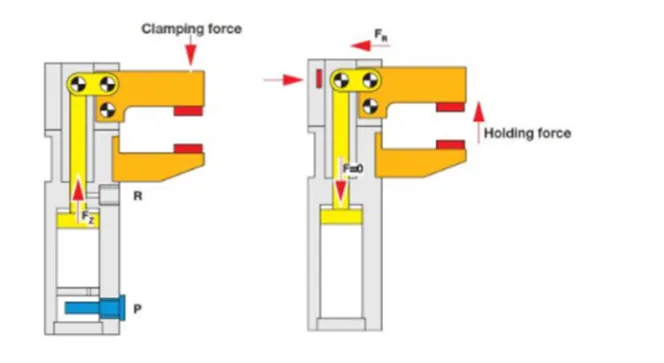
Clamping Force
Holding force
Clamping force is not the same as holding force.
Clamping Force:
Clamping force signifies the force applied to the workpiece by the drive mechanism via the clamp arm during gripping or clamping operations.
Clamping force = 48 * S3
Holding Force:
Holding force, on the other hand, denotes the maximum force after locking the knee-lever (over-center position) that can be applied by the workpiece on the gripper/clamp arm without destroying the mechanism. Therefore, Particular attention must be paid to the maximum holding force when, for example, during the production process (welding, bonding) there is a possibility of distortion of the component or if the clamp arm is used as a fixed stop.