Week 5 - Rayleigh Taylor Instability
AIM:
To perform the Rayleigh Taylor instability simulation by using ANSYS FLUENT for the given cases.
OBJECTIVE:
- To perform the Rayleigh Taylor instability simulation with water and air as the fluids in first part and with water and a user defined fluid with density = 400 kg/m3, viscosity = 0.001 kg/m-s in the second part.
- Perform the simulation by using basline and fine meshing for part 1 and compare the results.
- To define Atwood number and to calculate the same for the given cases.
THEORY:
Rayleigh Taylor instability is the instability of interface between two fluids of different densities ocuurs due when the lighter fluid is pushing the heavier fluid. Example of RT instability is the behavior of water suspended above oil in the gravity of Earth.
Practical CFD models that have been based on mathematical analysis of RT waves.
- Kelvin-Helmholtz instability
- Richtmyer-Meshkov instability
- Plateau-Rayleigh instability
Kelvin-Helmholtz instability mainly occurs when there is a velocity difference across the interface of two fluids. Example of such instabilites can be observed when wind blows across a water surface.
Richtmyer-Meshkov instability mainly occurs when two fluids with different densities are accelerated suddenly. Mainly this happens due to passage of a shock wave through the fluids. The instability begins with small amplitude perturbations which initially grow linearly with time and followed by a nonlinear regime.
Plateau-Rayleigh instability is called as Rayleigh Instability which explains how a falling strean of fluid breaks into smaller packets with same volume but less surface area. The main driving force of this instability is the surface tension which tend to minimize the surface area.
PROCEDURE:
- Open ANSYS Workbench 2022R2 select Fluid Flow (Fluent) from Toolbox.
- Rename the file and left click Geometry and select New Spaceclaim Geometry.
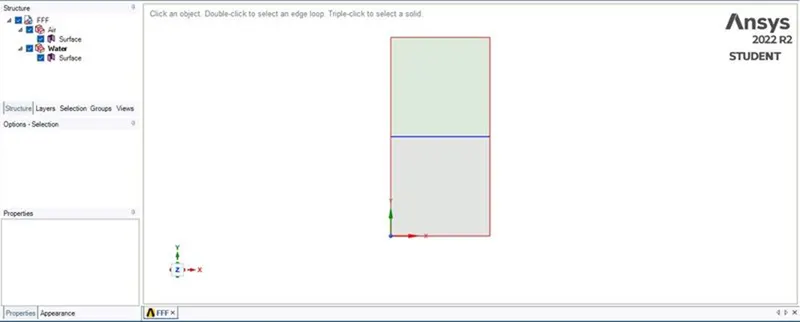
- Create the geometry as shown below using rectangle tool and create surface by using Fill option and rename the surfaces as solid and fluid. The created geometry is shown in the below figure.
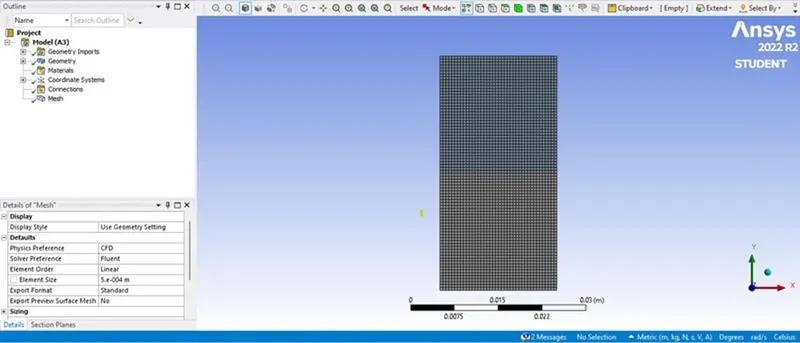
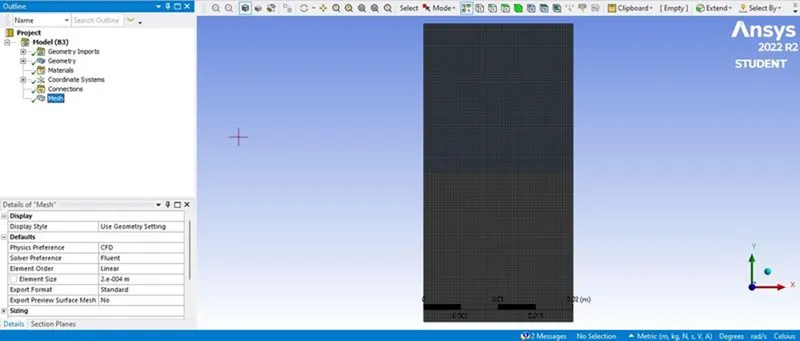
- Close SpaceClaimand double click on Mesh. Meshing window will appear. Now select the mesh from the tree and generate mesh with an appropriate element size of 50 mm for baseline meshing and 20mm for fine meshing. Perform the second part of the question (Water and user defined fluid) by using the fine meshing. The figures shown below are the final meshed geometry for both the cases.
- Baseline meshing (element size = 50mm)
- Fine meshing (element size = 20mm)
- Close Meshing and double click on Setup, select Double Precision and Fluent window will open. Check all the values and make necessary correction if needed.
- Select the conditions mentioned below.
Solver - Pressure Based
Time - Transient
Gravity - enabled, y = -9.81 m/s2
Multiphase - Volume of fluid
Viscous - Laminar
Material - Fluid - Air and Water
Note: For Second part use Material - Air and User defined with density = 400 kg/m3, viscosity = 0.001 kg/m-s
Solution Initialization - Standard Initialization.
Patch
Phase - Water - Volume Fraction. Provide 1 for water surface and 0 for air surface.
Results
- Base-Mesh
--> We use transient simulation for this type of simulation. We are using Volume of Fluid method (VOF) in Ansys fluent solver.
Viscous model -- Laminar
Time-step -- 0.05 s
- Refined-Mesh
Viscous model -- Laminar
Time-step -- 0.005 s
Defination of Atwood Number
It is a non dimensional constant in fluid dynamics which is used in the study of hydrodynamical instabilities in density stratified flows. It is a dimensionless density ratio. It is given as follows -->
Atwood number is an important parameter in the study of Rayleigh–Taylor instability and Richtmyer–Meshkov instability. In Rayleigh–Taylor instability, the penetration distance of heavy fluid bubbles into the light fluid is a function of acceleration time scale Agt^2 where g is the gravitational acceleration and t is the time.
ρ1 = 997
ρ2 = 1.225
A = 0.99754
Thus, Atwood Number in our case is 0.99754.
CONCLUSION:
A study has been carried out on a Rayleigh Taylor instability and the simulation of the same is performed for 2 cases and the results are discussed.