Week 5 - Rayleigh Taylor Instability
Aim :
The aim is to capture instability in multiphase regions using Rayleigh Taylor instability model. The multiphase used here is combination of water and air and one combination of water and user defined material. The effects of mesh size on solution animation is also discussed. Finally, Atwood number for different cases is calculated and based on observation, its effects on instability regime is discussed.
Introduction :
It is common to encounter multiphase regions both in industrial applications and natural conditions. Study of these multiphase regions is important so that it help to understand the pattern it follows and based on it we can, either control the flow regime or just adjust our mechanisms, to fulfill our functional needs. For example, in carborator of petrol engine we mix air and petrol in definite proportion. It comes under multiphase study. Similarly, oil sloshing in transportation and dam breaking are other some examples.
Multiphase and its Types :
Multiphase flow is flow of materials with different phases like liquid and air and flow of materials with different chemical properties but in same phase like liquid and liquid. There are primarily three types of multiphase flow, namely, mixed or transient flow, seperate flow and dispersed flow as shown in figure below.
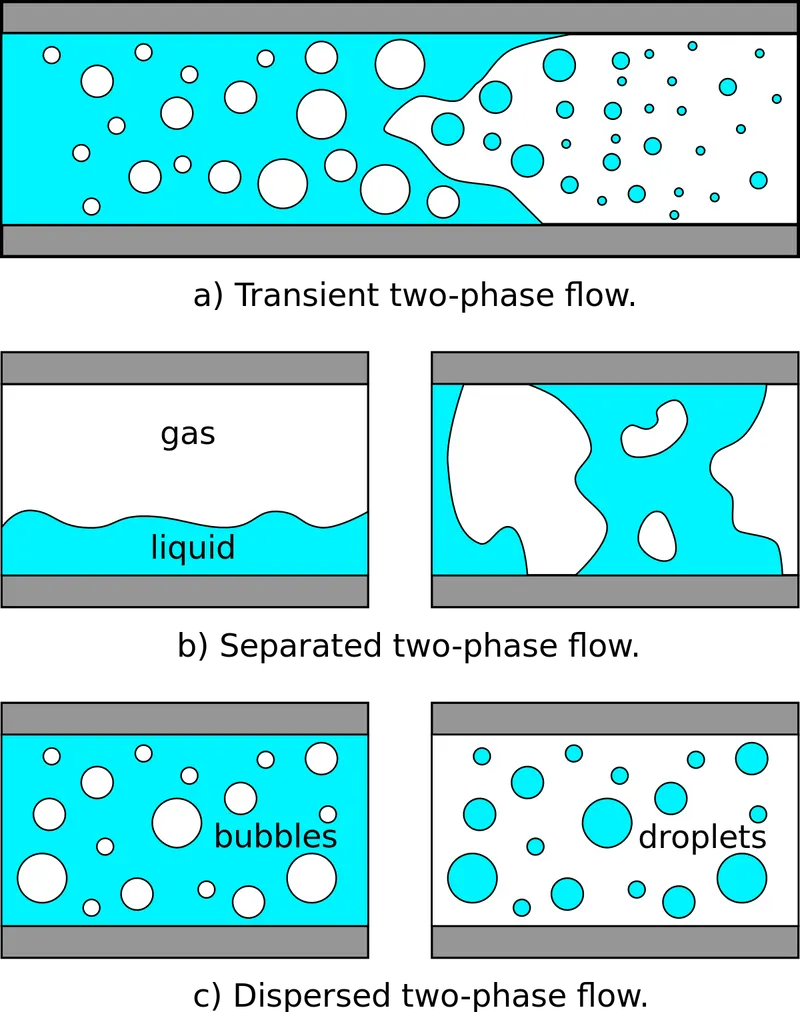
Transient or mixed flow is combination of both seperate and dispersed two phase flow. Whereas seperate flow is a flow in which two phases are seperated by interface. They are immiscible fluids. In dispersed flow, two phases are continously spreaded.
Models :
The instabilities in multiphase flow is primarily categorized as Rayleigh Taylor instability and Kelvin Helmholtz hydrodynamic instability. These two are frequent in many natural and industrial applications. Richtmyer-Meshkov instability is also used to capture instabilities in two fluids with different densities where they are impulsively accelerated, normally by shock wave. There are various mathematical models which are used to study Rayleigh Taylor Instabilities, some of them are as follows:
1. Volume of fluid or VOF model
2. Mixture model
3. Eulerian model
4. Wet Steam model
5. Lagrangian Multiphase model
7. Discrete element model
8. Dispersed phase model (DPM)
9. Eulerian Granular Model (EGM)
Volume of Fluid Model :
The volume of fluid model is most frequently used model to capture Rayleigh Taylor Instabilities in multiphase region. In this model, every cell or element is checked for either of two phases or mixture of two phases. Thus by identifying the cells having mixture of two phases, boundaries between two phases are defined. This evaluation is done for every time step and hence we can capture the instability when these two phases are allowed to mixed.
Different phases are indicated by phase fraction value `alpha`. If,
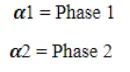
Then the addition of these two fraction in particular region should be 1 and is given as,
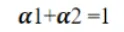
The volume of fluid model uses either of following two scheme to solve the equation:
1. Explicit method
2. Implicit method
The primary difference between these two method is that in explicit method we need to provide courant number and based on that the time step size is selected while in implicit method, we can select any time step size. Sometimes, adaptive time step size is also used. In this we use variable time step size but the cummulative flow time is same.
Rayleigh Taylor Instability Simulation :
Here we are simulating the instabilities for water and air multiphase flow and for water and user defined material. The geometry for both the simulation is kept same and for water and air combination mesh independent study is also performed by using coarse and fine mesh and studying its effects on simulation. Finally, effects of atwood number is also observed. The simulation uses volume of fluid model with two phases. The simulation and results are shown step by step below:
(1) Geometry :
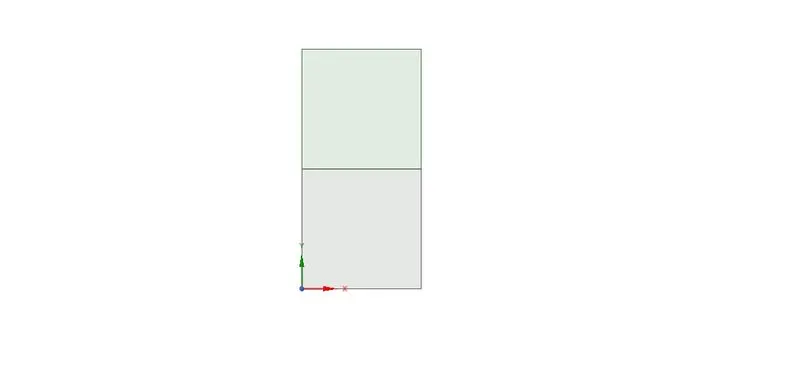
Here we use 20x40 mm container, seperated in the middle, dividing it into two equal halfs. The upper half contains water and the lower half contains air. The surface topology is shared for smooth flow of information. The geometry made using space claim is shown below:
(2) Meshing :
The mesh size used for water and air combination is 0.5 mm and 0.1 mm and for water and user defined material, we use 0.5 mm element size.
| Cases | Water and Air | Water and Air | Water and User defined |
| Element Size | 0.5 mm | 0.1 mm | 0.5 mm |
| Number of Element | 3200 | 80000 | 3200 |
| Number of Nodes | 3321 | 80601 | 3321 |
(3) Set up :
In set up, we use transient method and add the materials needed for simulation. After selecting volume of fluid method in multiphase, we assign primary and secondary phase. Then after initializing the solution, we patch it and run the simulation.
| Solver Type | Pressure based |
| Solver Time | Transient |
| Viscous Model | Laminar |
| Multiphase | VOF |
| Method | Implicit |
| Material | Water-Air / Water User defined |
| Primary Phase | Air |
| Secondary Phase | Water / User defined |
(4) Solution :
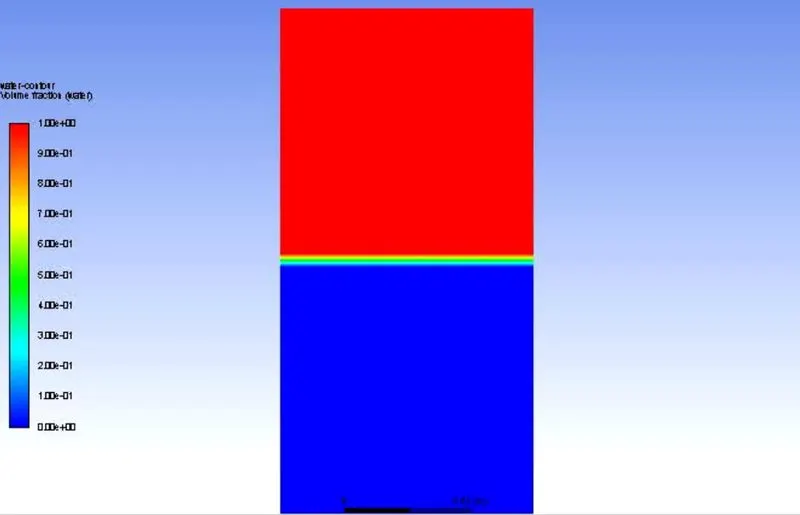
(a) Case 1: Water-Air with 0.5 mm Element size :
Initial condition :
Simulation :
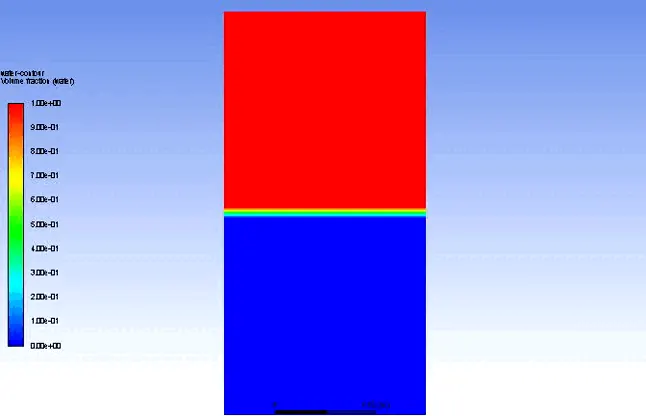
Final result :
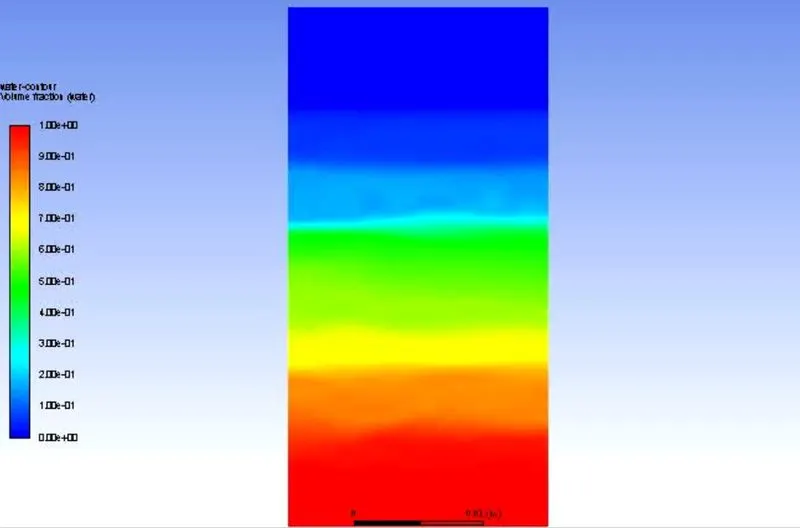
Observation :
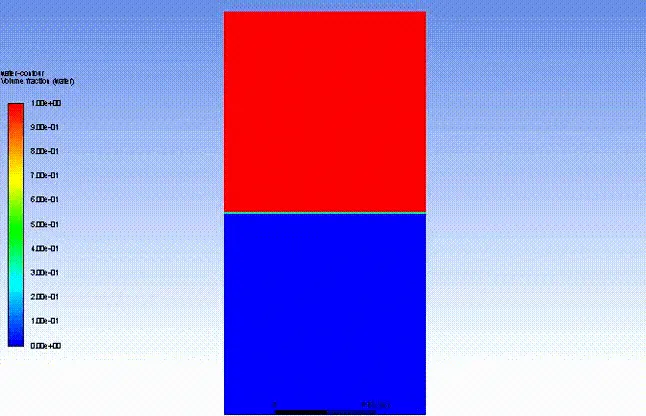
As soon as the partition between water and air phase is removed, the water having higher density, falls downward under the effect of gravity. It takes some time for it to get settled and water comes in the lower portion of container and air comes in upper portion. The instability during this time is captured after every time step using volume of fluid method and at everytime step, we can see the water zone, the air zone and boundaries between them.
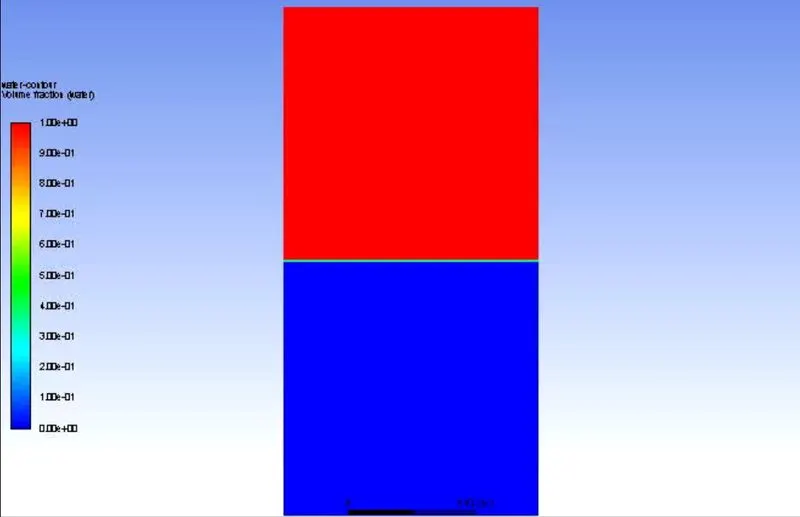
(b) Case 2: Water-Air with 0.1 mm Element size :
Initial condition :
Simulation :
Final result :
Observation :
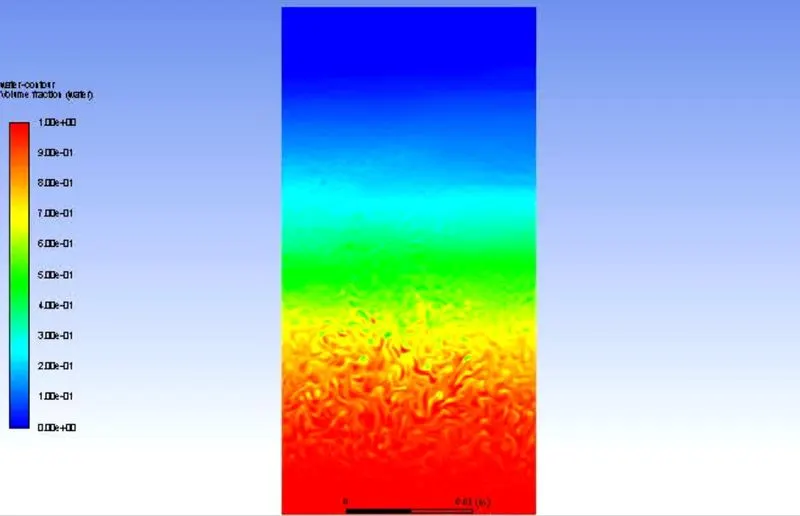
Here, we are simulating same case but with finer mesh size of 0.1 mm. It can be clearly observed that the regions of water and air are captured in much finer sense and the boundaries are much finer. Thus having more exact picture of instability in this multiphase region and is more close to reality. But since the mesh size is small, there are large number of elements and it takes more time to converge the solution.
(a) Case 3: Water-User defined material with 0.5 mm Element size :
Initial condition :
Simulation :
Final result :
Observation :
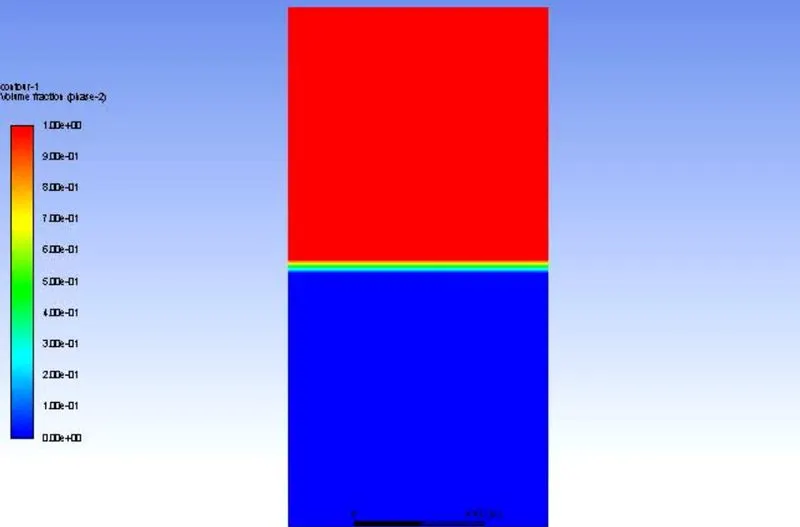
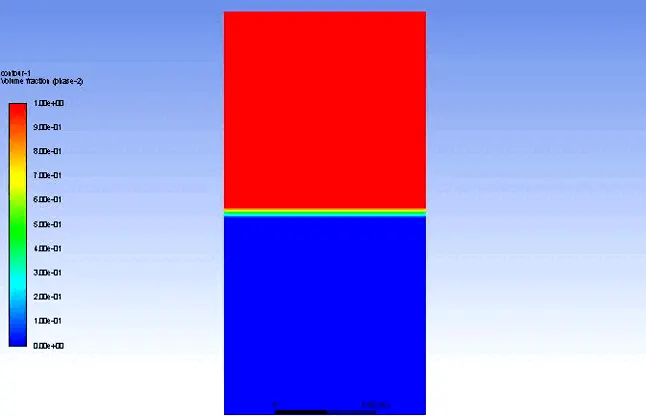
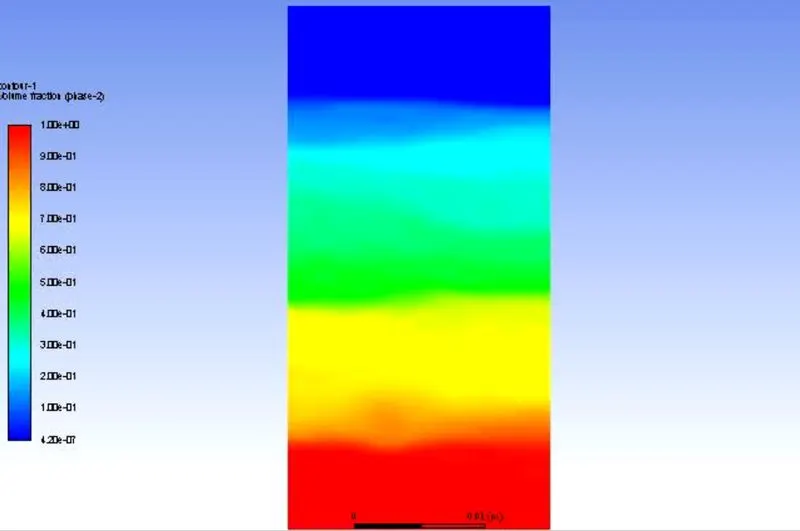
It can be observed that the flow pattern in this case is completely different from the one which is captured in case 1. This clearly shows that the changing the properties like density and viscosity will completely changes the instability regime in multiphase region and thus are quite important parameters to be taken care of.
Atwood number:
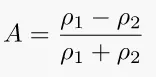
The Atwood number is a dimensionless number in fluid dynamics used in the study of hydrodynamic instabilities in density-stratified flows. In Rayleigh–Taylor instability, the penetration pattern of heavy fluid into light fluid is recognized using Atwood number. For Atwood number close to 0, RT instability flows take the form of symmetric “fingers” of fluid and for Atwood number close to 1, the much lighter fluid “below” the heavier fluid takes the form of larger bubble-like plumes.
Mathematically,
In the following table. the densities are in SI units
| Cases | Combination |
Density `rho` 1 |
Density `rho` 2 | Atwood number |
| Case - 1 | Water and Air | 1000 `(kg)/m^3` | 1.225 `(Kg)/m^3` | 0.9975 |
| Case - 2 | Water and Air | 1000 `(Kg)/m^3` | 1.225 `(Kg)/m^3` | 0.9975 |
| Case - 3 | Water and User defined | 1000 `(Kg)/m^3` | 400`(Kg)/m^3` | 0.4285 |
It can be seen from the animation that for water and air combination where atwood number is close to 1, plumes of air is made. The only difference in case 1 and 2 is that the case 2 have finely capture this phenomenon as the mesh size is small but the penetration pattern of heavy fluid into light fluid is same. Whereas, in case 3, the atwood number is 0.4285 or we can say somewhere in middle of 0 and 1. Therefore, we have both fingers and plumes types of pattern and this can be observed by seeing animation for this case.
Conclusion :
The Rayleigh Taylor Instability is studied for water and air combination and water and user defined material using volume of fluid models. The mesh independent studied for water and air shows that the finer mesh captures the regimes more accurately. The variation in density and viscosity changes the instability in multiphase region majorly and hence are important parameters to be taken care of while simulating instabilities in multiphase region. The Atwood number is calculated which tells about the penetration of heavy fluid into light fluid which can also be seen in simulation.